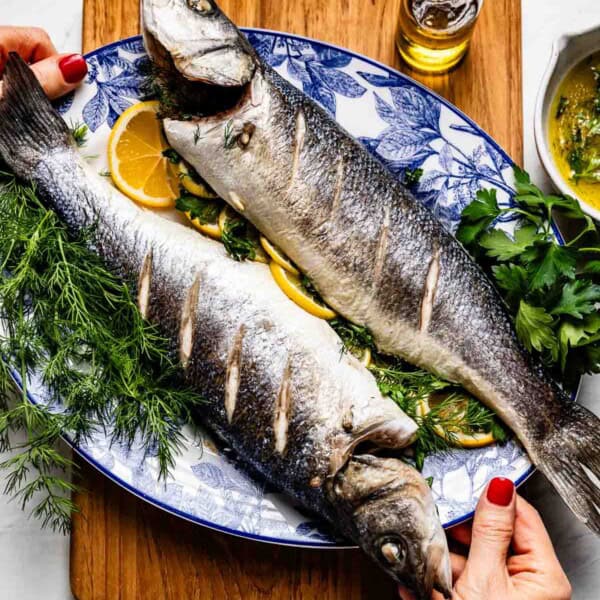

Mediterranean Roots, Real-Life Results: Why This Whole Roasted Branzino Works

Growing up in Turkiye, summers meant a trip to the Aegean coast (mostly around Bodrum), where the sea was basically our backyard. This meant that we would eat seafood every night. Levrek (the Turkish name for European Sea Bass, also called Branzino or Branzini for the plural) was my favorite because it was always so fresh, quick, and easy to cook. Not to mention, it was inexpensive.
When I moved to the U.S., I was surprised by how many people find this Mediterranean white fish intimidating, mostly because most recipes online tend to overcomplicate it for a beginner cook.
Having cooked and eaten branzino my whole life, I wanted to share the way we made it on the Aegean coast, with a minimalist approach that lets the fish do the work.
Why this method works:
Whole Fish = Better Flavor: I get it, most people in the US find it unappetizing to put a whole roasted fish on a plate. However, roasting the whole fish with the bones, head, and skin intact seals in moisture and adds a rich, buttery flavor you just can’t get from a plain fillet. And for those who prefer the filet version, my deboning instructions will show you how to serve it just like they do in restaurants.
There is No Need to Flip: Growing up, my mother never flipped the fish halfway through, and now I know why. I have tried the “flipping” method recommended by many reputable recipe sites, but ended up with lost skin and the delicate meat falling apart. Not only was it messy, but let me tell you, flipping a hot whole fish is no easy task.
My solution is a 425°F (218°C) oven and a parchment-lined pan. This high heat crisps the skin perfectly while cooking the whole fish evenly, so you never have to worry about the fish falling apart.
Basic Pantry Ingredients: The recipe I share here is served exactly as it is in Aegean restaurants by the seaside. You do not need fancy sauces or roasted vegetables on the side; just fresh lemon, olive oil, herbs, and salt. Branzino is naturally mild and sweet, so you really want the fish itself to be the star.
Ingredients You Will Need and Sourcing Tips
There are really just three parts to this recipe: the fish itself, a few simple seasonings, and a basic lemon olive oil sauce I make to serve it with. Since the ingredient list is short, I recommend using the best-quality ingredients you can get.
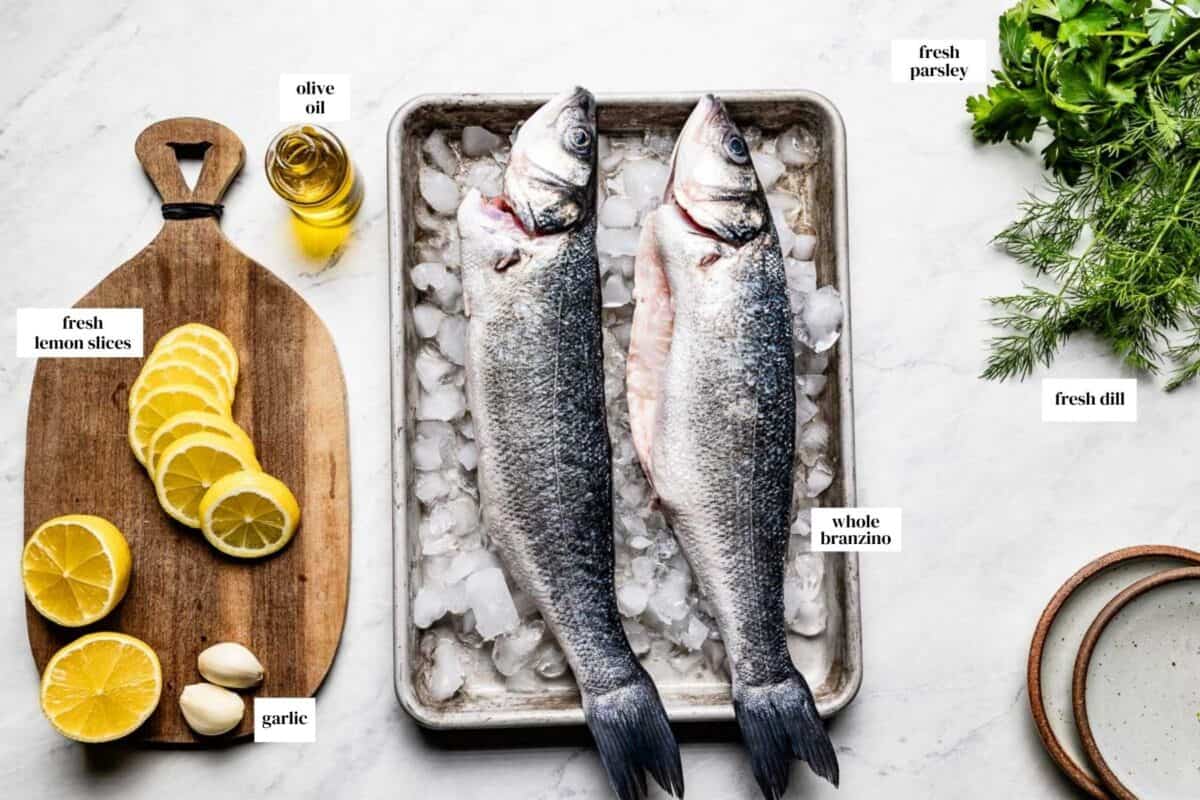
I’ll start by walking you through how to pick and prep the Mediterranean branzini, then share a few quick notes on the rest of the ingredients. You will find the complete ingredient list and exact measurements in the recipe card below.
How to Pick and Prep Your Branzino
Branzino is a mild, flaky Mediterranean white fish with a lean, delicate texture and a slightly sweet taste. Below is everything you need to know, from sourcing to what to tell the fishmonger to what to look for when buying it to make this recipe:
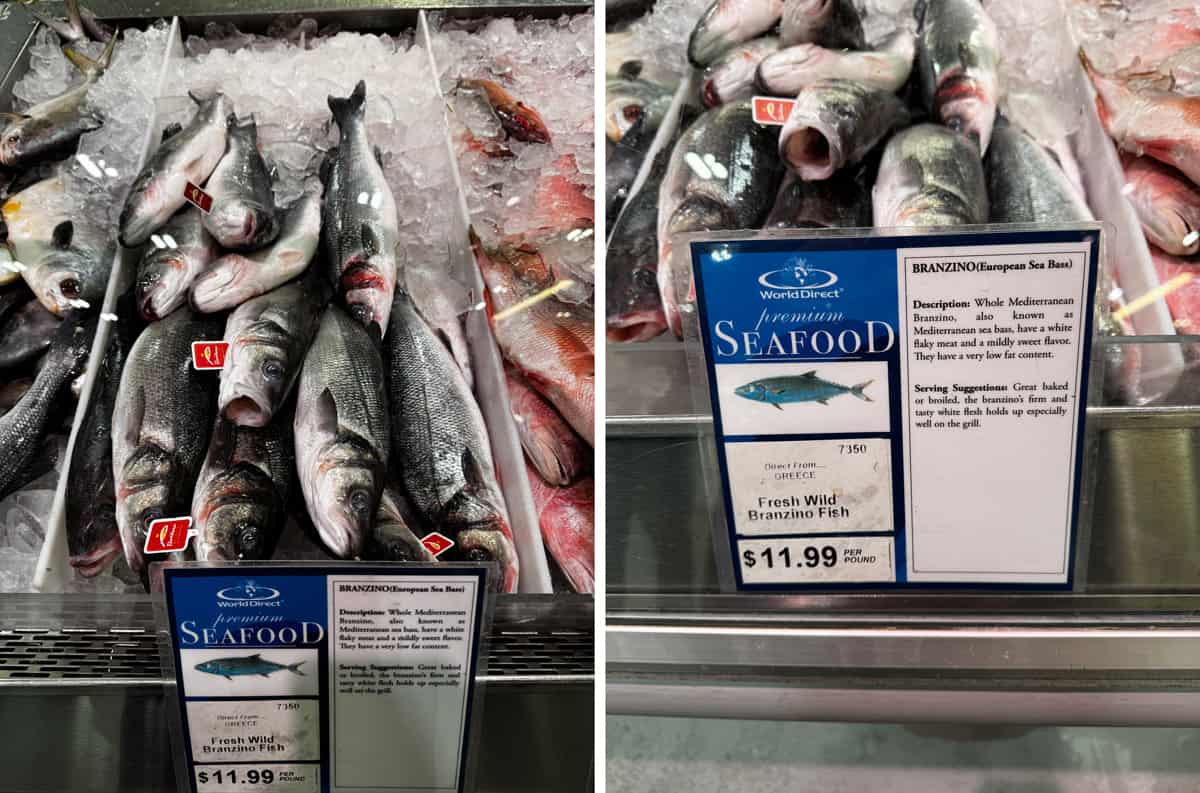
- Sourcing and origins: Most of what you’ll get in the US is farmed in the Mediterranean, primarily in Greece and Turkiye. My local fishmonger here in Atlanta, GA, advertises it as “fresh wild,” but that doesn’t necessarily mean it’s not farm-raised. This could be alarming to some, especially after what we heard about salmon farms in Scandinavia a few years back. However, Mediterranean branzino is raised in large sea enclosures in its natural habitat.
- Pricing: Here in Atlanta, GA, I usually pay around $12 per pound, but nationwide it ranges from $12 to $20.
- Check for freshness: The fish should be well-chilled and resting on clean, fresh ice, not sitting in cloudy water. Look for clear, bright eyes, shiny skin, and a fresh, clean smell. It should never smell overly fishy.
- What to tell the fishmonger: While places like Costco sell it already gutted, that’s not always the case. The good news is that most places can do it for you. Don’t feel intimidated at the counter. Simply ask for the fish to be scaled and gutted, with the head and tail left on.
- Size matters: For this recipe, I use branzino that is about 1¼ to 1½ pounds each. Do your best to buy them similar in size so they roast evenly.
Can’t find branzino? I have only tested this recipe with branzino, but this method should work with other mild whole white fish, such as red snapper, black sea bass, or whole trout. Though keep in mind that the cooking time should be adjusted according to the size of your fish.
The Rest Of The Ingredients
Olive oil: Since this recipe is so simple, using a good-quality olive oil really matters. To me, that means one that I can drink on its own with a light to neutral taste.
I like Costco’s single-origin organic extra virgin olive oil, but nowadays there are so many options at the store. Pick one that you’d use on salads.
Fresh lemons: You’ll need 3 to 4 thin slices per branzino to stuff the cavity, plus fresh lemon juice for the sauce. I would not recommend using bottled lemon juice here.
Fresh herbs: I usually reach for fresh parsley and dill here, since they are classic, mild-tasting Mediterranean herbs, but if you want more pronounced herb flavors, you can also use fresh thyme or oregano. However, keep in mind that they tend to have strong flavors, so less is more.
Garlic: I use freshly minced garlic in the olive oil and lemon juice in the sauce. While I highly recommend fresh minced garlic, you can use garlic powder for a milder flavor.
Red Onion (optional): Some people also add a few thinly sliced red onions in the cavity of the fish. My mom never did that, so I chose to opt out, but it would be a great addition if you prefer your fish with a bit of onion flavor.
How To Cook Branzino In The Oven (Step By Step)
Step 1 – Preheat the oven: Preheat your oven to 425°F (220°C). Line a large sheet pan with parchment paper so it’s ready to go once the fish is prepped.
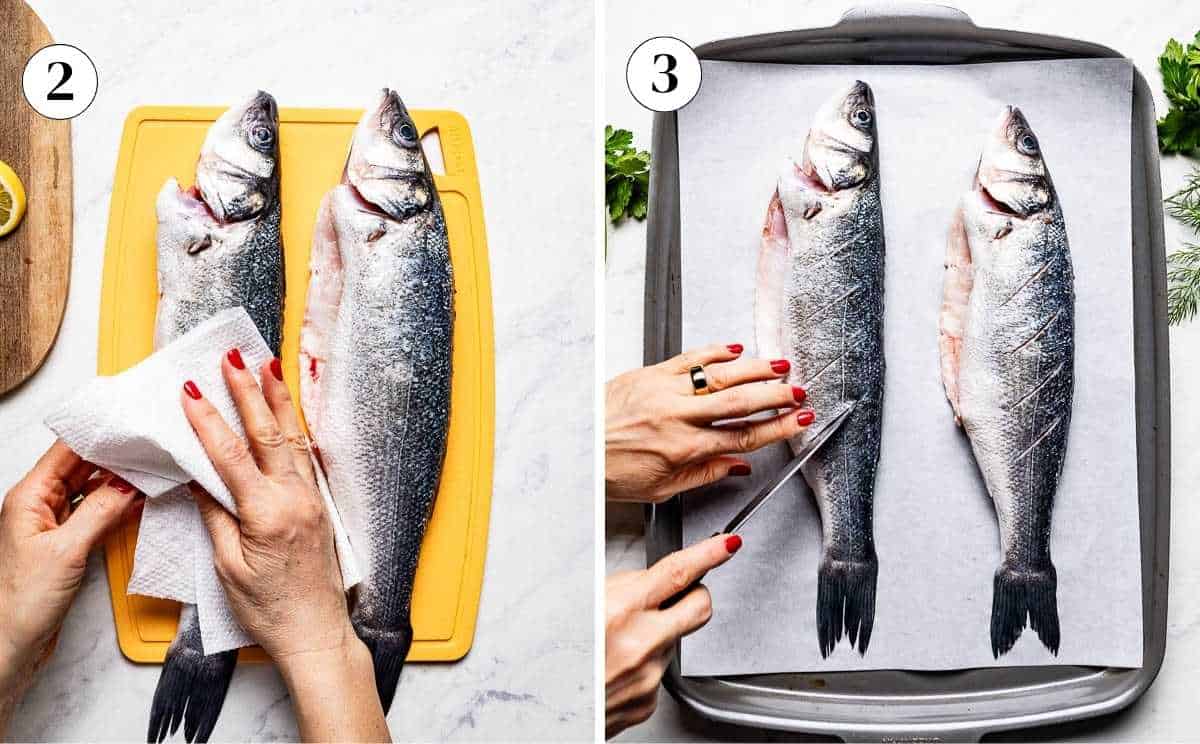
Step 2 – Dry the fish thoroughly: Using a few sheets of paper towels, pat the fish dry on both sides and inside the cavity. Take your time here. The drier the fish, the better the seasoning sticks, the better it roasts, and the better it will taste.
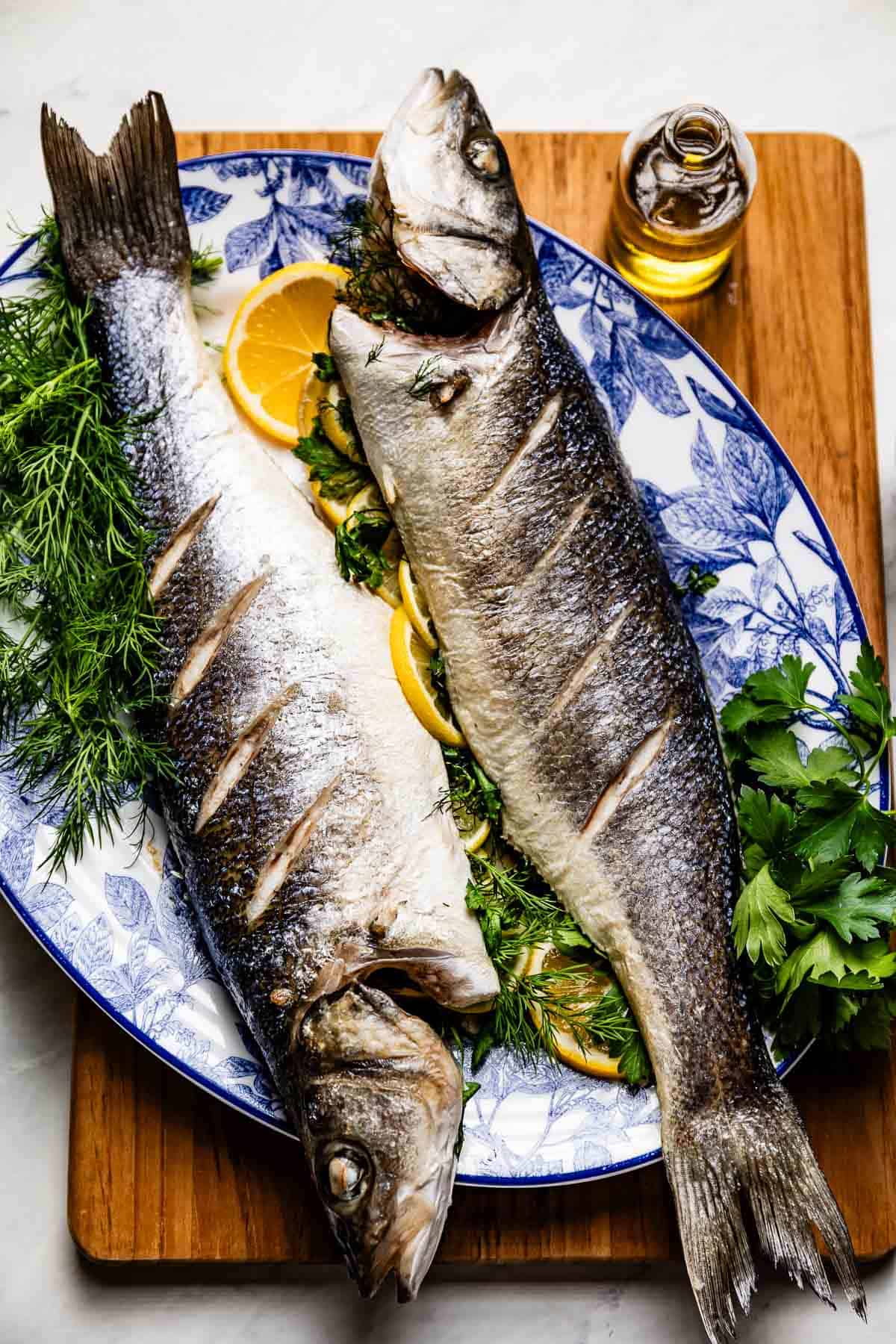
Step 3 – Score the fish: Transfer the fish to the parchment-lined sheet pan, then use a sharp knife to make a few slits on both sides, cutting through the skin. Doing this will help the seasonings go into the flesh rather than just sit on the surface.
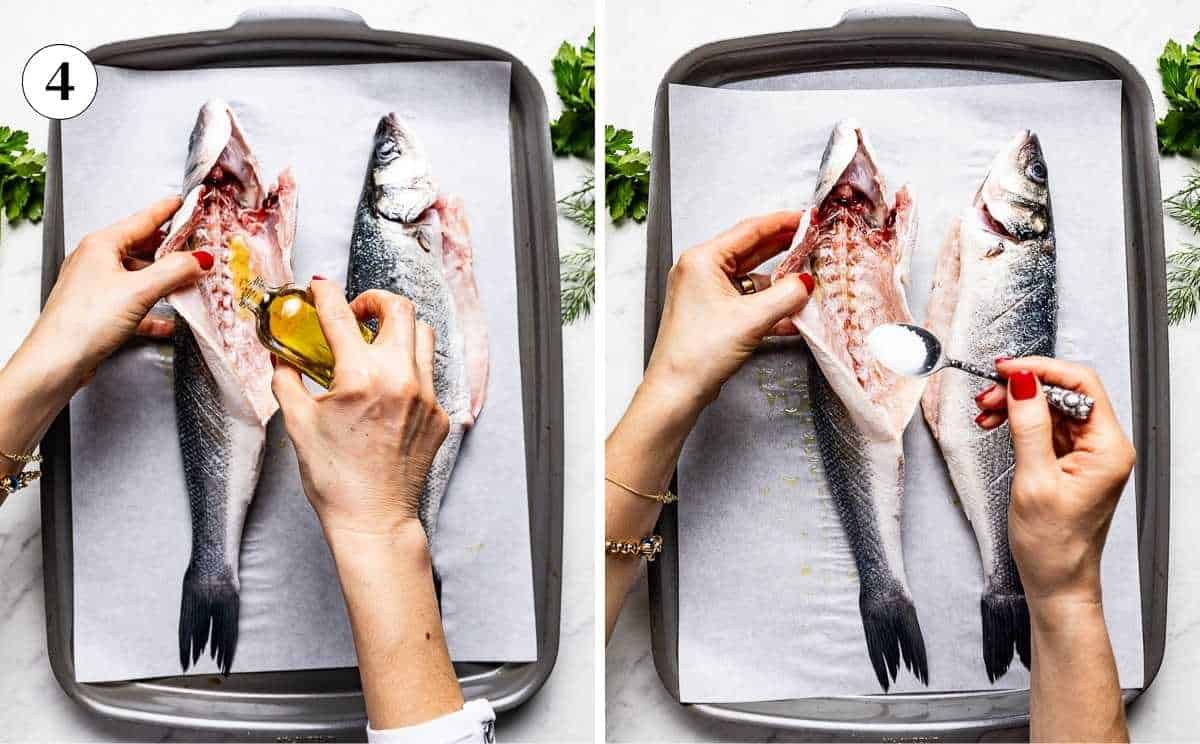
Step 4 – Oil and season generously: Drizzle olive oil over the fish, on both sides and inside the cavity. Use your hands to rub it everywhere, including into the slits you made.
Season generously with kosher salt, again, both the outside and the inside.
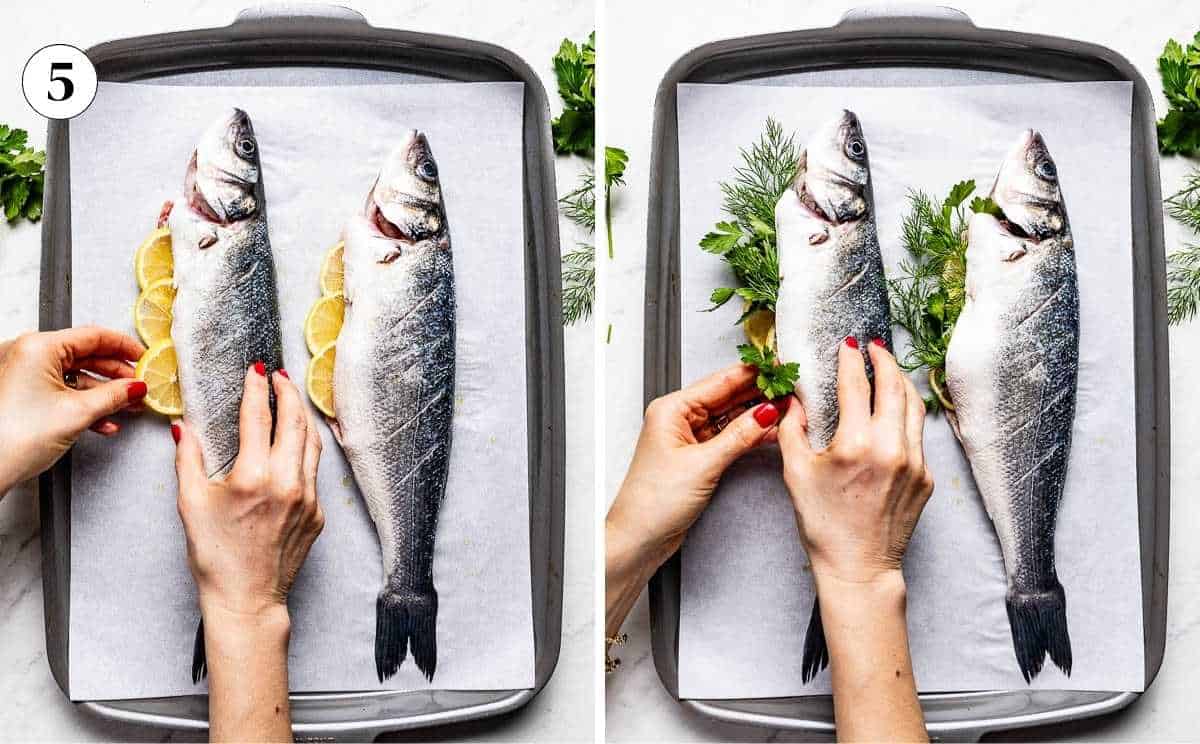
Step 5 – Stuff the cavity: Place the sliced lemon and a few sprigs of fresh herbs inside. I usually use 3 to 4 thin lemon slices, depending on the size of the fish.
As you are filling the cavity, keep in mind that we are not stuffing it to the brim. Rather, use these aromatic ingredients to infuse the fish with flavor while leaving some room for the air to circulate and cook it.
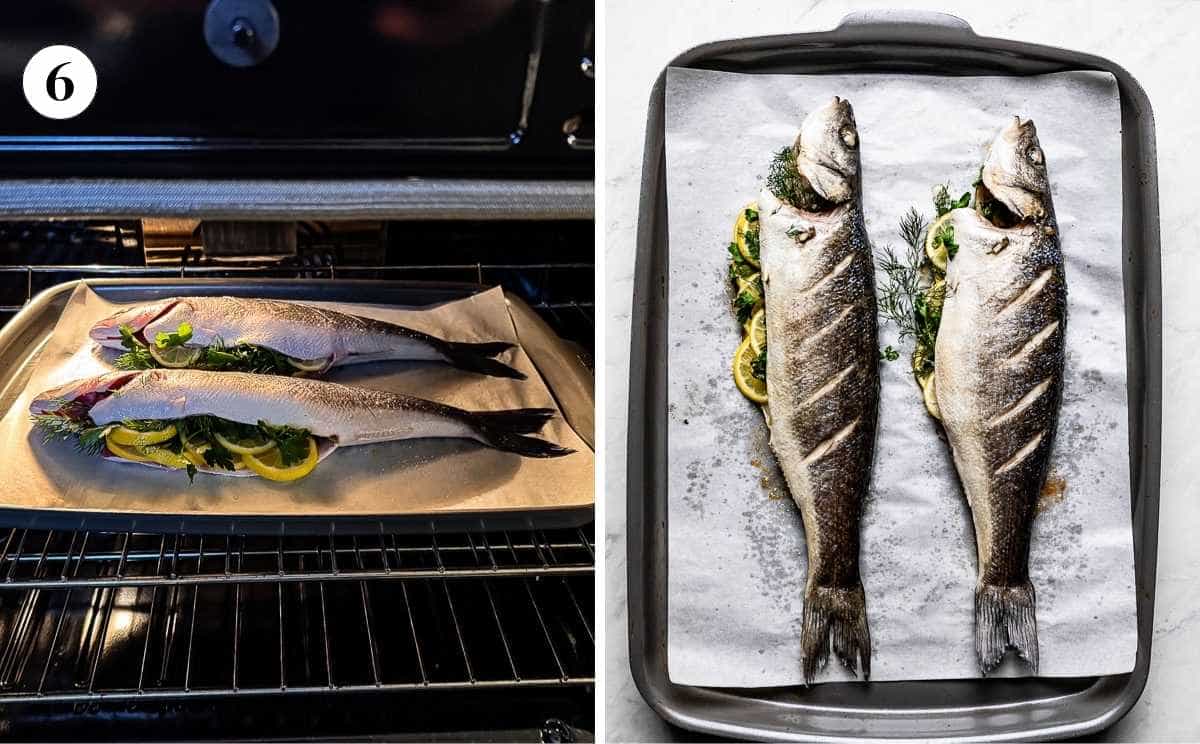
Step 6 – Roast the branzino: Place the fish in the oven and roast for about 18 minutes, rotating the sheet halfway through for even roasting. As I mentioned earlier, no flipping is needed.
Take the fish out of the oven and let it sit for a few minutes. This gives it a chance to cool slightly, making serving much easier.
Pro tip: The best way to check doneness is to use a meat thermometer. Simply insert it into the thickest part of the fish. Your branzino’s internal temperature should read around 135°F (57°C).
Keep in mind that the residual heat will bring it up to about 138°F (59°C) to 140°F (60°C), which is where we want to be before it feels dry.
A Word on Baking Time: Keep in mind that there is a direct correlation between the roasting time and the size of the fish. The larger it is, the longer it will take to cook.
If you don’t have a thermometer, use these timing guidelines:
- 1½ lb: about 18-20 minutes
- 1-1¼ lb: around 16 minutes
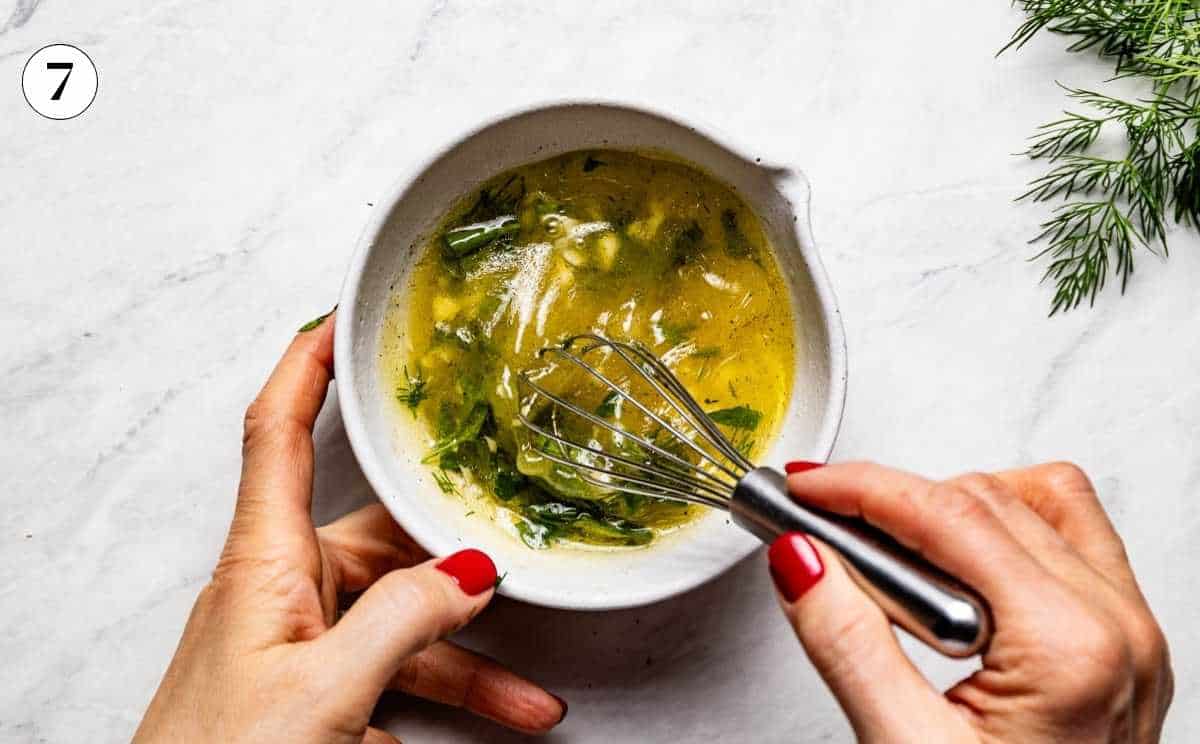
Step 7 – Make the sauce: While the fish is in the oven, I usually make a quick sauce alongside it to really bring everything together. Just whisk the lemon juice, garlic, olive oil, chopped herbs, salt, and pepper in a small bowl until combined.
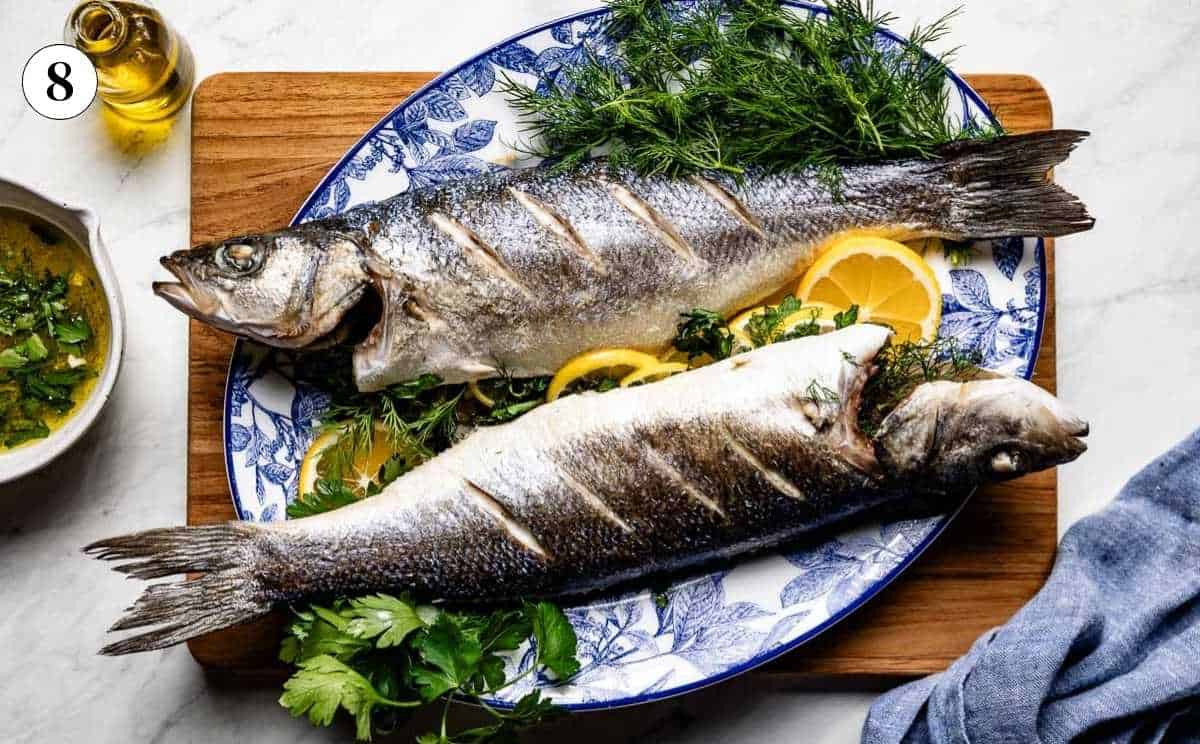
Step 8 – Serve: If you plan to serve it whole (as we do on the Mediterranean coast), you are ready to serve. Place it on a large platter, garnish with lemon slices around (or on top of the fish) and drizzle it with the sauce or serve it with the sauce on the side.
If you prefer to debone it, the instructions are below.
How To Debone A Whole Branzino (The Easy Way)
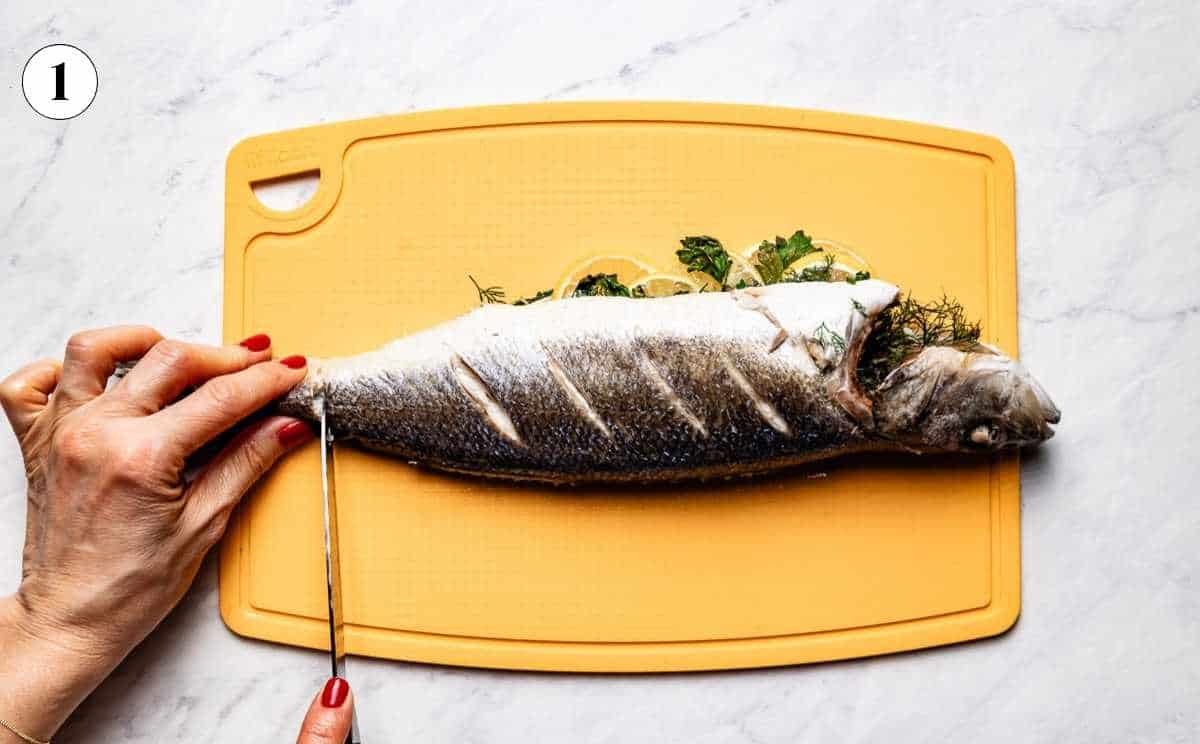
Step 1 – Cut the tail: Once the fish has rested, place it on a cutting board with the back of the fish facing you (this will feel more natural if you’re right-handed, like I am).
Grab a sharp chef’s knife and cut through the skin at the tail until you hit the bone.
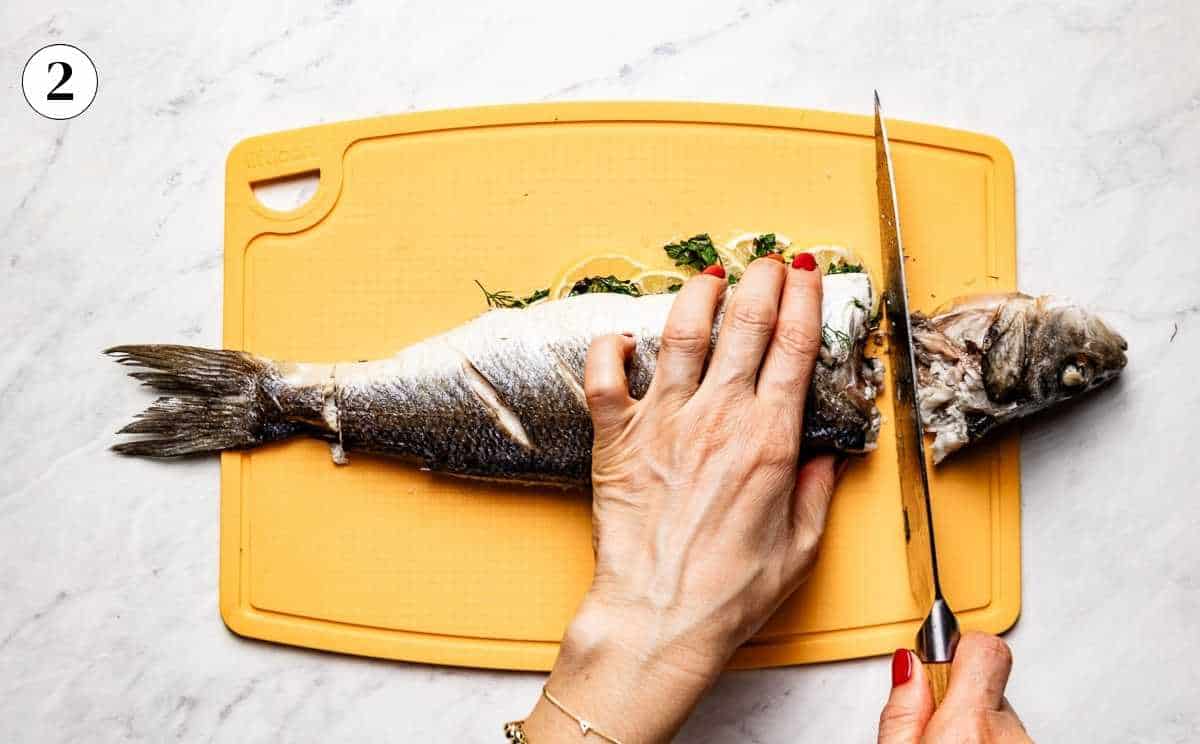
Step 2 – Remove the head: Then, carefully cut the head off entirely and discard it. As you cut, you might feel a bit of resistance, as the main bone in that area is quite thick. You may have to move the knife back and forth a few times.
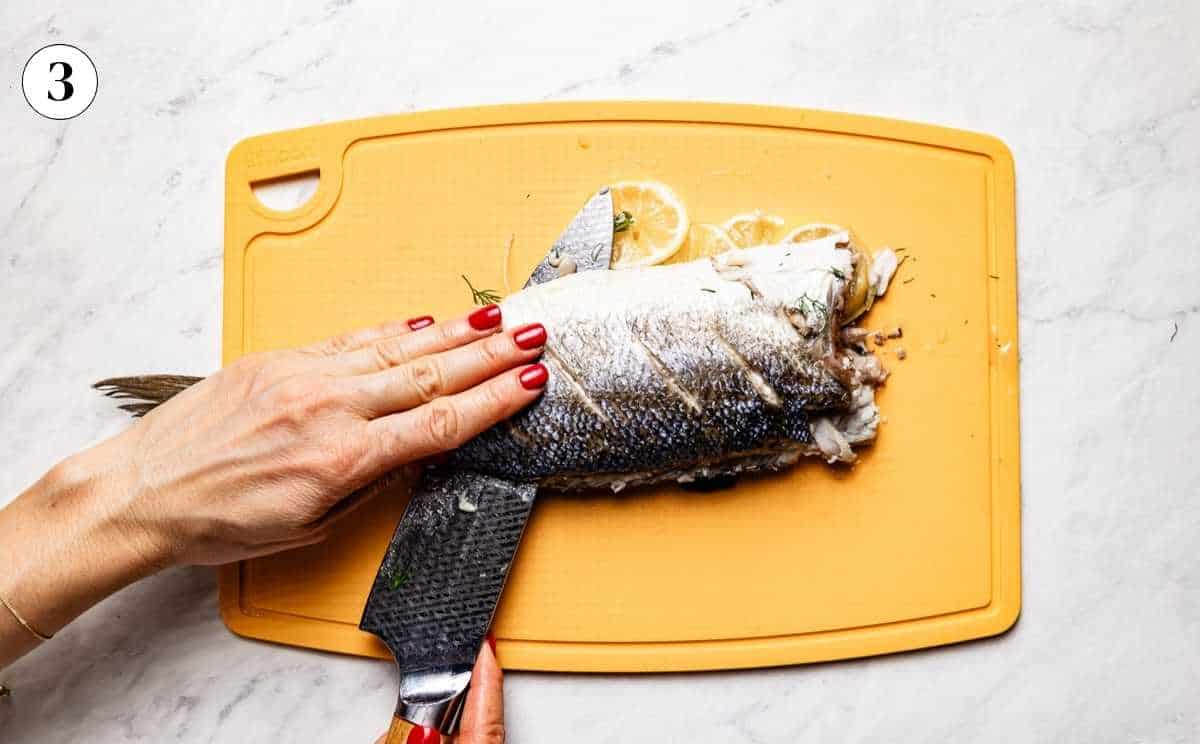
Step 3 – Remove the top fillet: Use your non-dominant hand to hold the fish in place on top, then slide your knife parallel along the backbone. Let the knife slide right on top of the spine. You should feel it as you go.
The goal is to keep the main bone underneath the knife so the top fillet comes off cleanly. Carefully lift the top fillet away from the bones using a spatula and transfer it to a plate.
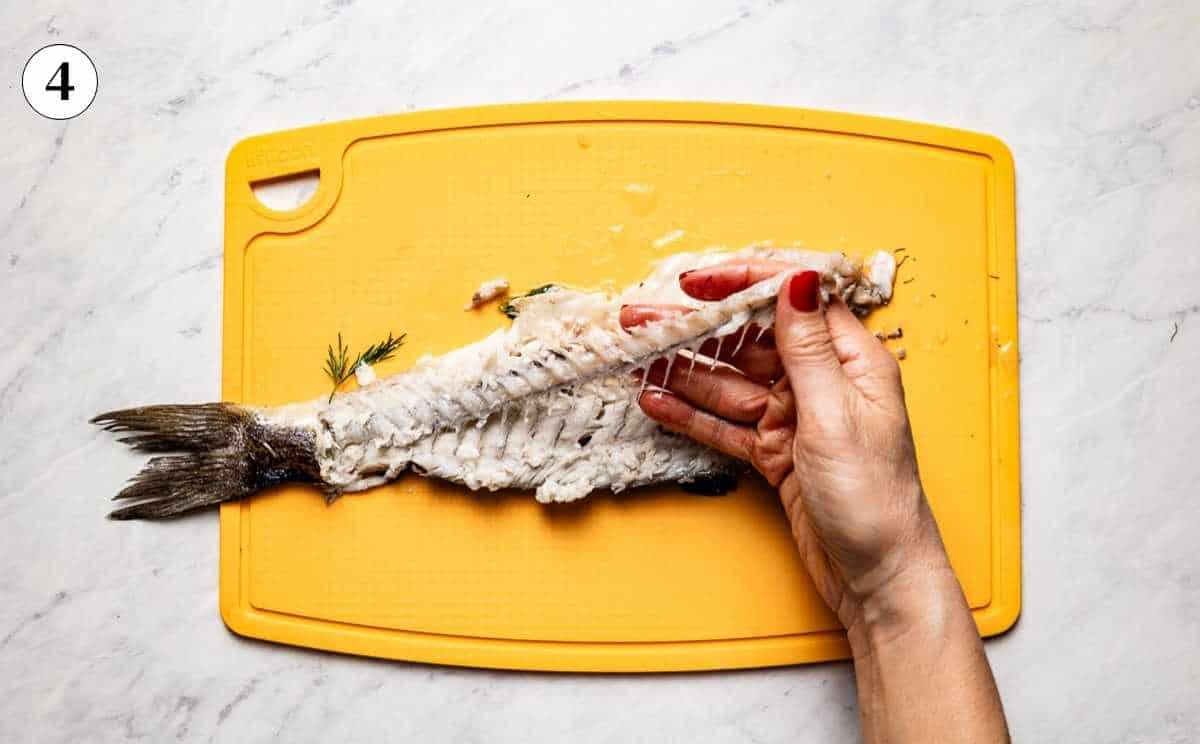
Step 4 – Lift out the backbone: You’ll now see the whole backbone exposed. Gently grab it at the head end and lift it out in one piece, tail and all. It should be easy to lift and remove. Discard the bone.
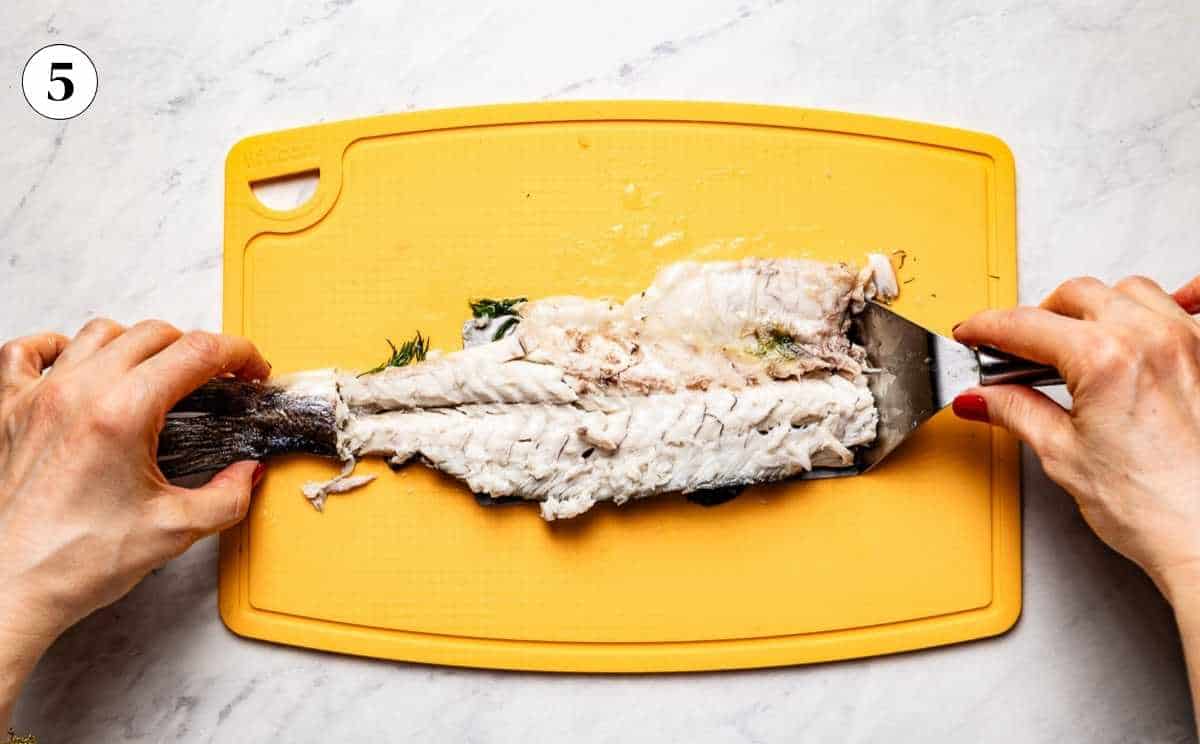
Step 5 – Check for remaining bones: While you can usually remove the backbone in one piece, sometimes a few may remain, so check the bottom fillet to ensure none are left.
Pro Tip: European sea bass has many bones, but the good news is that they tend to be quite large and easy to remove. Checking that no bones are left behind is especially important if you are serving this dish to kids.
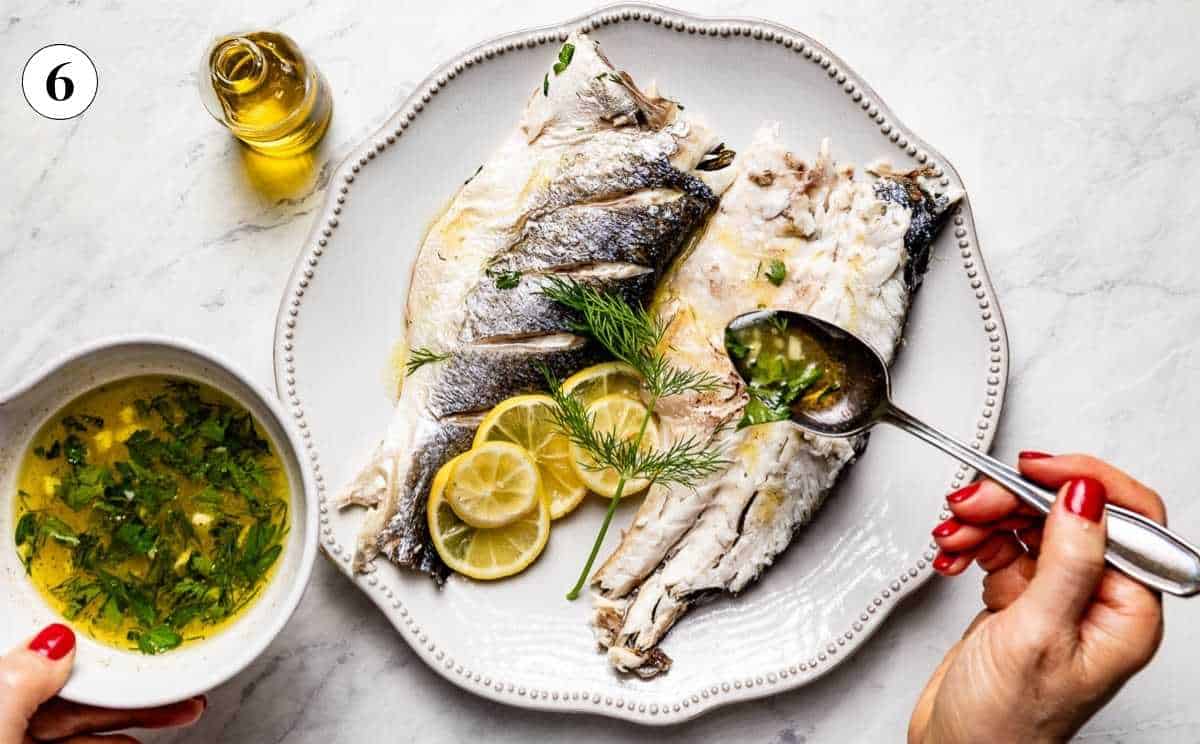
Step 6 – Serve and finish: When you’re ready to serve, transfer both fillets to a plate, drizzle generously with the lemon olive oil sauce, and finish with a few lemon slices and some fresh dill.
Expert Tips for The Best Roasted Branzino
While there isn’t much to making this whole branzino recipe, there are a few things I’d like to bring to your attention so you can succeed on your first try. Below are some helpful notes from my recipe testing:
Rotating the sheet pan: While there is no need to flip the fish, it is important to rotate the pan halfway through the roasting process, as temperatures vary inside most home ovens.
Rotating the sheet pan ensures that each branzino cooks evenly.
Serving size: I usually serve one branzino (1 to 1 ¼ lbs) per person. After deboning, you get about ¾ lb of flesh.
Cooking for 4: I wrote the recipe below for 2 servings. If you are cooking for 4 people, I recommend using two sheet pans instead of crowding one.
When using two pans, arrange the oven racks in the middle position and the one underneath. Place the first sheet pan in the middle and the second one underneath. Halfway through, switch their positions and turn the pans around front to back.
To clarify, we are not flipping the fish; we are just switching their positions and rotating the sheet pans to ensure even cooking. The timing shouldn’t change, but still, it is best to check it with a meat thermometer.
To tie or not to tie: I have seen versions of this recipe tying the fish with kitchen twine after stuffing it with lemon slices and herbs. I tested it both ways and ultimately decided it was not necessary.
Since we are cooking in the oven (without flipping), it was not necessary to tie it. Still, it can be helpful when transferring the cooked fish onto the plate.
If you decide to tie it, make sure that it is not too tight so the air can circulate inside the cavity.
The truth about “crispy skin”: I’ll be honest with you; during my research for this recipe, I came across several recipes claiming you can get crispy skin by oven-roasting a whole branzino, with some even recommending a broil at the end to get it.
I just don’t think that is accurate. The skin of a European sea bass is too thin and delicate to turn truly crispy at 425°F.
You can broil it briefly (as they suggest), but keep in mind that branzino overcooks fast, and a dry branzino is a sad branzino.
If crispy skin is what you are after, cooking it in a screaming hot cast-iron pan is the way to go. What you will get from this recipe is golden, flavorful skin and perfectly moist flesh, and to me, that is the better result anyway.
Should I finish it under the broiler? During my recipe testing, I noticed some recipes recommend finishing the fish under the broiler. I opted out of this because branzino is such a delicate fish, and it is easy to overcook and dry it out quickly. If you really want that extra browning, you can broil for a minute, but keep a very close eye on it.

Whole Roasted Branzino Recipe
Ingredients
- 2 whole branzino, 1 ¼ to 1 ½ lbs each – cleaned, scaled and gutted
- 2 tablespoons olive oil
- 1 teaspoon kosher salt
- 1 lemon, sliced thinly
- 6 sprigs of fresh herbs, dill, parsley, oregano, etc.
For The Sauce
- ¼ cup lemon juice
- 1 clove garlic, minced
- 3 tablespoons olive oil
- 1-2 tablespoons chopped fresh herbs
- ½ teaspoon kosher salt
- ¼ teaspoon black pepper
Instructions
- Preheat the oven to 425°F (218°C). Line a large sheet pan with parchment paper and set it aside.
- Using paper towels, thoroughly dry the branzino on all sides, including the cavity.
- Place it on the sheet pan. Using a sharp knife, make two to three slits on both sides of the fish, piercing all the way through the skin.
- Spread olive oil all over the fish and season generously with kosher salt, including the cavity. Be sure to rub the oil and salt into the slits you made.
- Stuff each branzino with 2-3 lemon slices and a few sprigs of fresh herbs.
- Transfer the fish to the oven and roast for 16-18 minutes*, or until the internal temperature reaches 135-138°F (57°C -59°C). There is no need to flip the fish.
- Remove from the oven and let it sit for a few minutes (no more than 5).
- Meanwhile, whisk together the lemon juice, garlic, olive oil, herbs, salt, and pepper in a small bowl until combined.
- To debone the fish, using a sharp knife, cut through the skin of the tail until you feel the bone. Then cut off the head entirely and discard.
- While holding the fish steady with your non-dominant hand from the top, slide your knife parallel along the backbone. You want to “feel” the bones with your knife to ensure you are cutting right on top. Remove the flesh and transfer it to a plate.
- The entire backbone will reveal itself. Gently hold the bone at the head end and lift the whole thing, including the tail. Discard the bone.
- Briefly check the bottom fillet for any stray bones before serving.
- When ready to serve, drizzle it with the lemon olive oil sauce.
Notes
- Yields: This recipe makes 2 roasted whole branzino and serves 2 adults. The nutritional data below is per serving and does not include the olive oil drizzle (as it depends on how much you decide to use).
- *A note on roasting time: There is a direct correlation between the weight of the fish and the cooking time. It is best to cook about 16 minutes if your fish is smaller than 1 ½ lbs. If it is closer to 1 ½ lbs, you can cook it for up to 18 minutes.
- Storing leftovers: This fish tastes best when it is still warm, fresh out of the oven. However, you can store the leftovers in an airtight container in the refrigerator for up to 3 days. Reheat it in a low oven at 300°F (150°C) until just warmed through for about 5 minutes. I would not recommend reheating it in the microwave as it could dry out the fish.
- Substitution for the fish: I tested this recipe using whole branzino. However, this method of roasting white flaky fish generally works with other fish, such as red snapper, black sea bass, or whole trout. For best results, cooking time should be adjusted based on the size of the fish.
Nutrition
Nutrition information is automatically calculated, so should only be used as an approximation.
How To Make Ahead, Storage and Reheat Leftovers?
This roasted branzino recipe is best when cooked right before serving and should be eaten shortly after it is out of the oven. To me, that is the best way to serve this fish. Below is how I do it:
Make Ahead: If I have friends coming over, I usually dry, season, and stuff the cavity, cover it with stretch film, and keep it in the fridge. Then I bake it for 20 minutes before serving, so it is nice and fresh when we are ready to eat.
Store and reheat leftovers: If you have leftovers, store them in an airtight container in the fridge for 2-3 days, then reheat. You can reheat it in a low oven at 300°F (150°C) until just warmed through, for no more than 3-5 minutes.
Pro tip: I would recommend skipping the microwave, as it will dry out the fish quickly.
What to Serve with Roasted Branzino
Back home, Mediterranean branzino is often served simply with a salad on the side, letting the fish really shine. That said, if you want to round out this branzino dinner a bit more, here are a few simple ideas:
A simple salad: A fresh, crisp salad is the most classic pairing and keeps the meal light and balanced. I especially love serving it with my Greek Cucumber Salad or Turkish Shepherd Salad for a true Mediterranean feast. But a simple Spring Mix Salad also works well when you want something quick and easy.
With a light starch: If you’d like something more filling on the plate, a light starch pairs beautifully with this baked branzino. Lemon Quinoa is a great gluten-free option, or for a more filling pairing, try my Mediterranean Pasta Salad.
Finally, if you prefer a creamy side dish, my Lemon Orzo is a crowd-pleasing warm side that you can make while the fish is roasting in the oven.
Roasted vegetables: When I want to serve it with a veggie on the side, I usually cook some Asparagus in the Oven or roast some cherry tomatoes to add a touch of sweetness.
Other Mediterranean Seafood Recipes
A Fast Weeknight Fish: My Mediterranean Baked Cod is a quick and easy dinner made with just 8 simple ingredients, making it a reliable, weeknight-friendly seafood option.
A Speedy Shrimp Dinner: If you are like me and prefer your shrimp lightly sauteed in butter, then look no further than my Shrimp Scampi. In my recipe, I use no wine, so everyone in the family can enjoy it.