
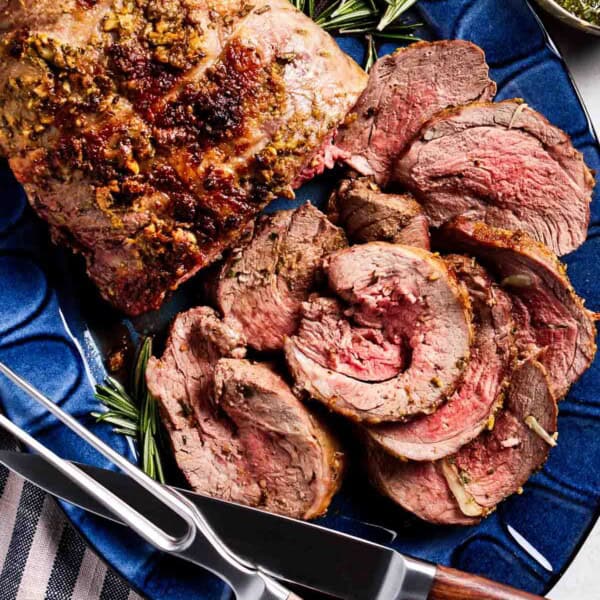

How I Learned to Love This Lamb Recipe (and Make It Foolproof)

Every time I talk to a friend about making lamb, I hear the same thing. She wants to cook it, but she feels intimidated. The odd shape, the seasoning, the doneness, and the one I hear most often: the gamey flavor.
I completely understand. Like many of you, I buy my boneless leg of lamb from Costco. It comes wrapped in a casing, shaped like a ball, and the moment you remove it, you are staring at this irregular, floppy piece of meat, wondering where to even begin.
But here is what I want you to know: Growing up in Türkiye, lamb was my mother’s special occasion meal, and I cooked enough of it beside her to know it inside and out.
This recipe is built on the flavors I grew up with: garlic, rosemary, and Dijon mustard, which not only adds a beautiful depth of flavor but also works as a natural tenderizer for the meat.
After many rounds of testing, I believe this is the best way to cook boneless leg of lamb. And if you are more of a visual learner, I have a detailed step-by-step video in the recipe card that walks you through the entire process.
Boneless Leg of Lamb Ingredients and Substitutions
With a few simple ingredients, all of which you can find on a single supermarket run, you can make this boneless leg of lamb roast recipe and wow everyone at your table.
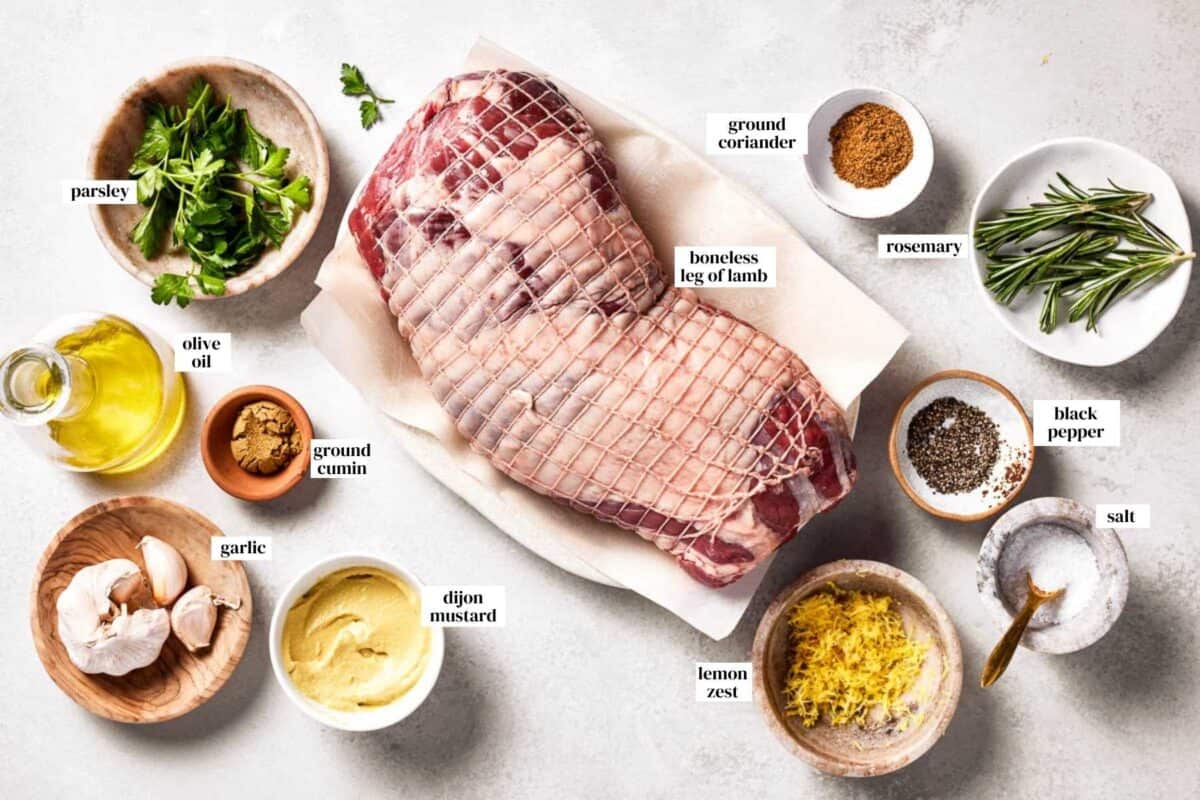
You can find the full ingredient list in the recipe card below. Here are a few notes from my recipe testing to help you as you gather your ingredients:
Boneless (or deboned) leg of lamb: Here in the U.S., you’ll typically find lamb from New Zealand, Australia, or the U.S. I usually buy mine from Costco, which carries Australian lamb leg.
Pro Tip 1 – How much to buy: At the store, you will see that boneless leg of lamb comes in different weights, so choose one based on how many people you plan to serve.
The one I am using here is just over 5 pounds, which is perfect for 6 to 8 adults, but you can go smaller or larger depending on your needs.
Pro Tip 2 – Remove the netting: If your lamb comes in a net casing, remove it completely before starting. You will retie it yourself with butcher’s twine for better control over the shape and to season it evenly.
Dijon mustard: This was my mom’s secret ingredient whenever she made a large piece of lamb. In the recipe, Dijon does two things:
- Adds a distinct but complementary tangy flavor
- Helps tame the gaminess of lamb.
While you can technically use yellow or brown mustard in a pinch, I find that they might be a bit harsh for this simple leg of lamb recipe.
Fresh garlic cloves: I use a whopping 8 cloves of garlic in this recipe, and that is no typo! Four of them will be minced to go into the marinade inside the lamb, while the other four will be sliced to be stuffed into slits on the outside once the lamb leg is rolled.
Fresh herbs: I used a combination of rosemary and parsley, though you can also use thyme as a substitute or an addition.
That said, it is imperative to finely mince these herbs, especially the rosemary, so that the pine-like needles blend in well.
Spices and seasonings: This deboned leg of lamb recipe is quite adaptable to a range of seasoning blends, depending on the flavor profile you are aiming for.
As a nod to my own Mediterranean roots, I opted for ground cumin and coriander, which paired beautifully with the tangy Dijon mustard and lemon zest in the marinade.
And to be honest, these are the spices I grew up cooking with in Türkiye, and I think they bring a warmth to the lamb that rosemary alone simply cannot achieve.
Lemon zest: Do not skip this. The brightness of fresh lemon zest elevates the entire marinade and balances the lamb’s richness. I always zest directly over the bowl so none of the oils are lost.
How to Cook Boneless Leg of Lamb in the Oven
Here is exactly how I make it, step by step:
Step 1 – Preheat the oven: Adjust your oven rack to the lower-middle position and heat the oven to 425 degrees F. (218 C). Place a wire rack on a baking sheet and set it aside.
Pro tip – A wire rack is essential. A wire rack allows air to circulate, resulting in an evenly cooked roasted leg of lamb. If you do not have a wire rack, you can use a roasting pan with a V-rack.
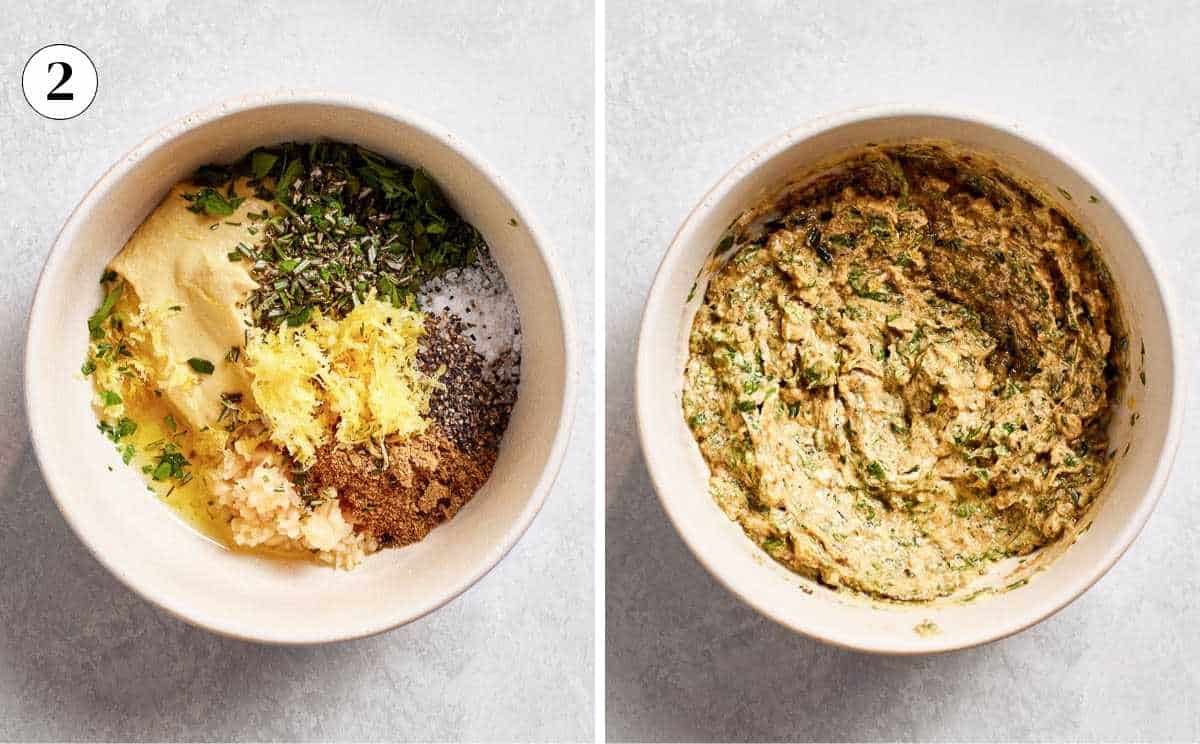
Step 2 – Make the seasoning: Into a medium-sized bowl, place Dijon mustard, olive oil, 4 cloves of minced garlic, finely chopped fresh rosemary, finely chopped fresh parsley, ground cumin, ground coriander, Kosher salt, black pepper, and the zest of a lemon. Stir mixture evenly.
Refer to the recipe card below for exact quantities.
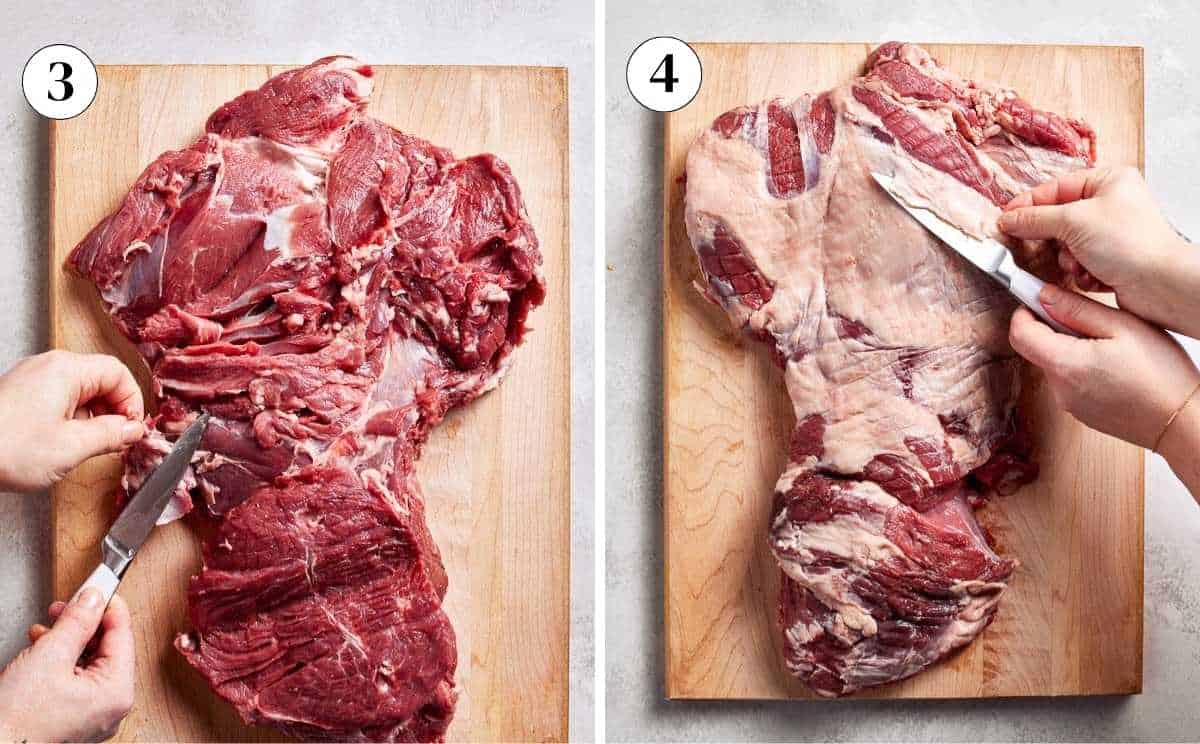
Step 3 – Prepare the lamb: Remove the lamb from its packaging. It will likely look like an uneven bundle of meat.
Lay it flat on a cutting board with the inside facing up. Do your best to spread it out as evenly as possible. Pat it dry with paper towels on both sides to remove excess moisture.
Step 4 – Remove the excess fat: Using a sharp chef’s knife, trim off any excess fat, focusing on greyish or tough areas.
Pro tip – What you need to know about removing the fat: As you trim, you will notice excess fat on the outer cap, and then some grey-ish fat on the inside. The grey fat is what gives the gamey flavor, which is why I focus on removing it in this step.
The outer cap, on the other hand, is different. Unlike the inner fat, it renders as it cooks, adding moisture and richness to the meat. While I still like to remove the excess, it is best to leave some of it for flavor.
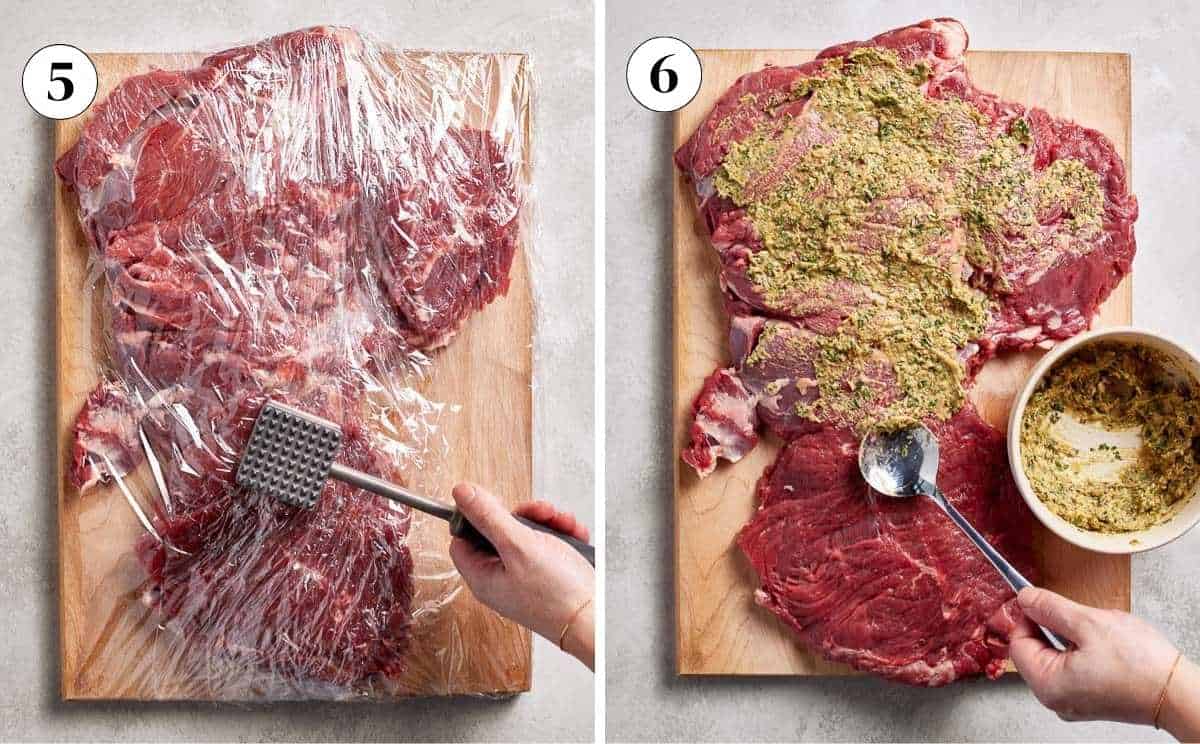
Step 5 – Even out the thickness: Flip the meat back to the inside-facing-up position. Cover the meat with plastic wrap. Using a meat mallet, gently pound the meat to create an even thickness of about 1 inch, focusing on the thicker areas.
Once it is even, you can remove the stretch film.
Step 6 – Spread it with the seasoning rub: Spread ⅔ of the Dijon-herb mixture evenly over the inside layer of the meat.
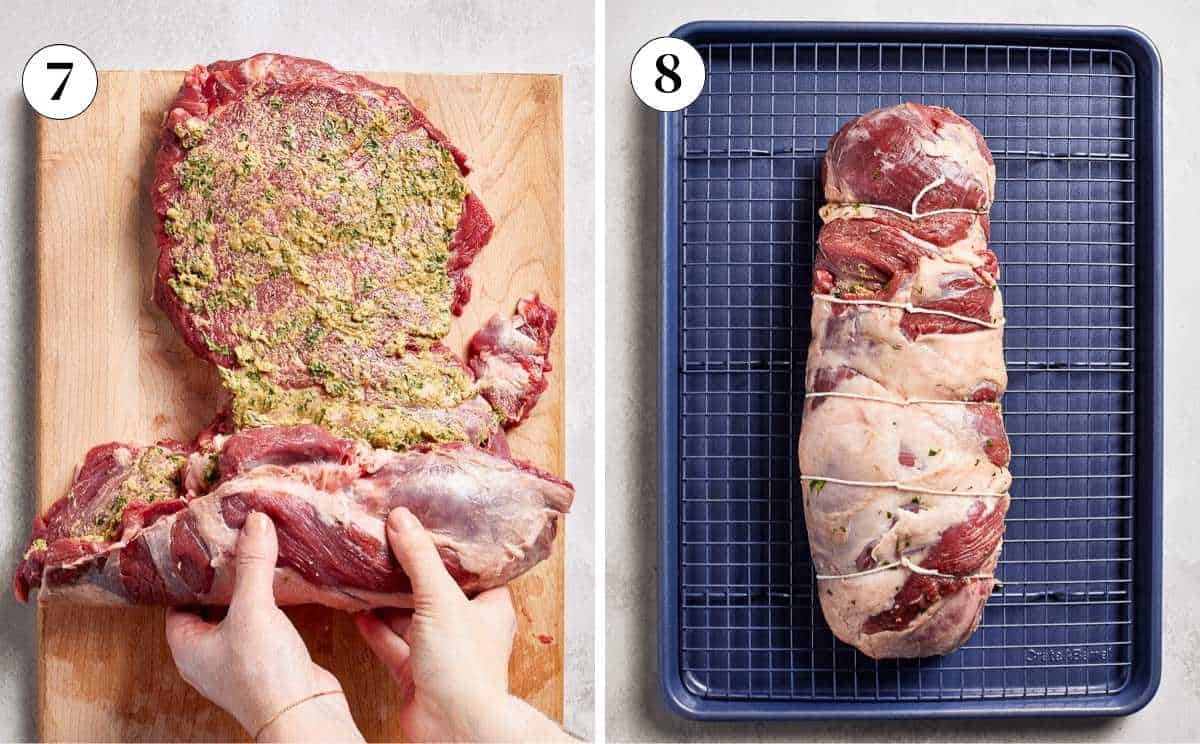
Step 7 – Roll into a cylinder: To roll the leg of lamb, begin with the bottom right of the meat and roll it toward the center (away from your body), pulling it snug as you go.
Then, take the left top side and roll it towards you, meeting the first roll in the middle. It should have a uniform cylinder shape. Tuck the ends of the meat inside the roll as much as you can.
Step 8 – Tie the lamb: Using butcher’s twine, secure the roast by tying loops around it at roughly 1 ½-inch intervals, ideally starting from the center and working towards both ends.
You’ll likely need about 8-9 loops to keep everything in place. It doesn’t have to be perfect!
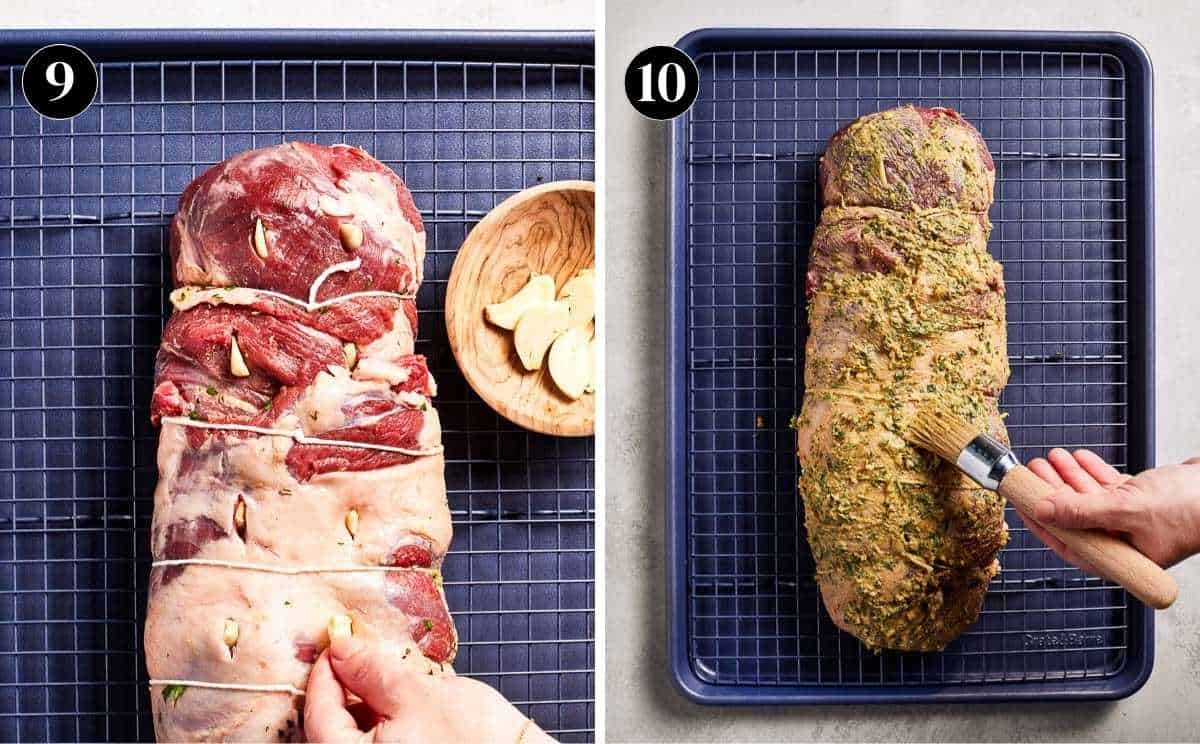
Step 9 – Cut small slits for more garlic: Using a pairing knife, cut 14-16 1-inch slits evenly around the exterior of the lamb, and insert the remaining 4 sliced garlic cloves into each cut as evenly as you can.
Step 10 – Season the outside: Spread the remaining Dijon-herb mixture over the outside of the deboned lamb roast, ensuring all sides are evenly coated.
Step 11 – Roast: Transfer the meat onto the prepared baking sheet.
Bake for 15 minutes in the preheated 425 °F (218 °C) oven for a good sear, then reduce the heat to 350°F (177 °C) and bake until the internal temperature reaches 125-130 °F (51-54°C) (for medium-rare) when a thermometer is inserted into the center of the roast. This takes about 40-45 minutes (a total of 1 hour in the oven).
Step 12 – Let lamb rest: When the leg of lamb is finished roasting, remove it from the oven, tent it with foil, and let it rest for 10-15 minutes.
Keep in mind that, as the lamb rests, its internal temperature will increase by 5 to 10 degrees due to residual heat.
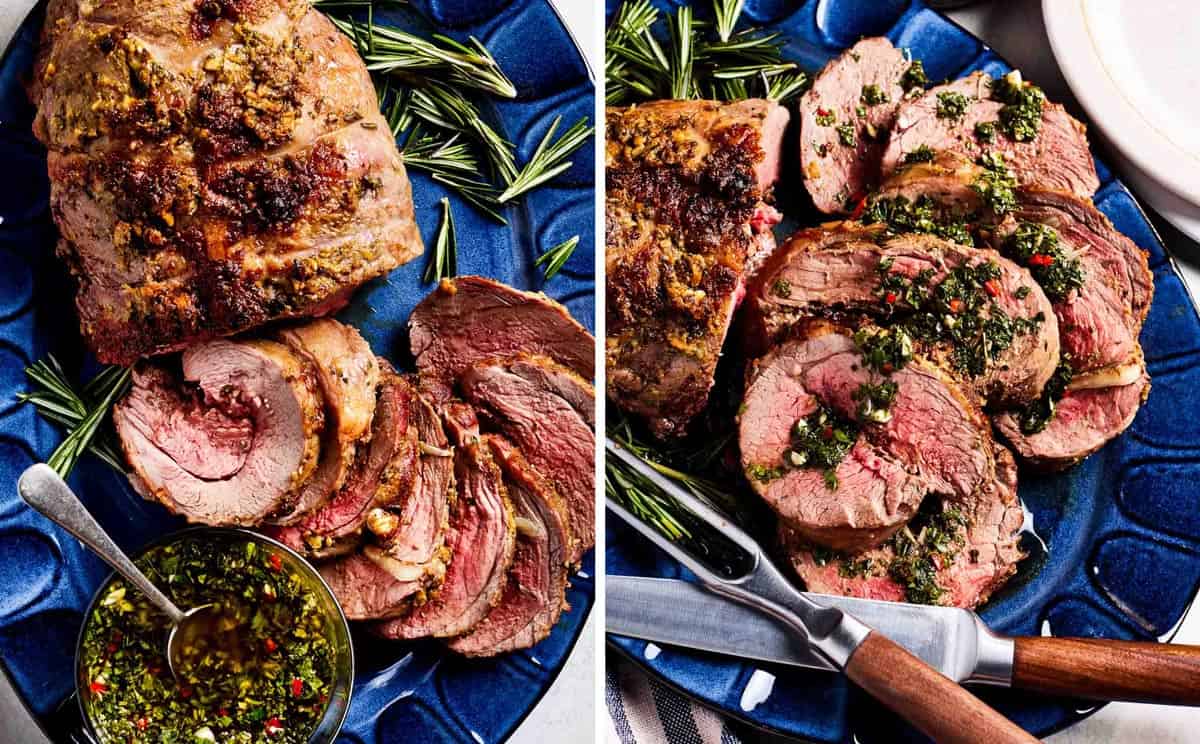
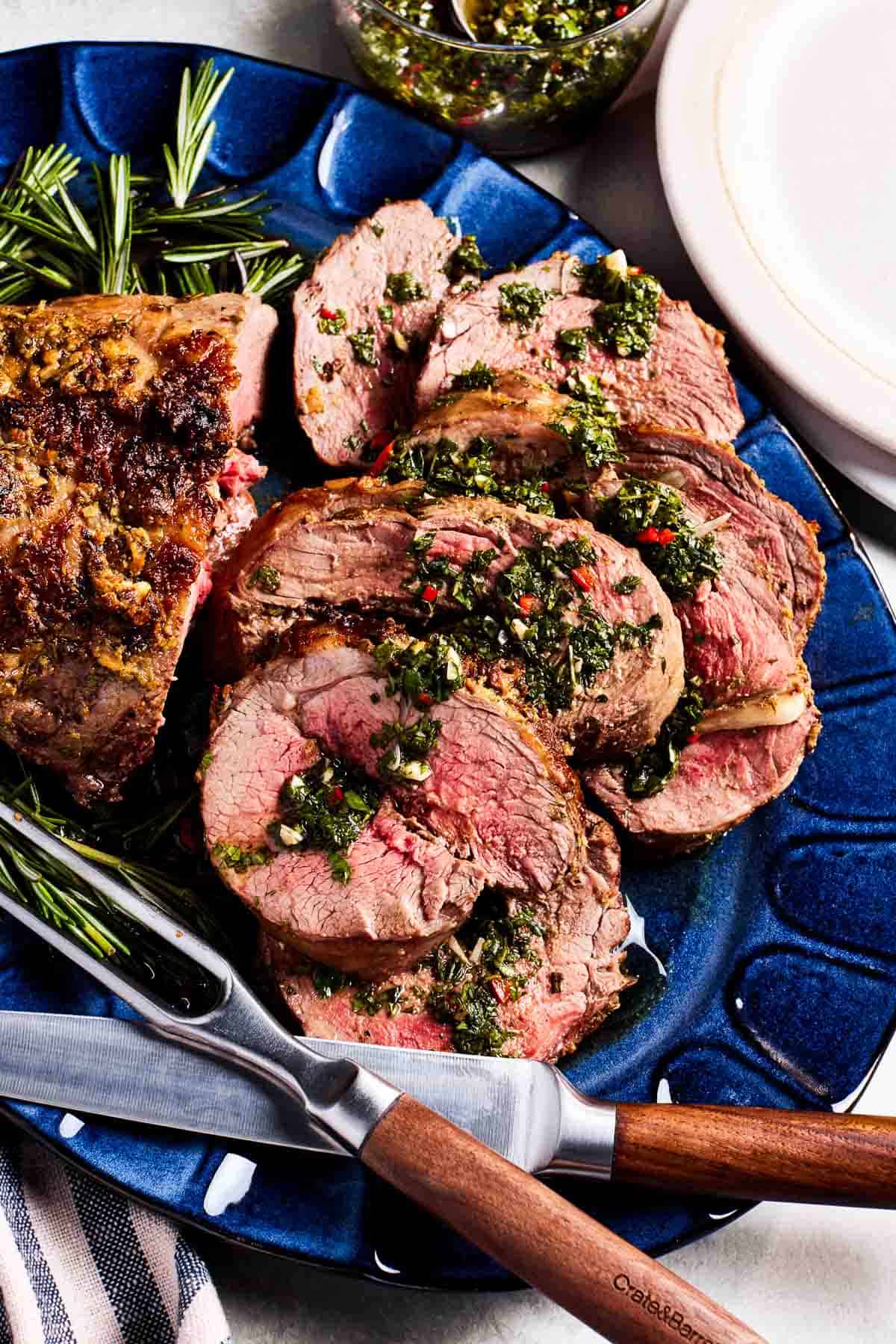
Step 13 – Slice and serve: Transfer your roasted boneless leg of lamb to a cutting board, remove the twine, and using a sharp chef’s knife, slice it into about 1-inch-thick slices, depending on your preference.
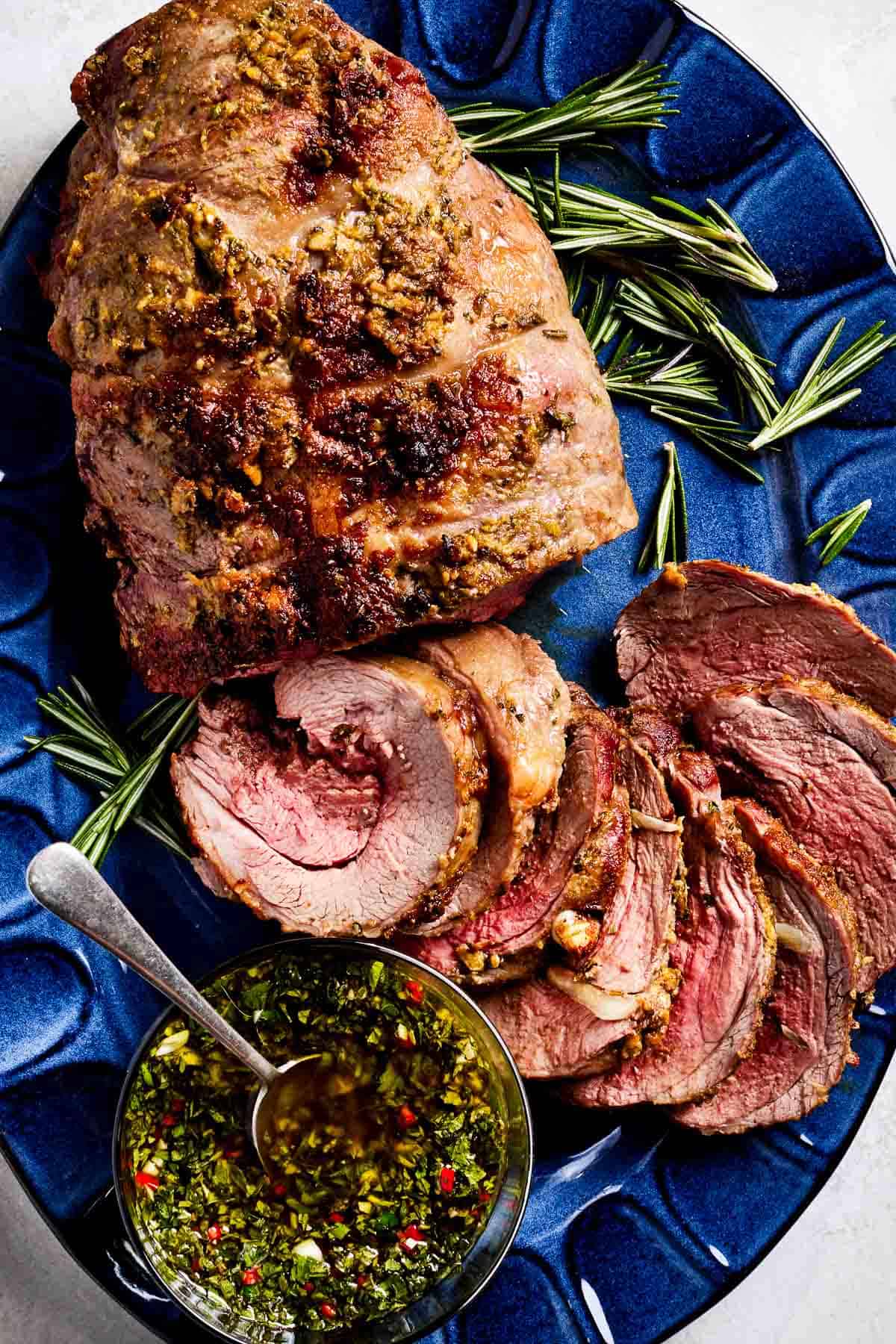
Transfer your boneless leg of lamb roast onto a plate and serve it with your favorite sauce. As you can see in the photos, I served mine with my quick mint chimichurri sauce, but I have included several other options below.
Ideal Temperature and Cooking Time for Boneless Leg of Lamb (Based on Doneness Level)
Getting the temperature and cook time right is the difference between a showstopper and a disappointment. Here is everything you need to know, based on my testing:
How long to cook a boneless leg of lamb depends on the weight and your preferred doneness level. While most boneless leg of lamb recipes say the cooking time per pound is about 15-20 minutes, I think it is more like 10-15 minutes.
3 things affect the boneless leg of lamb cooking time:
- The boneless leg of lamb temperature (I usually take the meat out of the fridge to come to room temperature for at least 30 minutes to an hour before working with it)
- The weight of your boneless lamb leg roast
- Your preferred doneness (rare, medium-rare, or medium).
For reference, my 5-pound leg of lamb reached 120°F (medium-rare) in about 55 minutes total using this method.
The two-step process – My approach to roasting lamb starts with a high-heat sear to lock in flavor, followed by a slow, gentle cook. I begin at 425°F for the first 15 minutes, then lower the temperature to 350°F to ensure a tender, evenly cooked roast.
The final touch comes as the lamb rests, allowing residual heat to finish cooking while keeping it juicy and flavorful.
Looking for a boneless leg of lamb roasting chart based on doneness? The chart below from America’s Test Kitchen cookbook, Meat Illustrated, is the one I use.
| Desired Doneness | Cooking Stop Temperature | Final Temperature After Resting |
|---|---|---|
| Rare | 115 to 120 °F (46 – 49 °C) | 120 to 125 °F (49 – 52 °C) |
| Medium-Rare | 120 to 125 °F (49 – 52 °C) | 125 to 130 °F (52 – 54 °C) |
| Medium | 130 to 135 °F (52 – 57 °C) | 135 to 140 °F (57 – 60 °C) |
| Medium-Well | 140 to 145 °F (60 – 63 °C) | 145 to 150 °F (63 – 66 °C) |
| Well-Done | 150 to 155 °F (66 – 68 °C) | 155 to 160 °F (68 – 71 °C) |
Pro tip: The best way to nail your preferred doneness is to use a probe thermometer. Insert it into the center of the lamb before it goes in the oven, set it to your target pull temperature from the chart above, and it will tell you exactly when to take it out.
I use this Tempro Digital Meat thermometer, and it works like a charm. No guessing, no cutting into the meat to check.
Residual heat will likely raise the temperature of your leg of lamb with garlic and rosemary by 5-10 degrees during the 10-15 minutes of resting. That means if I pull my lamb out when the internal temperature is at 120°F (49 °C), it should ultimately reach around 130°F (52 °C), which is exactly how I like it, pink, juicy, and perfectly moist.
How To Make Ahead, Store, and Reheat
- Make Ahead: This boneless lamb roast recipe can be fully prepped the day before. Simply follow all of the steps before putting it in the oven, then wrap it in stretch film. This is a great way to bring out more flavor by allowing it to marinate overnight. Just remember to take it out of the fridge an hour or two before cooking to allow it to come to room temperature.
- Storage: Store any leftover lamb as a cylinder or as slices. First, allow the meat to come to room temperature, then wrap it in an airtight container and store it in the fridge for up to 4 days.
- Freezing and Thawing: You can freeze any leftovers in a cylinder or as slices. Bring it to room temperature, then store it in a freezer-safe container for up to 3 months. Thaw it overnight in the fridge.
- Reheat: Cover loosely with foil to prevent drying out. Warm the lamb slices on low heat (275 °F to 300 °F) for 10 minutes or until thoroughly heated.
Roasted Boneless Leg of Lamb Recipe
Ingredients
- ¼ cup Dijon mustard
- 2 tablespoons olive oil
- 8 cloves garlic, divided – 4 cloves for rub minced, 4 cloves for inserting into slits sliced
- 2 tablespoons fresh rosemary, leaves removed from stems and chopped finely
- ¼ cup fresh parsley, finely chopped
- 1 teaspoon ground cumin
- 1 teaspoon ground coriander
- 3 teaspoons kosher salt
- 1 teaspoon black pepper
- Zest of 1 lemon, about 1 ½ teaspoon
- 5 lbs Boneless leg of lamb
Instructions
- Adjust oven rack to lower-middle position and heat oven to 425 degrees F. (218 C). Place a wire rack on a baking sheet and set it aside.
- Into a medium-sized bowl, place ¼ cup of Dijon mustard, 2 tablespoons of olive oil, 4 cloves of minced garlic, 2 tablespoons of finely chopped fresh rosemary, ¼ cup finely fresh parsley, 1 teaspoon ground cumin, 1 teaspoon ground coriander, 3 teaspoons kosher salt, 1 teaspoon black pepper, and zest of a lemon. Stir to combine.
- Remove the leg of lamb from its packaging (and discard the netting). It will likely look like an uneven bundle of meat. Lay it flat on a cutting board with the inside facing up. Do your best to spread it out into as even a shape as possible.
- Pat it dry with paper towels on both sides.
- Using a sharp chef’s knife, trim off any excess fat, focusing on removing any greyish or tough fat.
- Turn it over and trim away any thick or uneven fat patches, leaving a thin layer for flavor and moisture retention.
- Flip the meat back to the inside, facing up. Cover the meat with plastic wrap.
- Using a meat mallet, gently pound the meat to create an even thickness of about 1 inch, focusing on the thicker areas. Remove the stretch film.
- Spread ⅔ of the dijon-herb mixture evenly over the meat.
- To roll the leg of lamb, begin with the bottom right part of the meat and roll it toward the center, away from you, pulling it snug as you go. Then, take the left top side and roll it towards you, meeting the first roll in the middle. It should have a uniform cylinder shape. Tuck the ends inside the roll as much as you can.
- Using kitchen twine, secure the roast by tying loops around it at roughly 1 ½-inch intervals, ideally starting from the center and working towards both ends. You’ll likely need about 8-9 loops to keep everything in place.
- Using a paring knife, cut 14-16 1-inch slits evenly around the exterior of the lamb and insert the leftover four sliced garlic cloves into each cut as evenly as you can.
- Spread the rest of the dijon-herb mixture over the meat, ensuring that all sides are evenly coated.
- Transfer the meat onto the prepared baking sheet.
- Bake for 15 minutes in the preheated 425 degrees F oven and then turn the heat down to 350 degrees and bake until the internal temperature of the meat reaches 125-130 degrees F for medium-rare when a thermometer is inserted in the middle of the roast. This takes about 40-45 minutes* (a total of 1 hour in the oven).
- When the leg of lamb is finished roasting, remove it from the oven, tent it with foil, and let it rest for 10-15 minutes. As the lamb rests, the internal temperature will increase by 5 to 10 degrees, thanks to the residual heat.
- Transfer the roast onto a cutting board, remove the twine, and slice it into about 1-inch thick slices, depending on your preference.
- Transfer onto a plate and serve it with your favorite sauce.
Video
Notes
- Yields: This recipe makes about 10-12 slices (as shown in pictures), which is ideal for serving 6 adults (~2 slices per person and about ¾ lb per serving).
- *Use a thermometer: As it is with any large cut of meat like this, the best way to check doneness is by using a probe thermometer or an instant-read thermometer. If you have a probe thermometer, insert it into the meat before placing it in the oven, then set it to your desired temperature.
- Make ahead: You can season, roll, and tie the lamb a day in advance and store it in the fridge in an airtight container. Be sure to remove it from the refrigerator a couple of hours before roasting.
- Storage and reheating: Bring leftover lamb to room temperature, transfer to an airtight container, and refrigerate for up to 4 days. Warm them in a low heat (275°F to 300°F) oven for 10 minutes, or until warmed.
Nutrition
Nutrition information is automatically calculated, so should only be used as an approximation.
FAQs
No. For even cooking, first remove the net and follow my instructions to flatten the meat, then roll it into a cylinder to get the best results.
I usually serve ¾ lbs per person, about 2 slices each.
No, there is no need. You want the oven air to circulate evenly around the meat for a nice sear on the outside.
The most reliable way is a meat thermometer. Without one, you can make a small cut into the center and check the color. If it is pink and slightly glossy, it means it is medium-rare. That said, for a cut this size, I strongly recommend a probe thermometer to remove all the guesswork.
What To Serve with Boneless Leg of Lamb Roast
This leg of lamb recipe is a versatile main dish that pairs well with many sides, making it perfect for any special meal. Here are some great serving ideas:
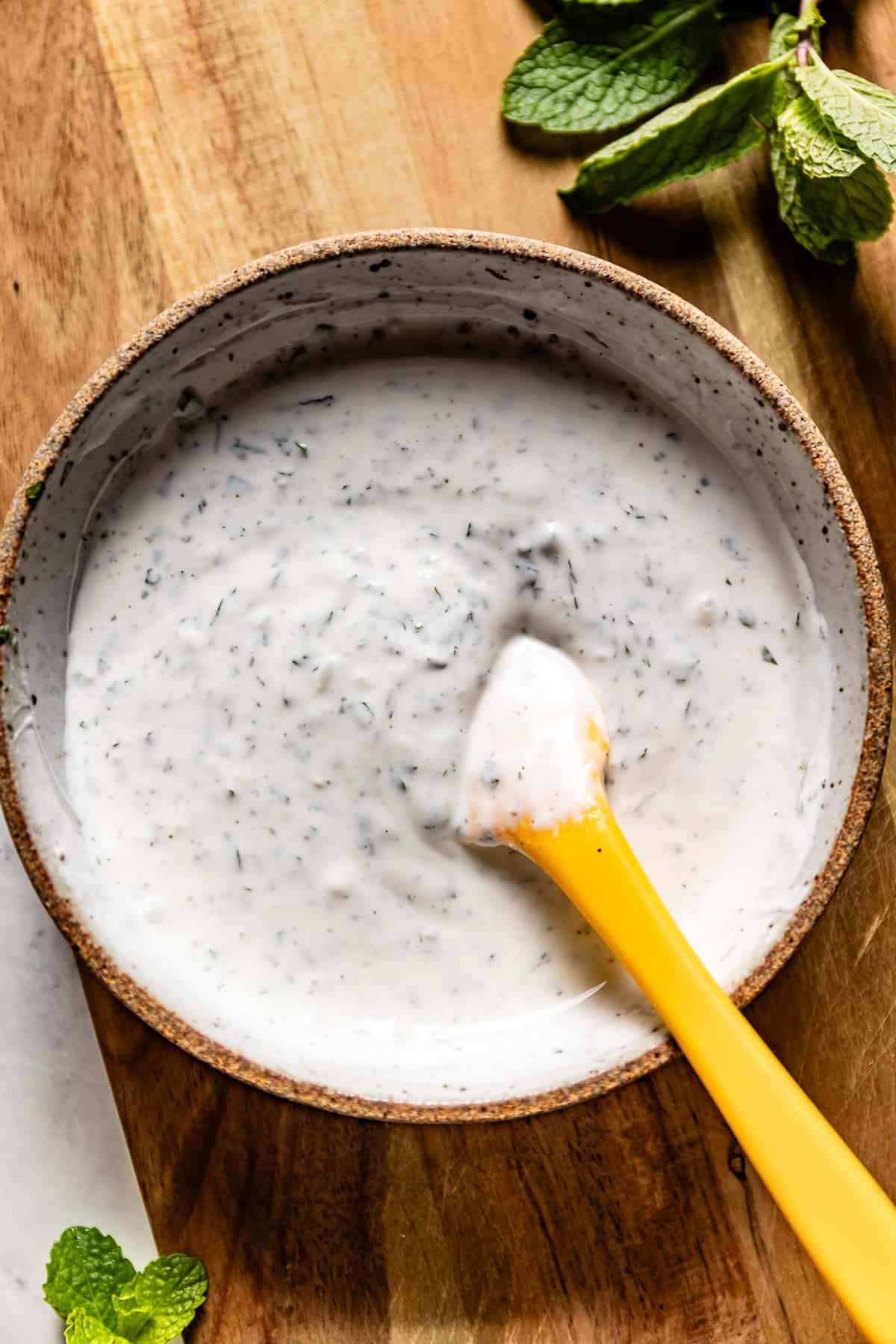
- Mint Sauce: Mint sauce is a classic pairing for roasted lamb of any kind. You can’t go wrong with either a Mint Sauce (British), a Mint Yogurt Sauce (Mediterranean/Middle Eastern), or a Mint Chimichurri (Argentinean).
- Salad: Leafy greens are always a refreshing side dish for any meat-based meal, and this one is no exception. A simple salad like my Greek Salad or my Spring Mix Salad would work beautifully.
- Vegetable sides: I have so many easy vegetable side dishes on the blog, and any of them would complement this leg of lamb nicely. Two of my favorite pairings are my Yukon Gold Mashed Potatoes and Garlic Green Beans.
- Grains: Any one of my grain dishes would work here as a warming side dish. I usually serve it with Vermicelli Rice or my mom’s Bulgur Wheat Pilaf. As a matter of fact, in Türkiye, lamb and bulgur pilaf are a classic combination. My mother never served one without the other.
Other Lamb Recipes You Might Also Like
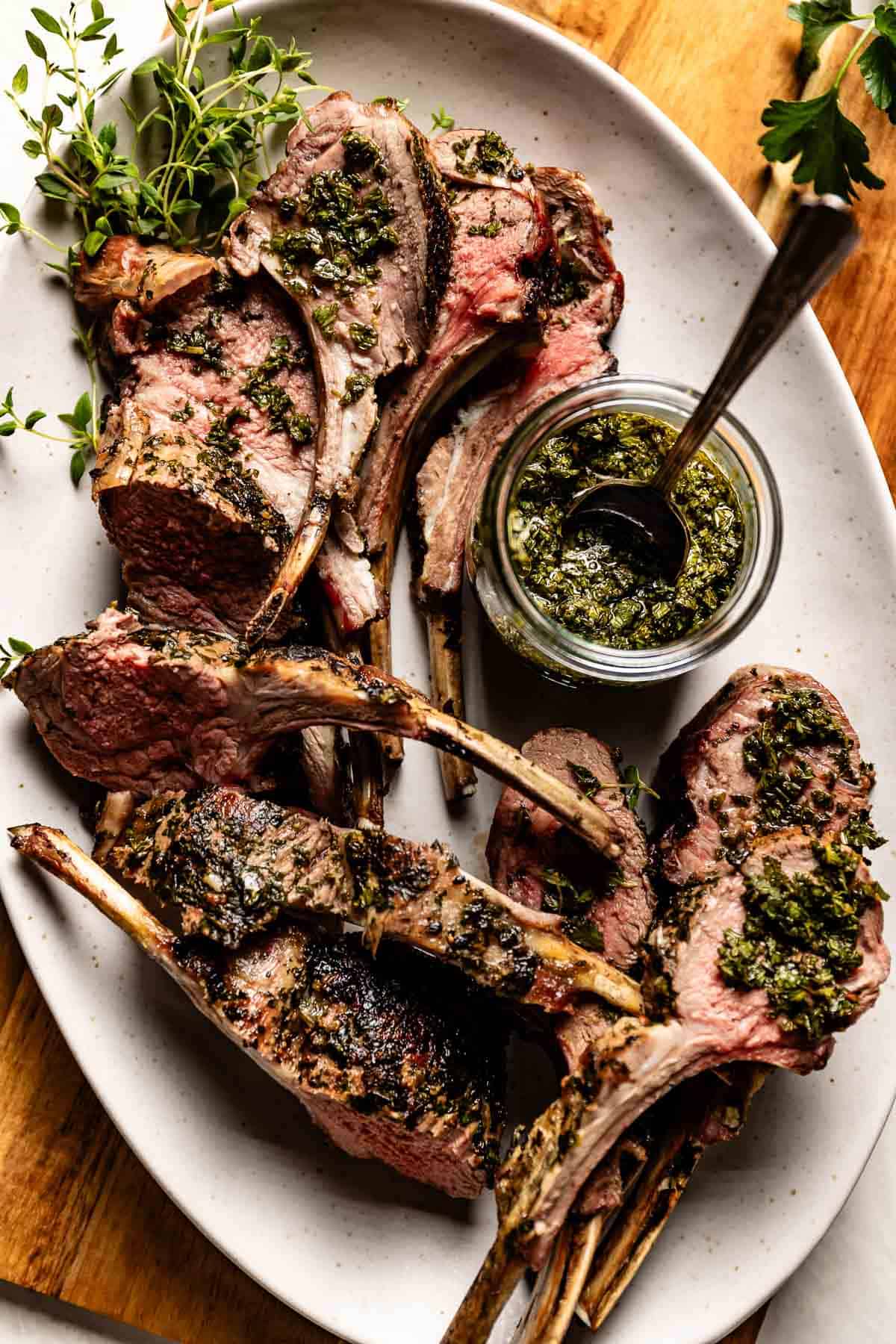
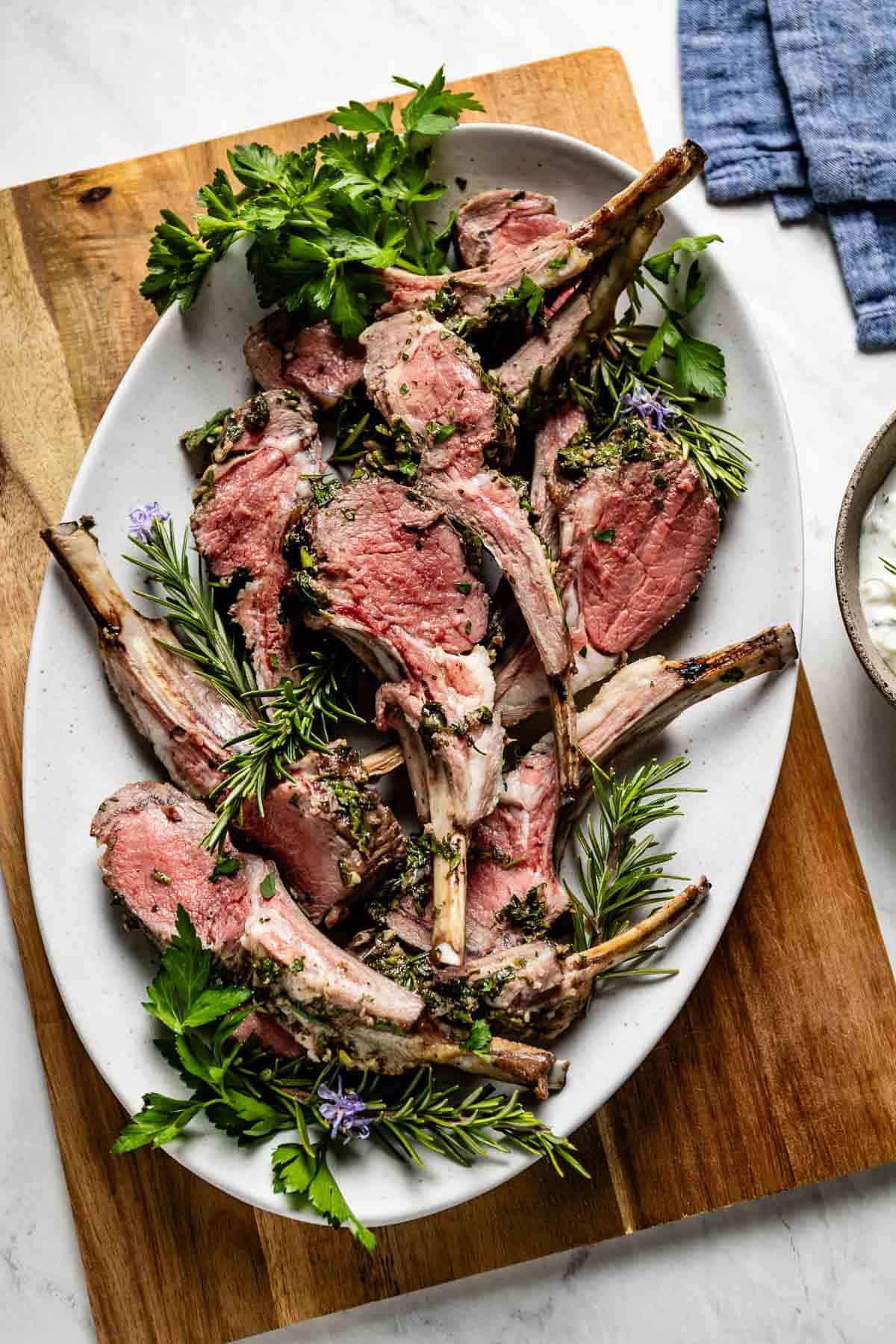
- An impressive weeknight dinner: My Roasted Rack of Lamb is ready in under an hour and is beginner-friendly for any lamb lover.
- Pressure cooker to the rescue: It is no secret that cooking lamb shanks on the stove takes a long time, but my Instant Pot version is ready in under 2 hours with only 20 minutes of hands-on time.
- Summer entertaining made easy: My BBQ rack of lamb is juicy, smoky, and ready in under 30 minutes. Impressive enough for guests but simple enough for a weekend cookout.
This post may contain affiliate links. If you purchase through these links, I may earn a small commission, at no additional cost to you.
Photography by Tanya Pilgrim.










Great recipe and spice blend ! It came out delicious, and the best version of lamb I had so far. Thank you very much !
I am so happy to hear that it worked out for you Andrew. Thanks for taking the time to leave a review.
Tender, delicious and worth buying lamb for. Directions were clear and helped me big successful on the first attempt.
Lorie,
This is music to my ears. I made it for our Easter dinner and my family loved it as well.
Thanks for coming by and taking the time to leave a review.