
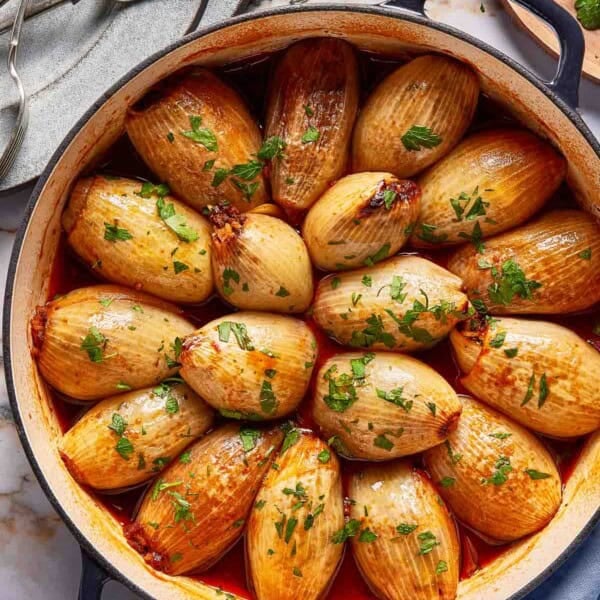

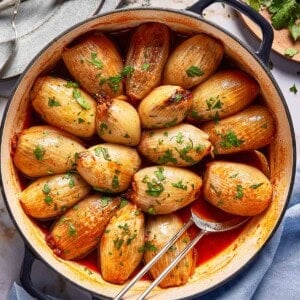
Growing up in Türkiye, our holiday tables looked a little different than the ones we have here in the US. Kebabs were always on the menu, but whenever my mom wanted to make something special, she made these ground beef stuffed onions, or soğan dolması as we call it.
It has been years since I last made them, but seeing their recent popularity on social media made me pull out my mom’s handwritten notes and bring this recipe back to life.
Here are a few things that make this version special:
- It has roots in Turkish cooking. There are many versions of stuffed onions across the Mediterranean and the Middle East, but the Turkish style uses pomegranate molasses to give the dish a gentle, sweet-and-tangy balance.
- The ingredients are simple. Pomegranate molasses might sound unfamiliar, but most grocery stores now carry it. Everything else is a pantry staple, and I included plenty of substitutions so you can make it work with what you have on hand.
- It looks impressive, but it is easier than it seems. Once you soften the onions and get the hang of rolling them, the rest of the process is surprisingly approachable and very forgiving.
If you have never made stuffed onions before, I think you will be pleasantly surprised by how doable this dish actually is.
Ingredients You’ll Need
If you’ve been following along on social media, you’ve probably seen me testing this recipe quite a bit. As I worked through each round, I learned a few things about choosing the right ingredients.
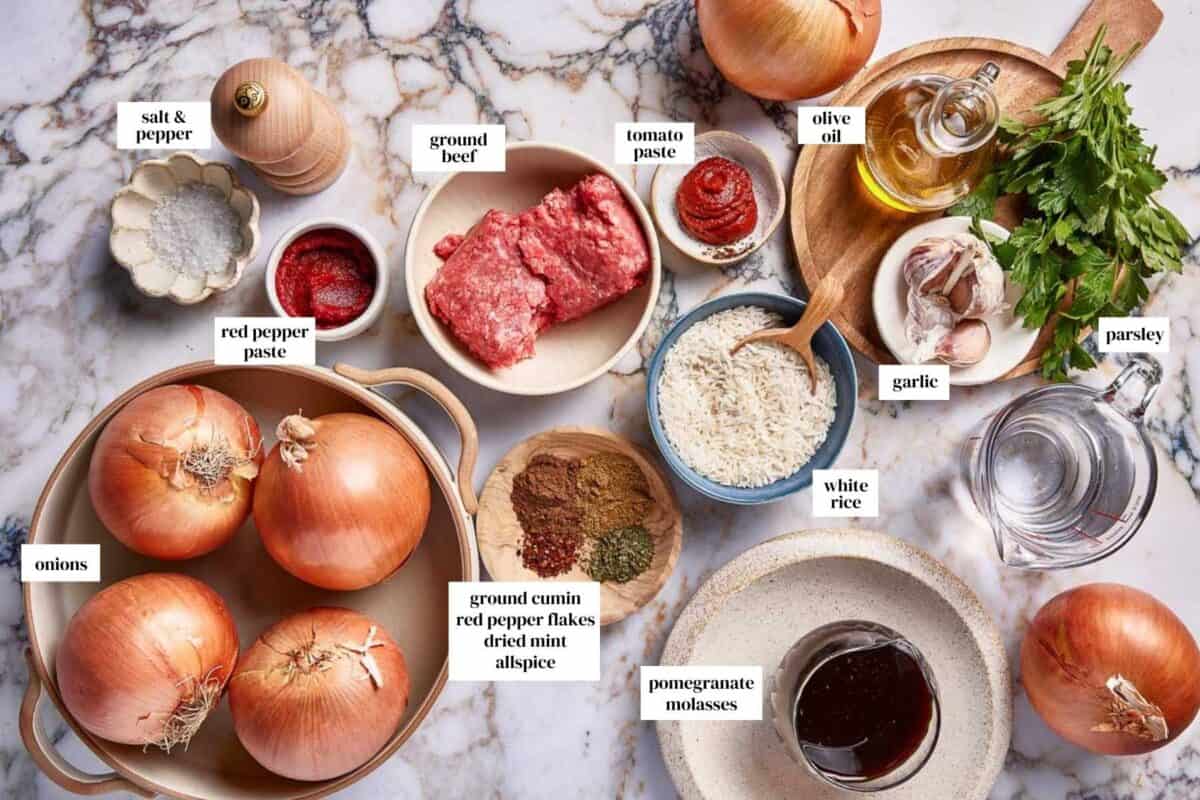
The exact measurements are in the recipe card below, but these are the notes I kept from all that testing:
Onions: Look for onions that are firm, fresh, and heavy for their size. Yellow onions work beautifully because they naturally become sweeter as they cook, but Vidalia onions and Walla Walla onions will also work if you want an even milder flavor. Red onions are also an option, but stuffed red onions are slightly sweeter than yellow onions.
Pro tip: In the recipe card, you’ll see four medium onions. If you’re making this for the first time, go ahead and buy one extra just in case. Depending on the size, four to five onions usually give me about 20 to 22 usable layers, which is right around what you’ll need for this stuffed onion recipe.
Ground beef: Fat equals flavor, so I like using 85/15 ground beef because it stays juicy and tender. If you prefer something richer, use 80/20 ground beef.
You can also use lamb if you like, or half lamb and half beef, which is pretty traditional. If you are looking for a lighter alternative, though not traditional, ground chicken would also work, but be aware that it would have a slightly different flavor profile.
White rice: I’m using long-grain white rice here, the everyday enriched kind that you can find in most grocery stores.
My mom always rinsed the rice under cold water until it ran clear, so I do that too, but I know some people prefer not to wash their rice, and that’s perfectly fine.
Some people soak their rice before using it, which helps it cook a little faster, but since we are using a rather small amount, I do not think that it is necessary.
Alternatively, medium bulgur wheat can be a good substitute for rice. It would have a distinct earthy flavor profile, but it would still be delicious.
Pomegranate molasses: Can you make it without it? You surely can. But, should you? Absolutely not, because pomegranate molasses takes these stuffed onions to another level, giving them the signature slightly sweet-and-sour taste. So, do not skip it.
Pro Tip: When shopping for it, look for a brand that uses 100% pomegranate juice and no added sugars. If you can’t find it in your local grocery stores’ Middle Eastern section, look for it online. My favorite one is this Pomegranate Molasses.
Red pepper paste: This is known as biber salçası in Turkish cooking. You can find mild or hot versions, and both work here. If you can’t find it, you can use an equal amount of tomato paste as a substitute, and it will still be delicious.
Most Middle Eastern supermarkets carry it, but if you can’t find it there, you can buy it online. I like Oncu Turkish Mild Pepper Paste, which has great depth without being overly spicy.
Spices: This part of the recipe is the most flexible, and you can get as creative as you want. I use ground cumin, dried mint, black pepper, and red pepper flakes for a little heat.
If you can’t get your hands on dried mint, you can omit using it or use a tablespoon of chopped fresh mint instead.
How to Make Stuffed Onions
If this is your first time making stuffed onions with meat, and it looks like a lot of work, let me assure you, it is not. Once you start stuffing and rolling your first couple of onions, you’ll see quickly that the whole process is actually quite simple.
Below, I am sharing every step of the process with the little things I learned from my mom and from making this Mediterranean dish over the years for my own family:
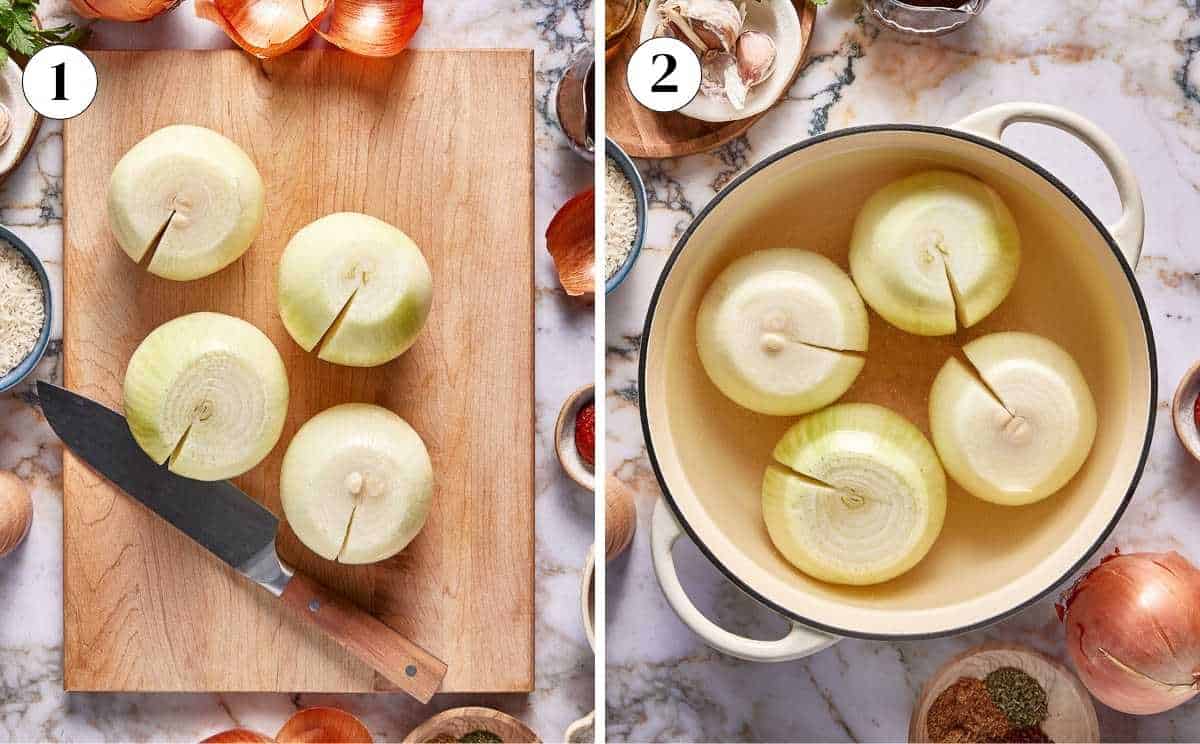
Step 1 – Prep the onions: If there’s one part to pay a little extra attention to, it’s this step. We’re trying to separate the layers in one piece as much as we can. Even if a few tear, don’t worry, they still work just fine once they’re stuffed.
Start by cutting off both ends of each onion, peeling the outer skin, and making a single straight cut down to the center without slicing all the way through. Doing this helps the layers loosen easily after boiling. Use a sharp knife here to make it easier on yourself.
Step 2 – Boil the onions: Add the onions to a large pot of water, bring it to a boil, and let it simmer for about 15 minutes. You don’t want them overly soft, just soft enough that they don’t rip when you start separating the layers later.
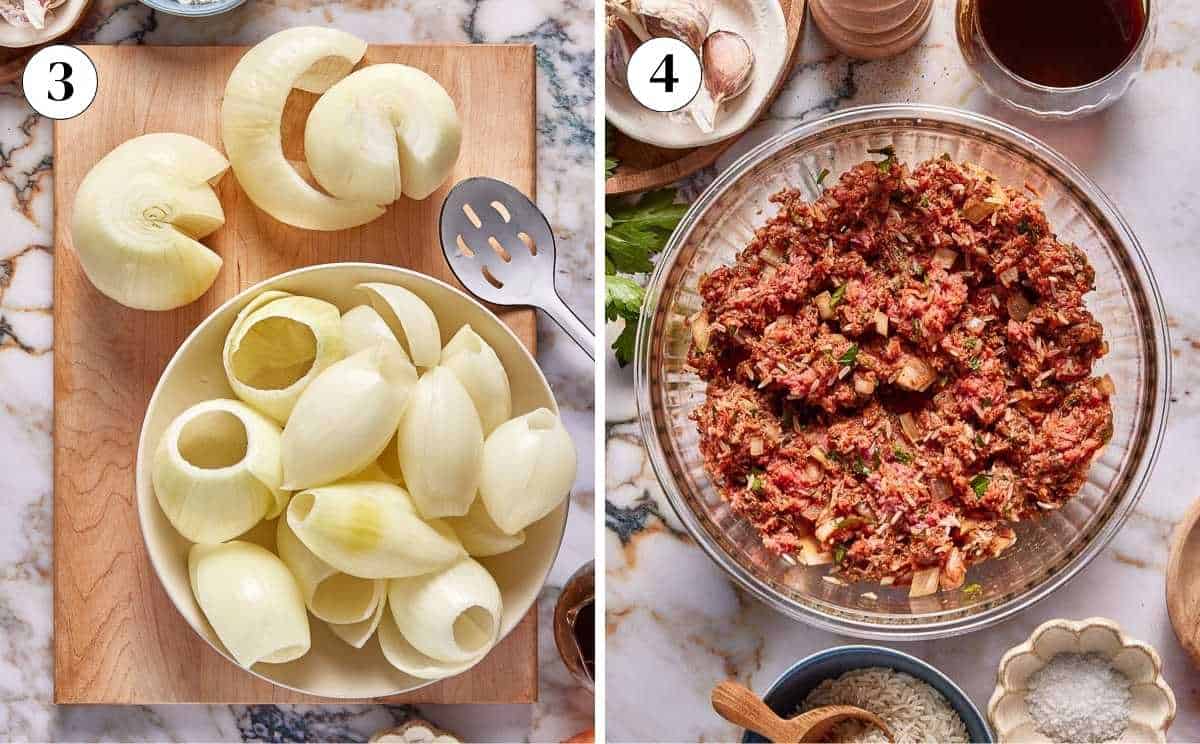
Step 3 – Let them cool and separate the layers: Spread the onions out on a plate and let them cool on the counter.
Pro Tip: It takes a while to cool down, especially the inner layers. If you are short on time, you can place them in a colander and run them under cold tap water to speed up cooling. However, it is imperative that you let them drain properly before you start stuffing and rolling them.
When cool enough to handle, carefully remove each layer of the onion, being gentle to avoid tearing it. You should have about 20-22 onion layers in the end.
As you peel off each layer, you’ll notice a thin membrane. If you have the time, remove it; it helps the onions cook more evenly and prevents any chewiness. But if you’re in a pinch, you can skip this step. I’ve made this dish plenty of times, leaving the membrane on, and it still turns out great.
As you get closer to the middle, you’ll end up with the onion cores. Don’t throw them out. We’ll use them in the filling, so put them in a large bowl.
Step 4 – Mix the filling: Preheat the oven to 400°F (204°C), and while it heats, make the filling. Add the ground beef, rice, red pepper paste, tomato paste, all of the spices and seasoning, pomegranate molasses, and parsley to the bowl with the chopped onion cores.
Using clean hands, give it a good mix so that everything is evenly combined. You’re looking for a mixture that feels slightly sticky and moist but holds together when you press it between your fingers.
Step 5 – Roll each layer into a little stuffed onion (aka dolma): Place about 1 ½ tablespoons of filling inside each layer and roll it tightly.
Pro Tip: As you stuff and roll, you’ll see that the very outermost layers of the onion are longer than the inner layers. I find that stuffed onions made with these longer layers are a bit chewy, so I cut them in half. This way, all layers are roughly the same size, and every stuffed onion tastes the same after everything is baked.
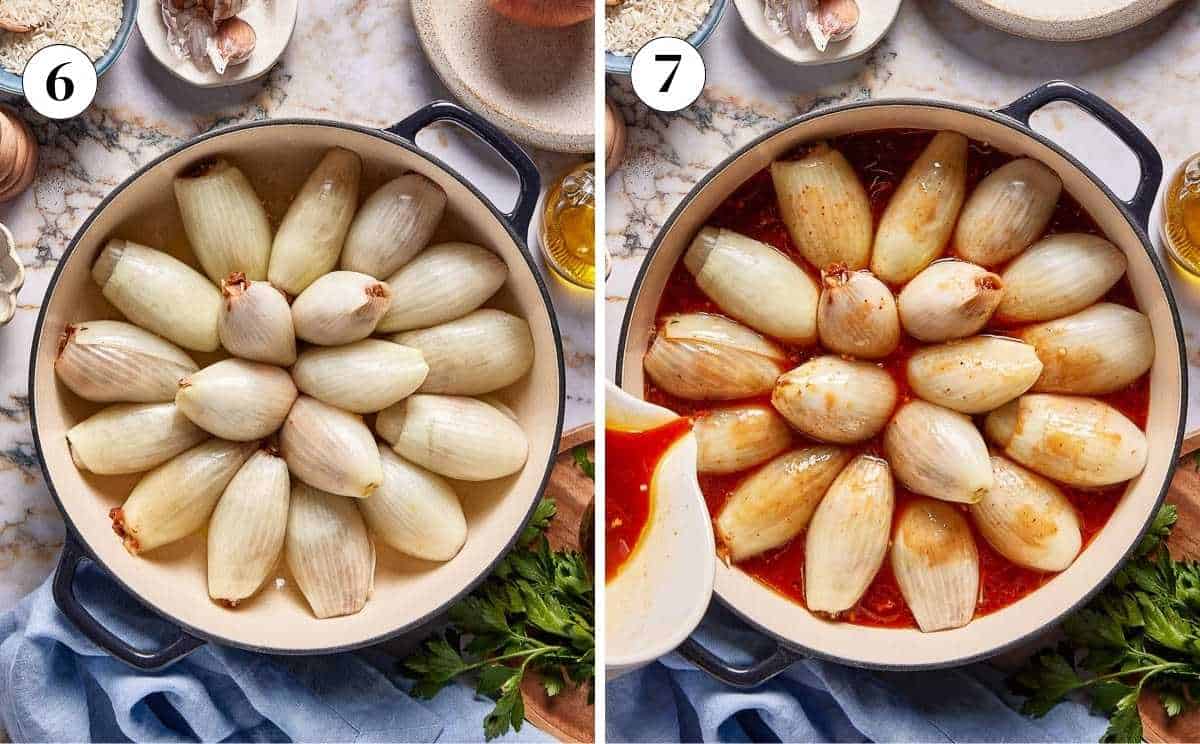
Step 6 – Arrange them in the pan: I am using a 3 ½-quart cast iron skillet, but a large casserole dish would also work well.
Place the stuffed onions in a spiral, starting from the outer edge, tucking each one right up against the next.
You want them close enough to support each other without squeezing them too tightly. In my 12-inch pan, depending on the size of my onions, I can usually fit 18-22 stuffed onions in one spiral layer.
Step 7 – Make the sauce: In a measuring cup, combine olive oil, pomegranate molasses, tomato paste, red pepper paste, garlic, salt, and boiling water. Whisk until everything dissolves.
Pour the sauce right over the onions. You can cover the pan with foil or a large sheet of parchment paper.
Pro Tip: During my recipe testing, I kept thinking the sauce looked like too much. It isn’t. You need that liquid to help the onions and filling cook slowly and evenly, and most of it evaporates in the oven, leaving just the right amount behind.
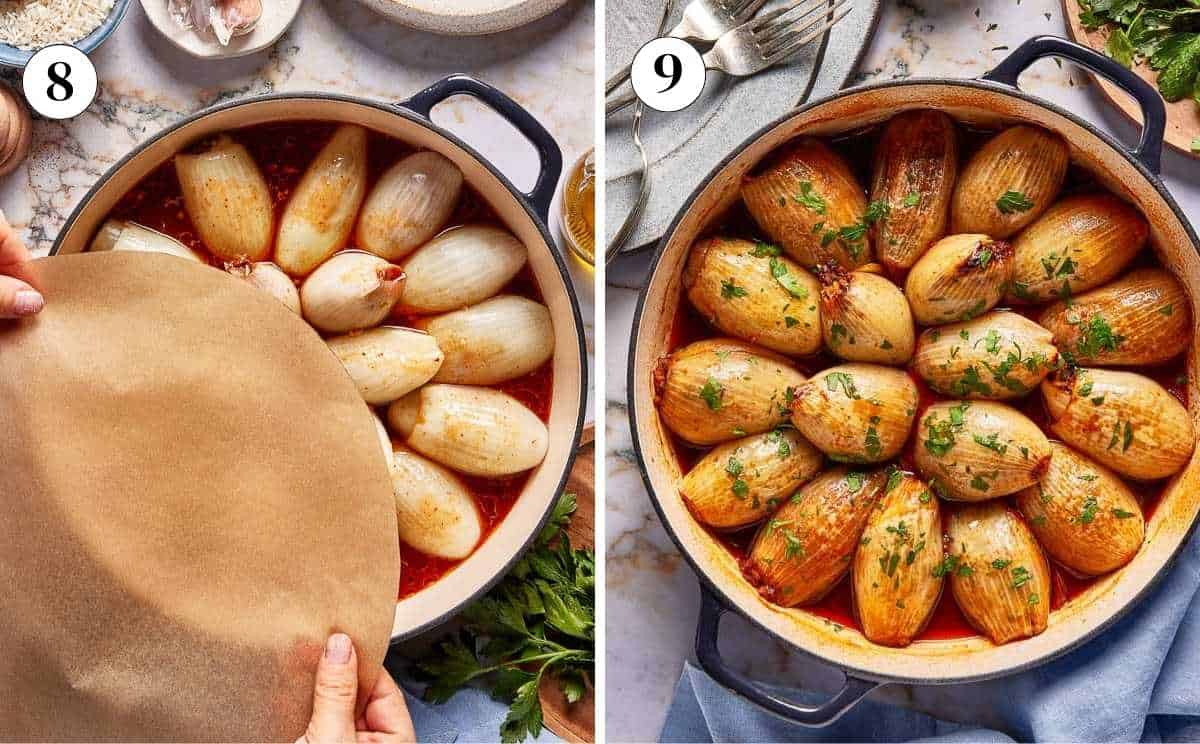
Step 8 – Bake: Place the onions in the oven, covered, for about 30 minutes to soften all the way through. Then uncover the dish and let them brown and caramelize around the edges for another 20 minutes or so.
You’ll see that the remaining liquid will be thicker and reduced almost in half.
Step 9 – Finish with fresh parsley and serve: I love adding a handful of parsley at the end to brighten the entire dish. Serve your baked stuffed onions warm, with extra sauce spooned over the top.
Expert Tips From My Mediterranean Kitchen
Stuffed roasted onions look fancy, but once you understand a few small techniques, the whole process becomes much easier (and more enjoyable).
Here are a few lessons I learned during my recipe testing, along with a few things I learned watching my mom make these when I was growing up in Türkiye.
Don’t over-boil the onions: Keep a close eye on them once they start boiling. Let them simmer just until they become soft enough to bend, usually around 15 minutes. If you cook them too long, the layers become mushy and tear easily when you try to separate them.
Cool the onions before handling: Letting the onions cool takes some time. If you are in a pinch, you can run them under cold water to speed things up. However, it is imperative that you drain them properly before stuffing.
It is okay to cut long onion layers: The outer layers of the onion are sometimes too long for rolling. If they are, simply slice them in half. Too much onion wrapping around the filling can become chewy after baking.
You do not need extra oil: Some versions of this recipe online (especially on social media) add additional (between ¼ cup to ½ cup) olive oil to the filling. I tested this recipe both ways and did not think it was necessary, especially if you are using 85/15 ground meat.
That said, if you’re using leaner meat, feel free to add ¼ cup olive oil to keep the filling tender and moist.
Use boiling or hot tap water for the sauce: When making the sauce, it is hard to dissolve everything with cold (or even room temperature) water, so I recommend using hot water to make it easier on yourself.
Use parchment paper or foil to cover: Most Turkish cooks use parchment paper to cover the dish. You need to cut it so it covers the entire surface and stays put. However, aluminum foil can also be used.
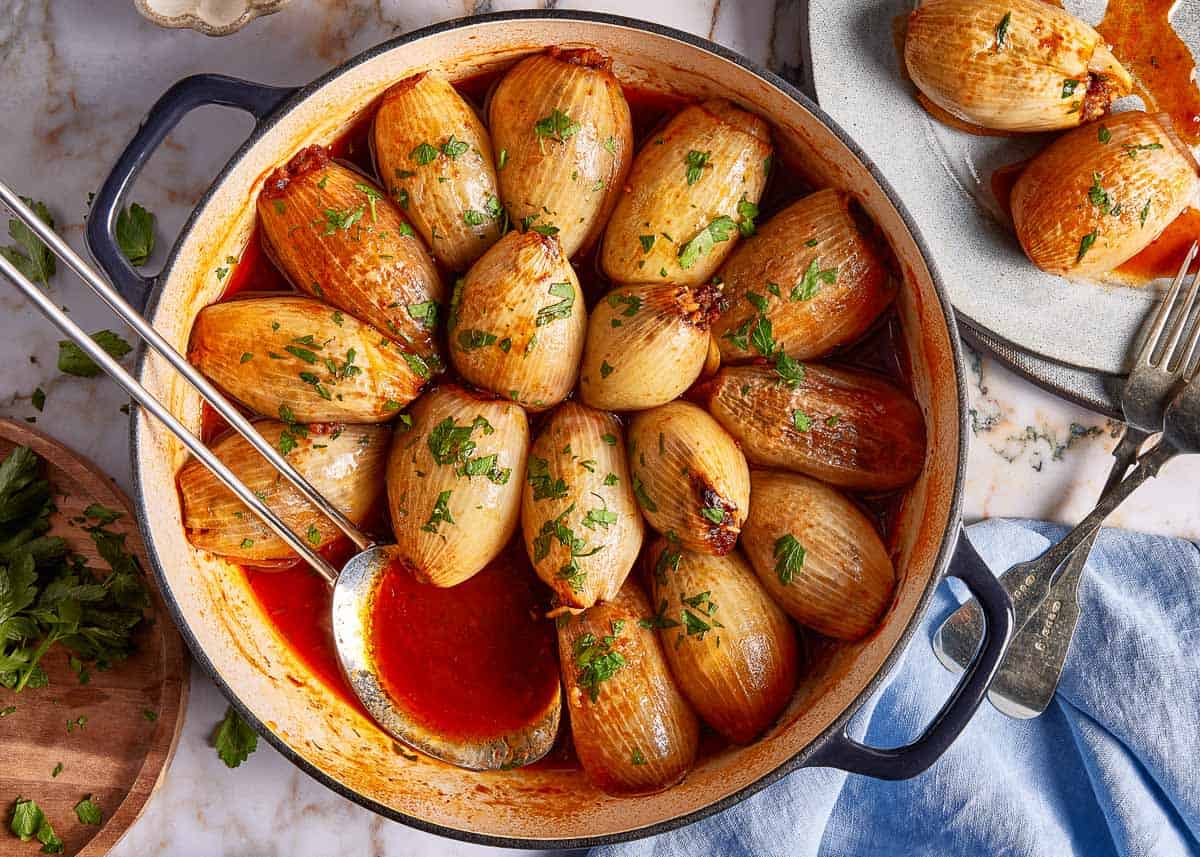
Stuffed Onions Recipe
Equipment
Ingredients
For The Onions
- 4 large onions, ~ 2 ½ lbs
- Salt
For The Filling
- ½ lbs ground beef, 85-15
- ½ cup white rice, rinsed under hot tap water
- ¼ cup pomegranate molasses
- 2 tablespoons red pepper paste, Use tomato paste if you can't find it
- 2 tablespoons tomato paste
- 1 ½ teaspoons kosher salt
- ½ teaspoon black pepper
- 1 teaspoon ground cumin
- 1 teaspoon allspice
- ½ teaspoon dried mint, optional
- ¼ teaspoon red pepper flakes, Urfa or Aleppo pepper, optional
- 1 cup chopped fresh parsley, plus more for garnish
For The Sauce
- ¼ cup olive oil
- ¼ cup pomegranate molasses
- 2 tablespoons red pepper paste, Use tomato paste if you can't find it
- 2 tablespoons tomato paste
- 2 cloves garlic, minced
- ½ teaspoon kosher salt
- 1 ½ cups boiling water, or hot tap water
Instructions
- Cut both ends of the onion and peel them one by one. Slice halfway through to the center without cutting all the way.
- Fill a medium-sized saucepan with water and add the onions over medium heat. Bring to a boil and simmer for 15 minutes. The leaves will soften, and separate a bit.
- Using a slotted spoon, carefully remove the onions from the boiling water and transfer them to a plate, and let them cool.
- When cool enough to handle, carefully remove each layer of the onion, being gentle to avoid tearing it, and discard the thin membrane as needed. As you get closer to the middle, you’ll end up with the cores of the onions. Set them aside; we’ll use them in the filling.
- You should have about 20-22 layers of onions in the end. Set them aside.
- Meanwhile, preheat the oven to 400 degrees F.
- While the oven is heating, make the filling. Into a mixing bowl, place ground beef, white rice, pomegranate molasses, red pepper paste, tomato paste, kosher salt, black pepper, ground cumin, allspice, dried mint, red pepper flakes, and chopped fresh parsley.
- Chop the reserved onion cores and add them to the bowl. Give it a good mix to ensure everything is fully incorporated.
- When it is time to stuff, fill each layer of the onion with a tablespoon of the meat filling, then roll tightly. Repeat this process for the remaining onion layers, then arrange them in a spiral pattern in a large skillet or casserole dish.
- To make the sauce, whisk together olive oil, pomegranate molasses, red pepper paste, tomato paste, garlic, salt, and boiling water in a measuring cup until combined.
- Carefully pour the sauce over the stuffed onions. You can cover it with foil or a large sheet of parchment paper.
- Bake in the oven for 30 minutes, then remove the parchment paper and continue baking for an additional 20 minutes, or until onions turn golden brown.
- Garnish with chopped parsley and serve immediately.
Video
Notes
- Yields: This recipe makes 18-22 stuffed onions, which is ideal for serving 4 adults, with each adult eating 4-5 stuffed onions. The nutritional values below are per serving.
- Make Ahead: Prep the onions and the filling. Stuff and roll the onions and arrange them in a casserole or skillet. Cover tightly and keep in the fridge for up to 24 hours. When ready to cook, make the sauce and bake as directed.
- Storage: Bring the leftovers to room temperature, place in an airtight container, and store in the fridge for up to 3-4 days.
Nutrition
Nutrition information is automatically calculated, so should only be used as an approximation.
What to Serve With Stuffed Onions
So you’ve made your beautiful stuffed baked onions. They’re tender, aromatic, and perfectly seasoned. But what should you serve alongside them to turn this into a complete meal?
Below are a few traditional and Mediterranean-inspired pairings to help you serve them the way they’re enjoyed across Türkiye:
Pair them with a cool yogurt sauce: A creamy yogurt sauce is one of the most classic pairings to dolma-style dishes. My Yogurt Dill Sauce adds a bright, herby note with lemon and fresh dill, while my Tzatziki Sauce Recipe is a classic pairing with thick Greek yogurt, cucumber, and garlic.
Add a refreshing salad: A crisp salad never disappoints. Turkish Shepherd Salad is a traditional go-to with juicy tomatoes, cucumbers, and herbs, especially in the summer months. If you want something a bit more herby, Tabbouleh is another option with lots of fresh herbs.
Serve with rice or pilaf: To make this a little more filling, pair your stuffed onions with a starchy side dish. If you want a Turkish side, my Bulgur Pilaf is a classic, or try my Vermicelli Rice, another staple you’ll often see served alongside dishes like this in many Mediterranean restaurants. And if you want a gluten-free option, Lemon Quinoa brings a fresh, zesty note without overpowering the main dish.
How to Make Ahead, Store & Reheat
One of the things I love most about this stuffed onion recipe is that you can make it ahead, and it tastes better the next day. The flavors magically deepen as they sit, which makes it an ideal recipe for make-ahead dinners, holiday prep, or easy leftovers.
Here’s how I do it:
Make Ahead: You have two make-ahead options:
- You can prepare, stuff, and roll all the onions, arrange them in your pan, and refrigerate them unbaked, without the sauce, for up to 24 hours. When you’re ready to cook, simply mix the tomato sauce, pour it over the onions, and bake as directed.
- Alternatively, you can bake them completely a day ahead. Let them cool, cover tightly, and refrigerate. Just pop them in the oven to warm thoroughly, sprinkle with fresh herbs, and serve!
Storage: Once baked, let the stuffed onions cool completely before storing. Transfer them to an airtight container and refrigerate for up to 4 days.
Reheat: Reheat the stuffed onions in a 350°F (177°C) oven, loosely covered with parchment or foil, for 10-15 minutes, or just until warmed through. You can also microwave them if needed, but the oven keeps the texture softer and more consistent.
Freezing: Stuffed onions freeze very well. Once completely cooled, place them in an airtight container and freeze for up to 2 months. For the best texture, thaw them overnight in the refrigerator, then reheat.
FAQs
Yes, you can make a vegetarian version. Simply increase the rice to 2 cups and add 3 tablespoons of extra-virgin olive oil to the filling. It is not traditional, but some cooked lentils or mushrooms can be added to the mixture to make it even more satisfying.
This usually happens when the onions are overcooked. Boil them just until they’re soft enough to bend, but not mushy. Using firm, fresh onions also helps because the layers are sturdier.
Yes. To do so, stuff the onions, arrange them in the baking dish, cover tightly, and refrigerate for up to 24 hours. When you’re ready to serve, simply add the sauce and bake.
Technically, yes, but it takes much longer to cook and stays much firmer inside the onions. For best results, stick with white rice (long-, medium-, or short-grain). If using brown rice, soak it for at least 1 hour to soften it before adding it to the filling mixture.
Yes. Red, white, or yellow onions will all work for this recipe. Just make sure the onions you choose are fresh, firm, and not soft, so the layers hold up well when boiling and rolling.
While the concept is pretty similar, the Greek version of this recipe does not use pomegranate molasses. It is also often made with ground pork, but, similar to my recipe here, ground beef and ground lamb can be good substitutes for pork.
Other Mediterranean Recipes You’ll Love
If these meat-stuffed onions made you curious to try more, I invite you to check out a few of my favorite recipes from the Mediterranean and Middle Eastern regions below:
- If make-ahead meat dishes are your favorite, try my Greek Lamb Meatballs for an easy dinner or a quick appetizer.
- You’ve probably seen the Doner Kebab recipe going viral on social media. It takes the century-old classic recipe and turns it into a weeknight dinner with a clever shortcut.
Photos by Tanya Pilgrim.
This post may contain affiliate links. If you purchase through these links, I may earn a small commission, at no additional cost to you.










So delicious!
I am happy to hear that you liked it Maddy. Thanks for coming by.