
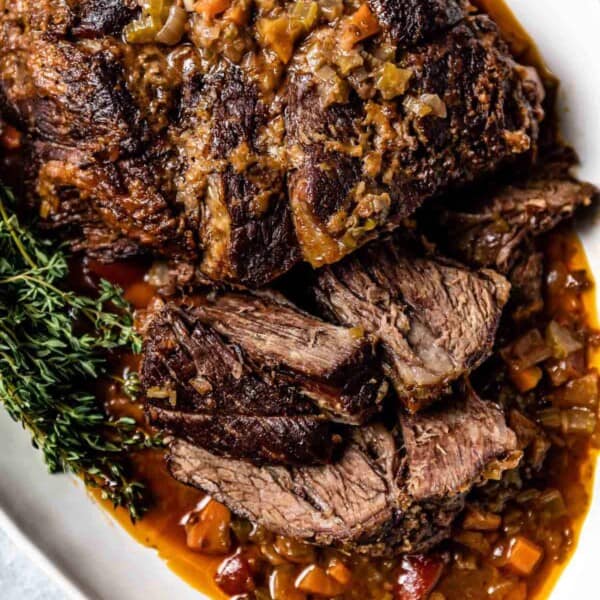
Why This Recipe Works

Like many people of my generation, I’ve been a fan of Ina Garten for years. Her cookbooks are the ones I reach for most, especially when I want a dish that feels generous and dependable.
This pot roast is a recipe I first made in 2008, when Back to Basics came out. In the recipe intro, she explains that she calls it “Company Pot Roast” because it is a great dish to serve a crowd. And I cannot agree more with that statement.
Since then, this recipe has been my go-to whenever I need a main dish that can feed a group, especially for special occasion dinners like Christmas, New Year’s, or Easter. It’s the kind of centerpiece you can bring to the table and know it will carry the whole meal.
Over the years, after making it more times than I can count, I started noticing a few things that aren’t fully explained in the book but made a big difference, especially if you’re new to cooking a large piece of meat like a chuck roast.
That’s why I wanted to share it on the blog so that I can walk through the process step by step (with photos and a short video) and share a few lessons I’ve learned along the way. Because I know from experience that a big chuck roast can feel intimidating if you don’t cook roasts often.
Here’s why I keep coming back to this recipe:
- The steps are simple and easy to follow, even if you’ve never cooked a roast before.
- The meat turns very tender as it cooks slowly in the oven.
- The vegetables soften and naturally help thicken the sauce.
- It tastes even better the next day, which makes it ideal for making ahead.
Ingredients You’ll Need
Ina Garten’s pot roast recipe uses simple ingredients you can easily find at most grocery stores. From a well-marbled beef chuck roast to everyday vegetables and fresh herbs, everything comes together to create a classic pot roast you can rely on.
You can find the full list of ingredients in the recipe card below, but here are a few helpful notes from my recipe testing:
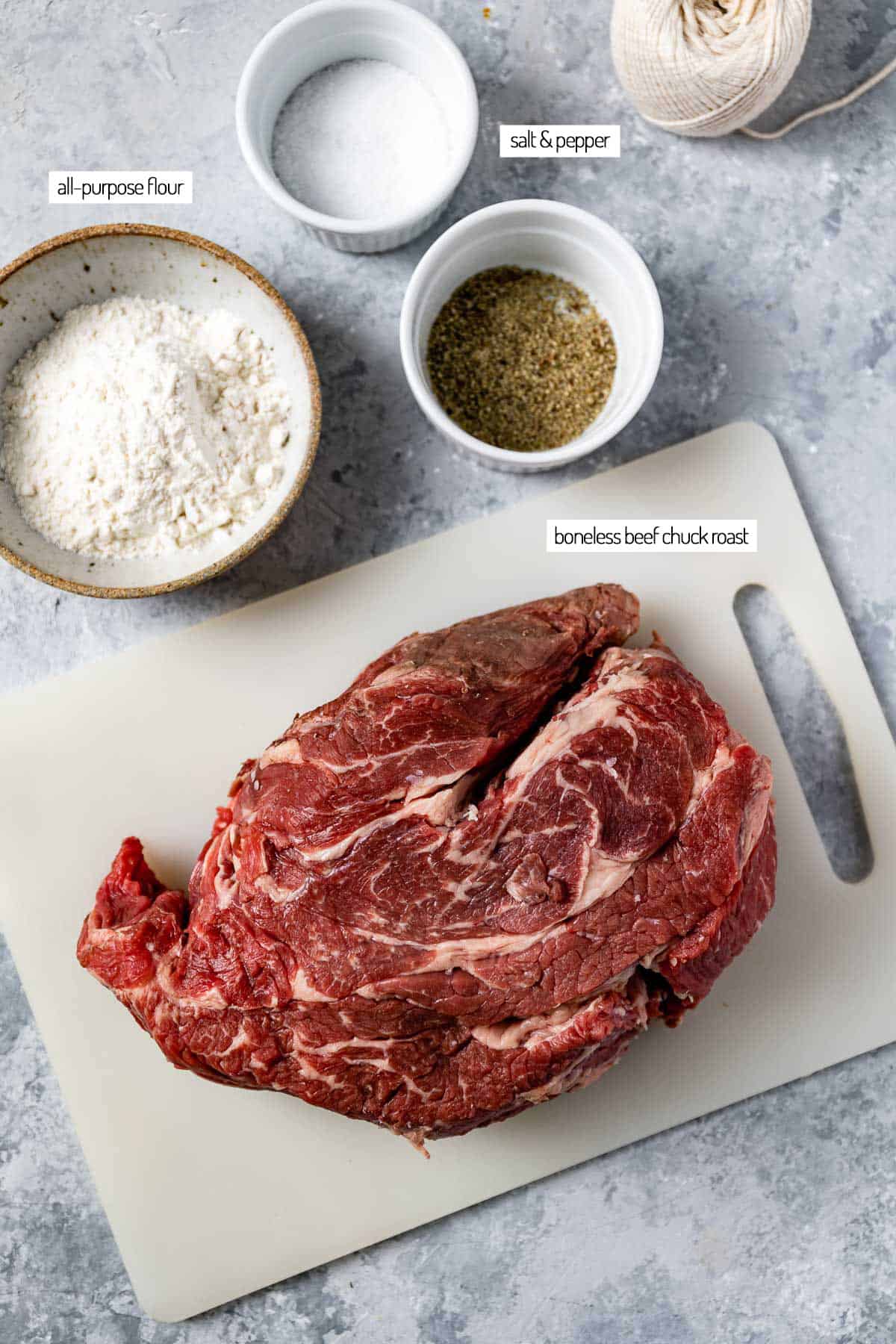
Boneless beef chuck roast: Ina Garten uses a boneless beef chuck roast in her original recipe, and it’s the cut I recommend for the closest results. Chuck has enough marbling to stay tender during the long, slow cooking time.
That said, I’ve also tested this recipe with other cuts, such as eye round (sometimes labeled London broil), bottom round (rump roast), and brisket, and they work as well, but you may have to adjust the cooking time based on the cut you use.
No matter which cut you use, tying the meat with kitchen twine helps it keep its shape as it cooks.
All-purpose flour: I used regular unbleached all-purpose flour, but if you’d like to make this recipe gluten-free, you can use a 1:1 gluten-free all-purpose flour.
Olive oil: I recommend using extra-virgin olive oil for its rich flavor, but other neutral oils with a higher smoke point, such as avocado oil or ghee (clarified butter), would also work.
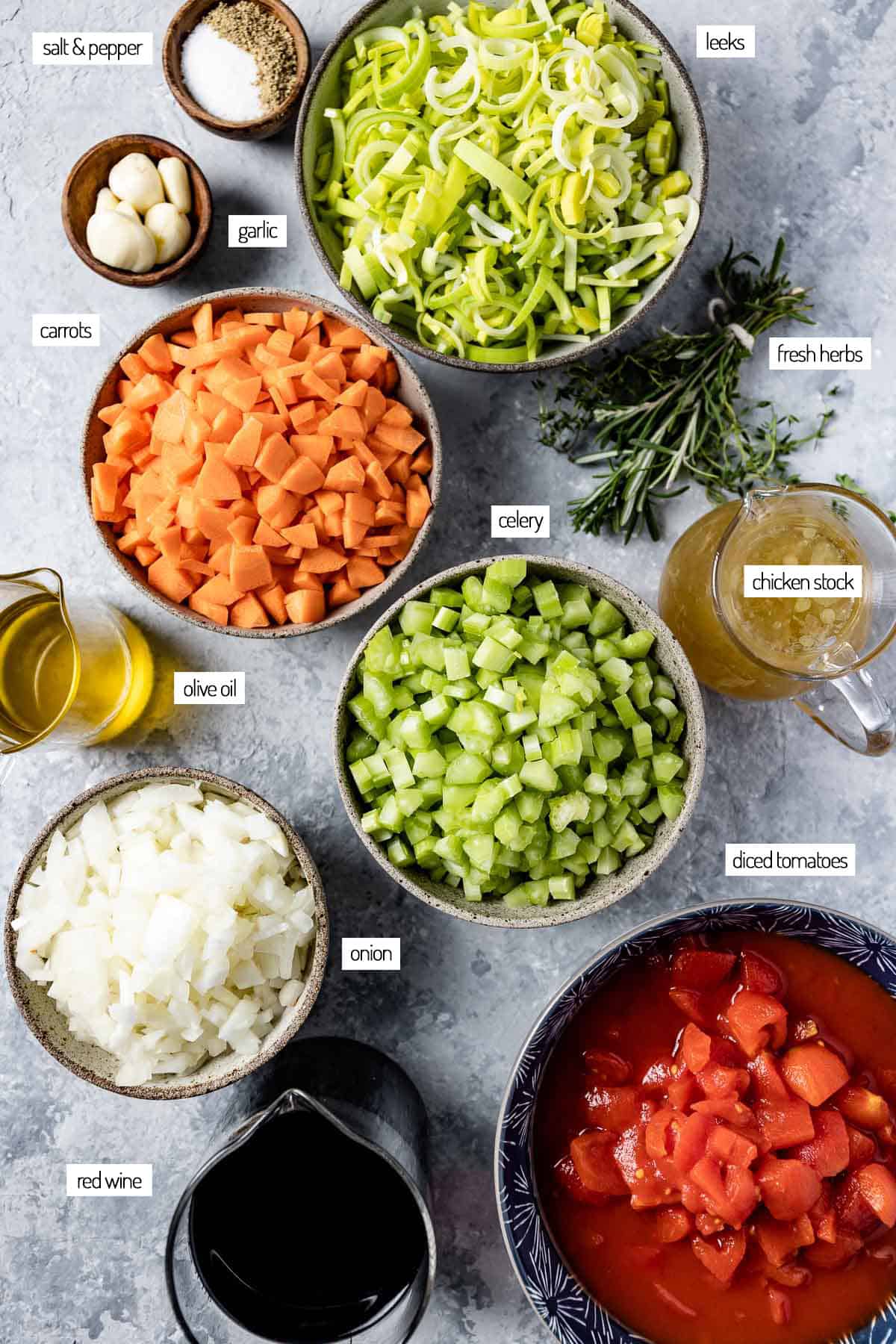
Vegetables: This recipe uses a variety of aromatic veggies, including carrots, yellow onions, celery, leeks, and garlic cloves. If you can’t get your hands on leeks, you can simply use one extra yellow onion instead.
Wine and (optional) cognac: Ina suggests we use a good-quality red wine, one good enough to drink. She uses Burgundy in her original pot roast recipe, but other reds, like Chianti or Cabernet Sauvignon, would also work.
You may also add two tablespoons of cognac or brandy to this recipe, though this is optional.
No alcohol option: If you prefer to cook without alcohol, you can substitute the red wine with an equal amount of chicken stock and a tablespoon of balsamic vinegar to mimic the wine’s acidity.
Chicken stock: You will also need one cup of chicken stock, which you can buy from the store (buy low-sodium so you can adjust the salt in the recipe). However, as a lifelong Ina fan, I always make a batch of her Chicken Stock Recipe and stash it in my freezer. If you have the time, I highly recommend using homemade stock.
Alternatively, beef broth can also be used.
Canned tomatoes: The original recipe calls for whole plum tomatoes, but I use diced tomatoes in my version because it is quicker (no need to have to break or cut them).
Chicken bouillon (optional): Ina uses chicken bouillon for an extra boost of richness and salt, but I ended up not using it because I’d like to have full control over the salt in my recipes.
Fresh herbs: Fresh thyme and rosemary perfectly balance the meaty overtones of this beef roast with light, earthy flavors. I like to tie them together with kitchen twine so I can remove them easily once everything is cooked.
Unsalted butter (optional): Ina thickens her pot roast with a mix of unsalted butter and flour. I chose to skip this step because my chuck roast already had enough fat. I did not want to make it excessively fatty. Plus, the sauce was perfectly thickened after I pureed most of the vegetables and added the mixture back into the pot.
Equipment You’ll Need and What You Can Use If You Don’t Have Them
Whenever I share a recipe on the blog, I do my best to feature recipes that anyone can make with basic everyday tools in their kitchens. And this beef pot roast recipe is no different.
However, since I am sharing an original Ina recipe, I wanted to take a moment to list the tools she uses along with some alternatives:
Dutch oven: Ina uses a 7.25 qt. Le Creuset Enameled Cast Iron Signature Round Dutch Oven. You could also use a more cost-effective version, such as this Enameled Cast Iron Dutch Oven.
If you don’t have a Dutch oven with a lid, you can sear the meat and saute the vegetables in a large skillet, then roast them in the oven in a large casserole dish. One with a lid is ideal, but otherwise you can use aluminum foil the cover it tightly.
Immersion blender: You will need an immersion blender to make a smooth and creamy sauce, which is key to this roast recipe.
If you don’t have an immersion blender, you can use a food processor or blender.
Kitchen twine: Twine is necessary to tie the beef and herb bouquet. Tying the meat will help maintain its shape while cooking and ensure it’s evenly roasted.
Kitchen Tongs: A pair of sturdy kitchen tongs is highly recommended for searing and transferring meat.
If you don’t have tongs, you can use two large forks with a spatula, but it would be more difficult.
How to Make Ina Garten’s Pot Roast Recipe (The Foolproof Oven Method)
If you watched Barefoot Contessa make this pot roast recipe on her TV show, you know there are quite a few steps and a bit of waiting while the dish cooks. However, none of the steps is hard. Simply follow my simple instructions and step-by-step photos to make the most tender pot roast of your life:
Step 1 – Preheat the oven to 325°F (165°C).
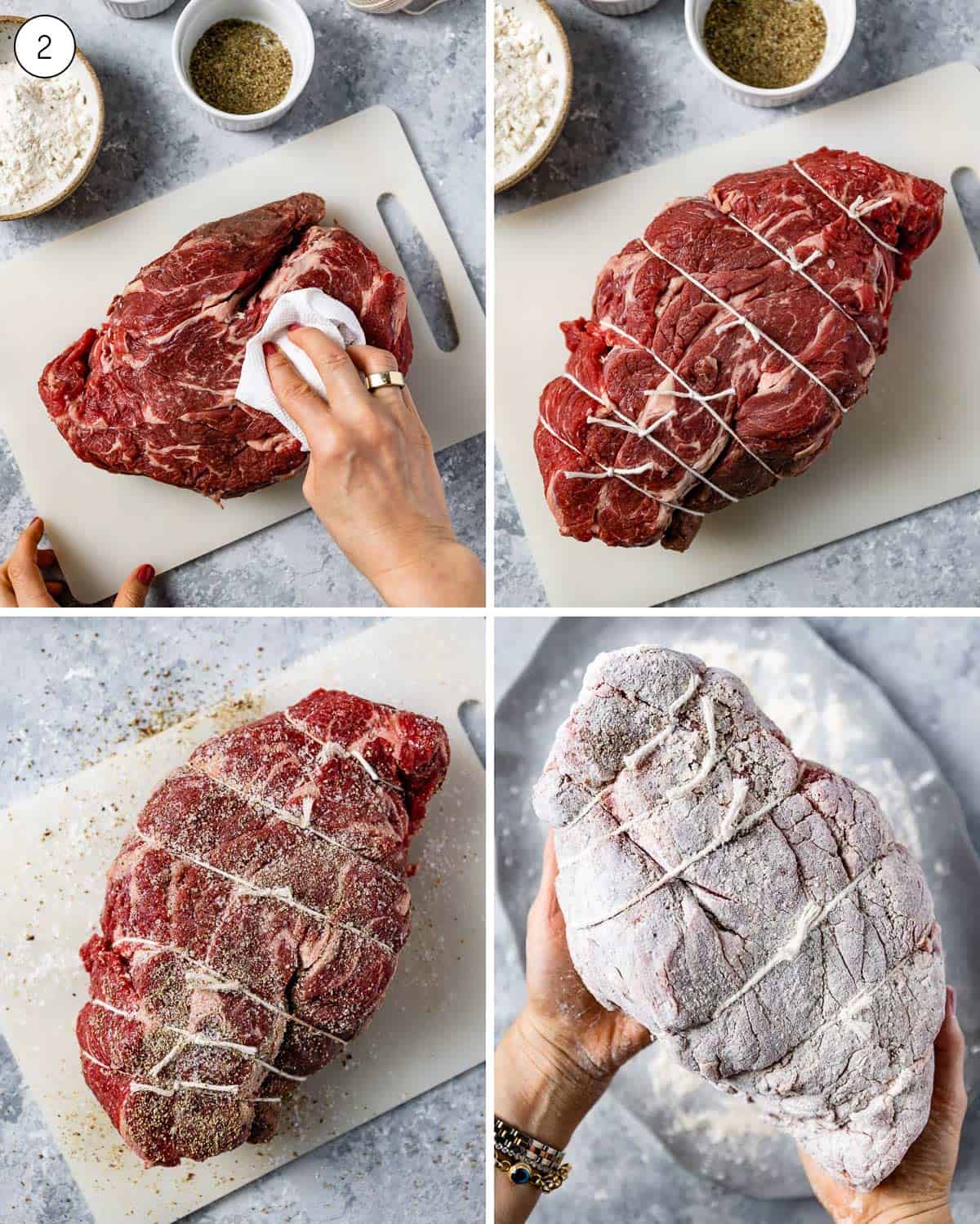
Step 2 – Prepare the meat: Next, pat your beef chuck roast dry on all sides with a sheet of paper towels. Do not skip this step; otherwise, it won’t sear well.
How To Tie a Chuck Roast? If this is your first time working with such a large piece of meat, you might think it’s hard, but it is actually very simple.
Depending on the size of your roast, you’ll probably need 5-6 pieces of twine just long enough to tie around the meat (Mine were about 20 inches).
Tie a piece of kitchen string around the center of the meat with a double knot. Move down about one inch and tie another one. Keep doing this until the whole roast is tied up on both sides.
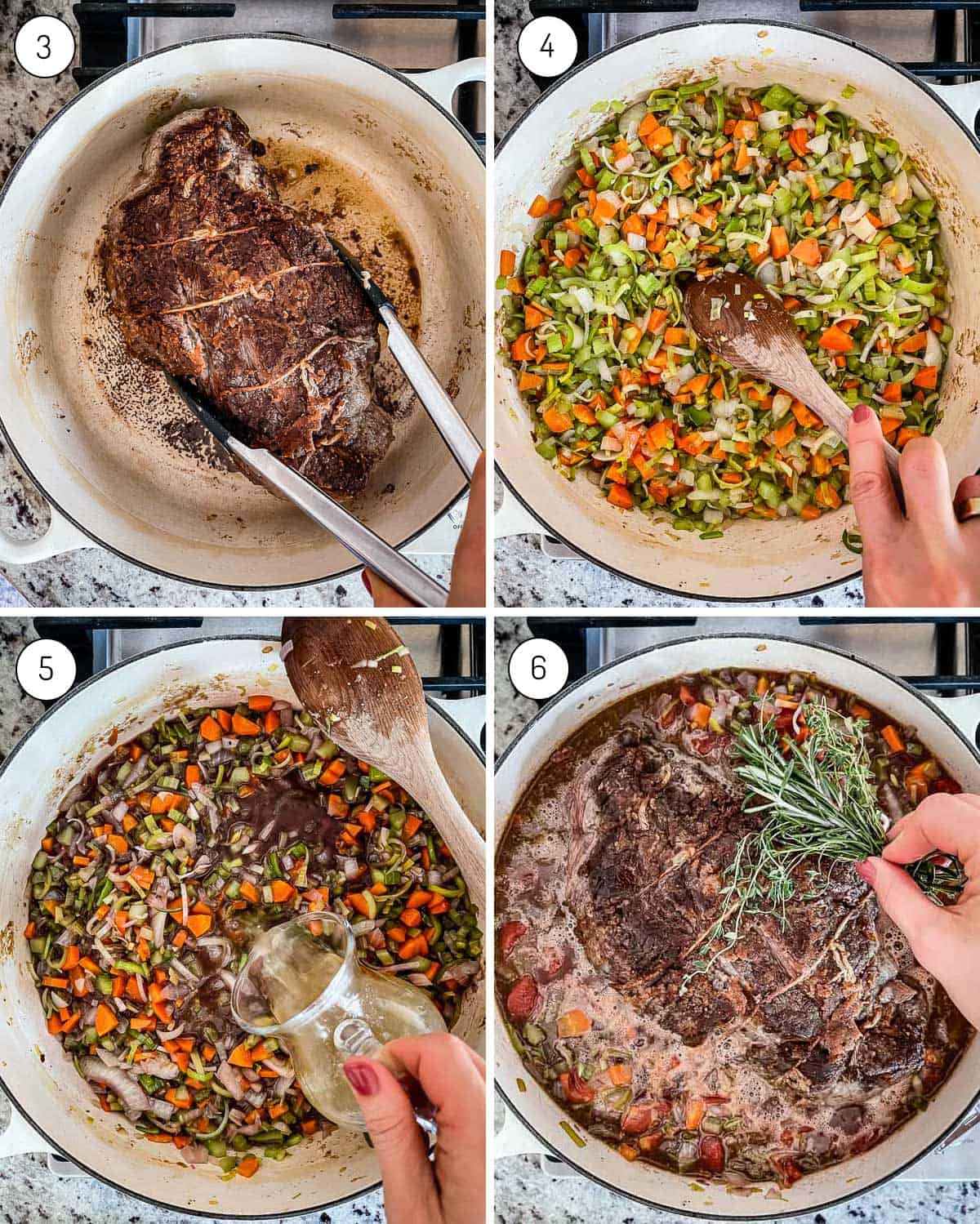
Step 3 – Sear the meat: Heat the oil over medium heat in a large Dutch oven. Once it’s hot, cook the beef for 4-5 minutes on each side.
Patience is key here: This process will take about 20 minutes, and you are going to have to turn and hold the meat using kitchen tongs so it browns evenly on all sides. Arguably, this is the most time-consuming part of the recipe, but it is equally important because it builds much of the final flavor.
Carefully, transfer the now-browned meat to a large plate, cover it with aluminum foil, and set it aside. Don’t wash the Dutch oven.
Step 4 – Cook the vegetables: Heat some olive oil in the same Dutch oven and add the chopped carrots, onions, celery, leeks, garlic, salt, and pepper.
Cook until the veggies soften for about 12-15 minutes, stirring often. No need to brown them as they will continue to cook in the oven.
Step 5 – Add liquids: Stir in the wine, brandy (if using), canned tomatoes, and chicken stock.
Step 6 – Add the beef roast: Carefully transfer the seared meat back to the Dutch oven. Next, make a herb bouquet by tying together fresh thyme and fresh rosemary, and add it to the pan.
Bring the mixture to a boil, then let it simmer for 12-15 minutes.
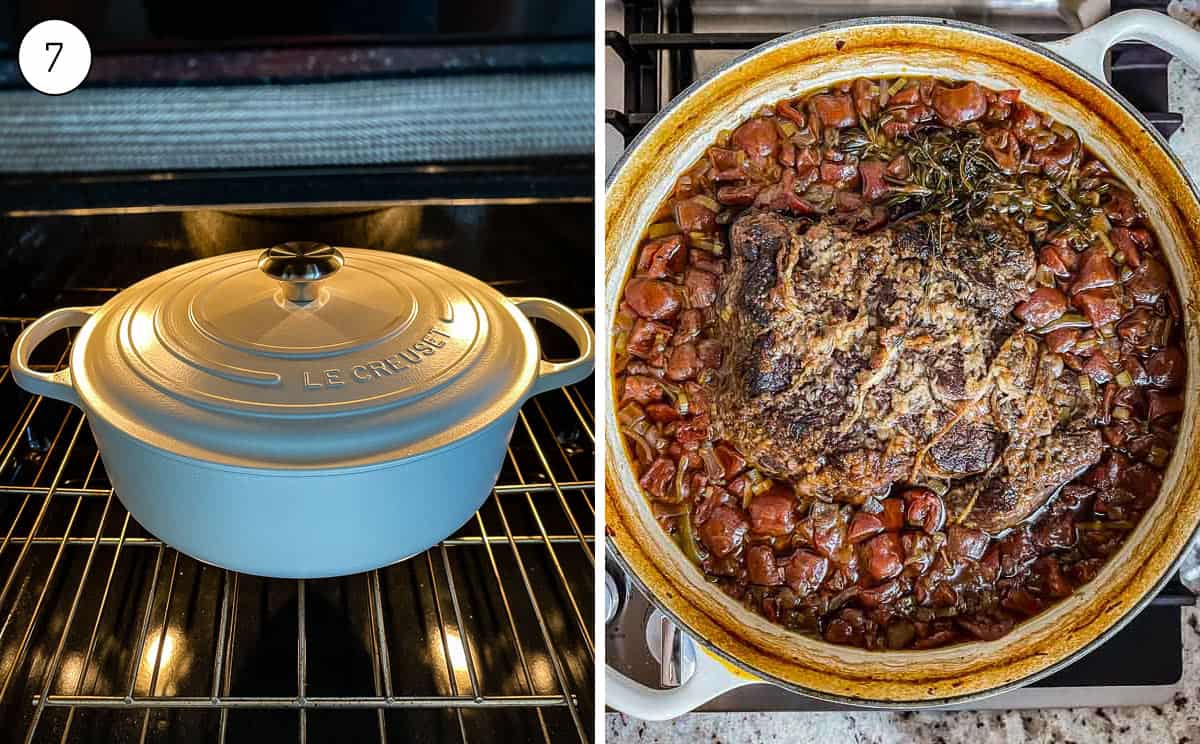
Step 7 – Cook the pot roast: Cover the Dutch oven, and place it in the preheated oven. Roast it for 2½ hours or until the meat registers 160°F (71°C).
Caution: During the first 2 ½ hours, do not open the lid, even to take a quick peek. You need to wait for the alcohol to cook (and evaporate) before removing the lid.
Turn the oven temperature down to 250°F (121°C) and let it continue to simmer at that low temperature for an hour.
Checking if your pot roast is done: Throughout the years of making this recipe, I learned that when it comes to checking doneness, it is best to rely on visual cues rather than just the thermometer.
Perfectly cooked pot roast should be “fork tender”, which means the meat should fall apart easily. To check it safely:
- Pull out the rack: Carefully slide the oven rack out just a little bit so you can reach the pot easily.
- Do the fork test: Take two forks and gently poke the meat. Try to pull a small piece away.
- If it is done, it should slide in like butter, and the meat will fall apart easily.
- If it feels firm or tough, it means it needs more time in the oven (no more than 30 minutes to an hour).
Using a thermometer: If you feel more comfortable using a thermometer as a guideline, look for 195-205°F (90-96°C). At this point, the tough parts of the meat should have melted and softened.
Step 8 – Let it rest: Carefully remove the Dutch oven from the oven, open the lid, transfer the pot roast to a cutting board, and loosely cover it with aluminum foil.
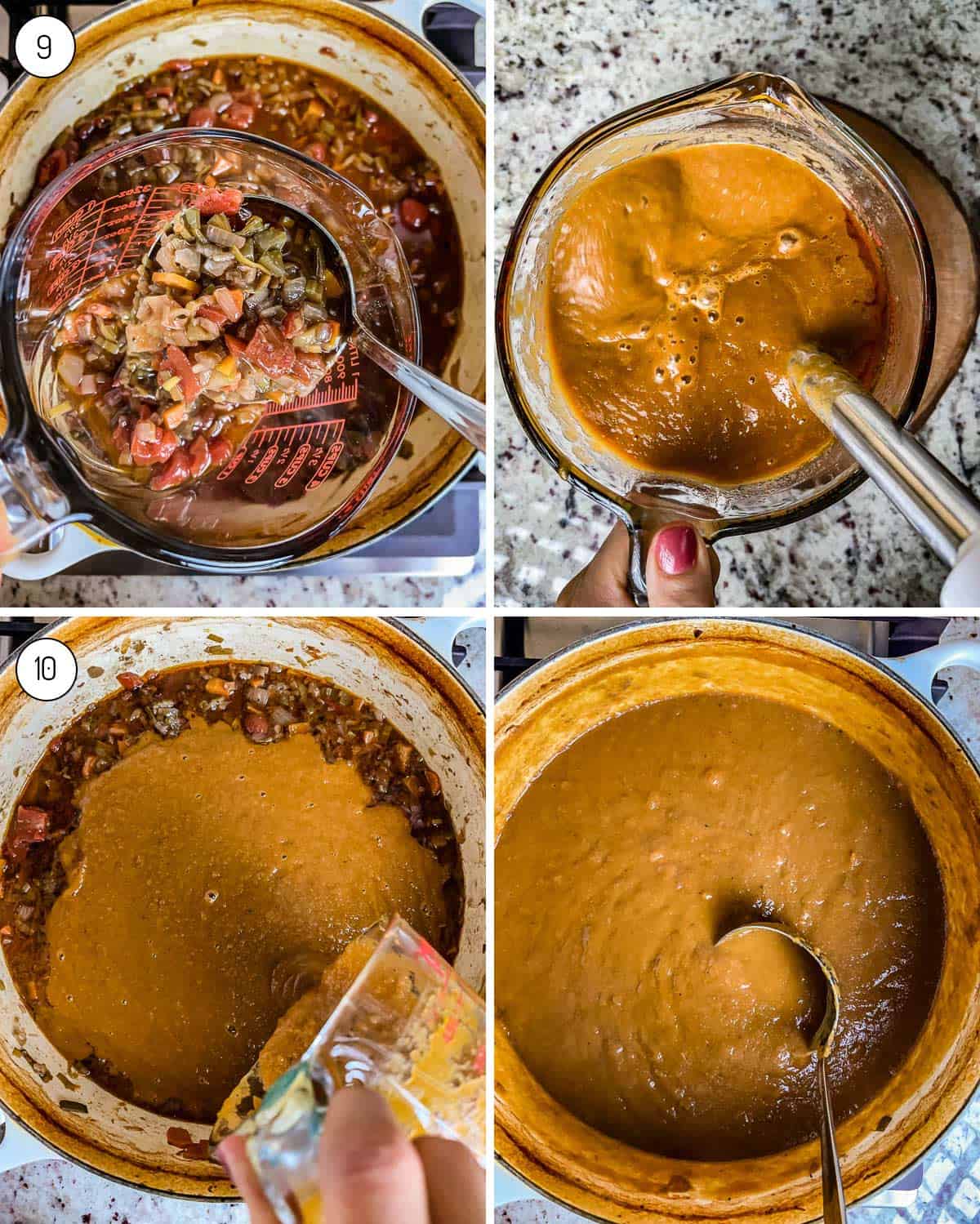
Step 9 – Purée the sauce: Carefully fish out the herb bundle from the pot.
Depending on the fattiness of your meat, you may be left with some fat on the surface. Using a large spoon, skim off as much fat as possible (and discard it).
Transfer 3 cups of the sauce and vegetables into a bowl and puree until smooth.
Pro tip: I use an immersion blender to do this, but a food processor fitted with a steel blade or a blender would also work. However, I recommend blending the liquid in smaller batches to avoid spills or worse, burning yourself.
Step 10 – Simmer the sauce: Add the pureed sauce back to the Dutch oven. Place the pot on the stovetop, turn the heat to medium-low, and return to a simmer.
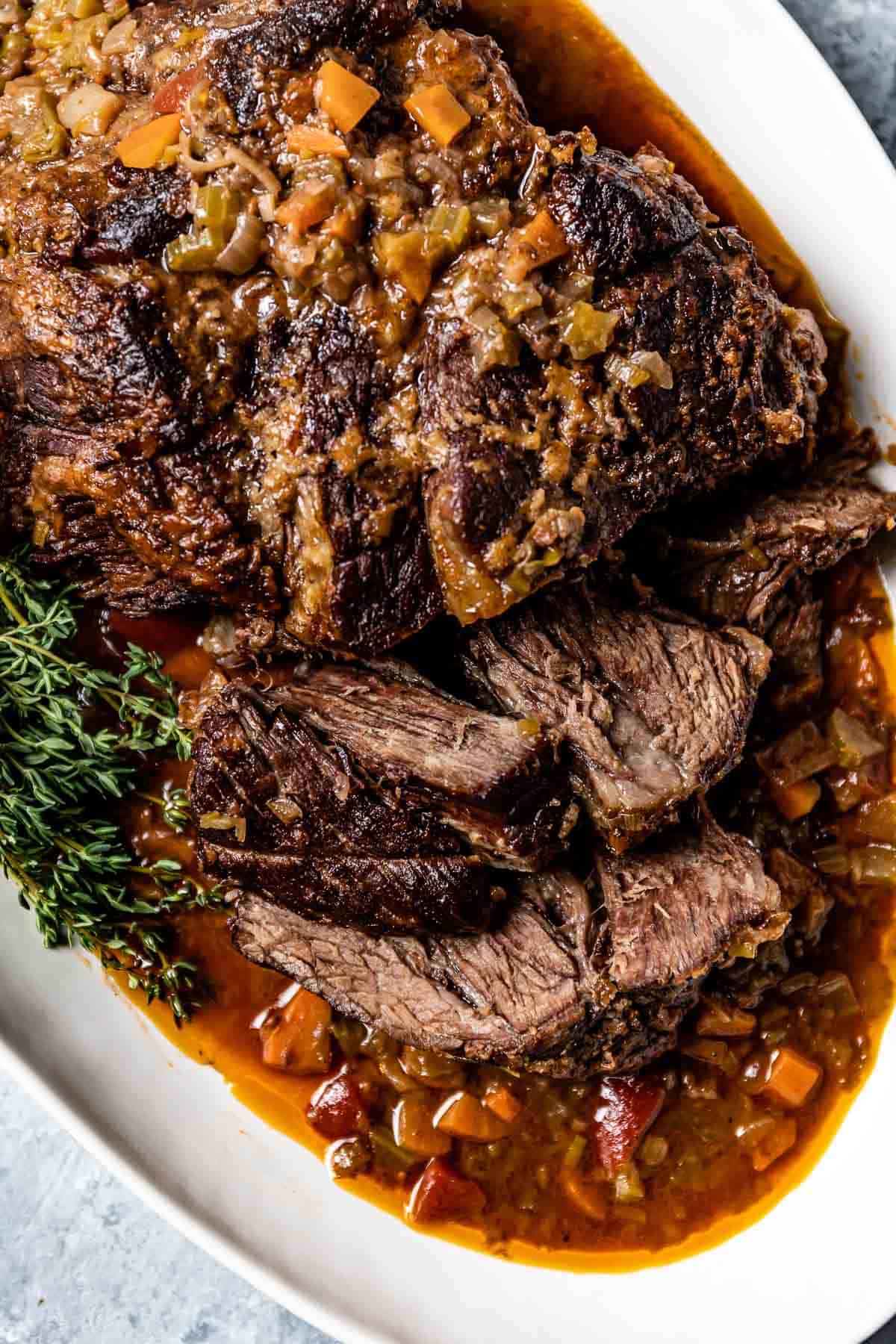
Step 11 – Slice & serve: Remove the twine from the roast and slice the meat. When ready to serve, place two or more slices of roast beef on each dinner plate and spoon the sauce on top.
How to Make this Recipe in a Slow Cooker?
If you prefer not to use the oven, you can also make Barefoot Contessa’s pot roast in a slow cooker. The ingredients and much of the process is the same, with just a few small adjustments to the cooking method:
Step 1 – Prepare the meat: Tie your beef with a kitchen string, season it with salt and pepper, and dredge the whole roast in flour. Then, heat olive oil in a pan over medium heat.
Sear your meat on all sides for about 4-5 minutes per side, then set it aside under a piece of tin foil. Do not skip this step, as it is a crucial one for building complex flavors.
Step 2 – Cook the veggies: When the olive oil is hot, add your chopped celery stalks, carrots, onions, leeks, garlic, salt, and black pepper. Cook, frequently stirring, for 12-15 minutes until the veggies soften.
Step 3 – Transfer: Transfer the now-semi-cooked veggies into the slow cooker insert. Stir in the wine, brandy, canned tomatoes, stock, and the herb bouquet. Add the seared roast and cook on low heat for 7-8 hours or on high heat for 6-7 hours.
It should be done when the meat is fork-tender and falls apart when poked with a fork.
Step 4 – Purée the sauce: During the last 30 minutes of cooking, purée 3 cups of the veggies and liquid until smooth. Pour the puréed sauce back into the slow cooker and let it simmer until ready to serve.
Step 5 – Serve: Carefully remove the roast from the slow cooker, slice it, and drizzle each portion with a generous portion of the sauce.
My Best Tips for A Perfect Roast Every Time
Yes, there are quite a few steps and some tending to the stove, but once you get the hang of it and serve it to your friends and family, I know you’ll agree this is truly the best pot roast recipe.
Below, I am sharing some of the things I learned throughout the years of making this recipe so you can cook safely and succeed on your first try:
Be very careful: This recipe involves searing a large roast, transferring a heavy Dutch oven to the oven, and puréeing hot liquid, so it’s best to move slowly and carefully at each step.
If you have young children around the kitchen, take extra care during the searing and blending stages. I recommend using oven mitts when handling the pot and being mindful of the hot steam when removing the lid.
While the pot roast is cooking in the oven, keep the lid on for the first couple of hours so the wine (and cognac, if using) can evaporate.
This recipe makes a lot of sauce: When I first made it, I was a bit surprised by how much liquid I was left with. But that’s totally normal. The meat needs all that liquid to stay juicy while it cooks.
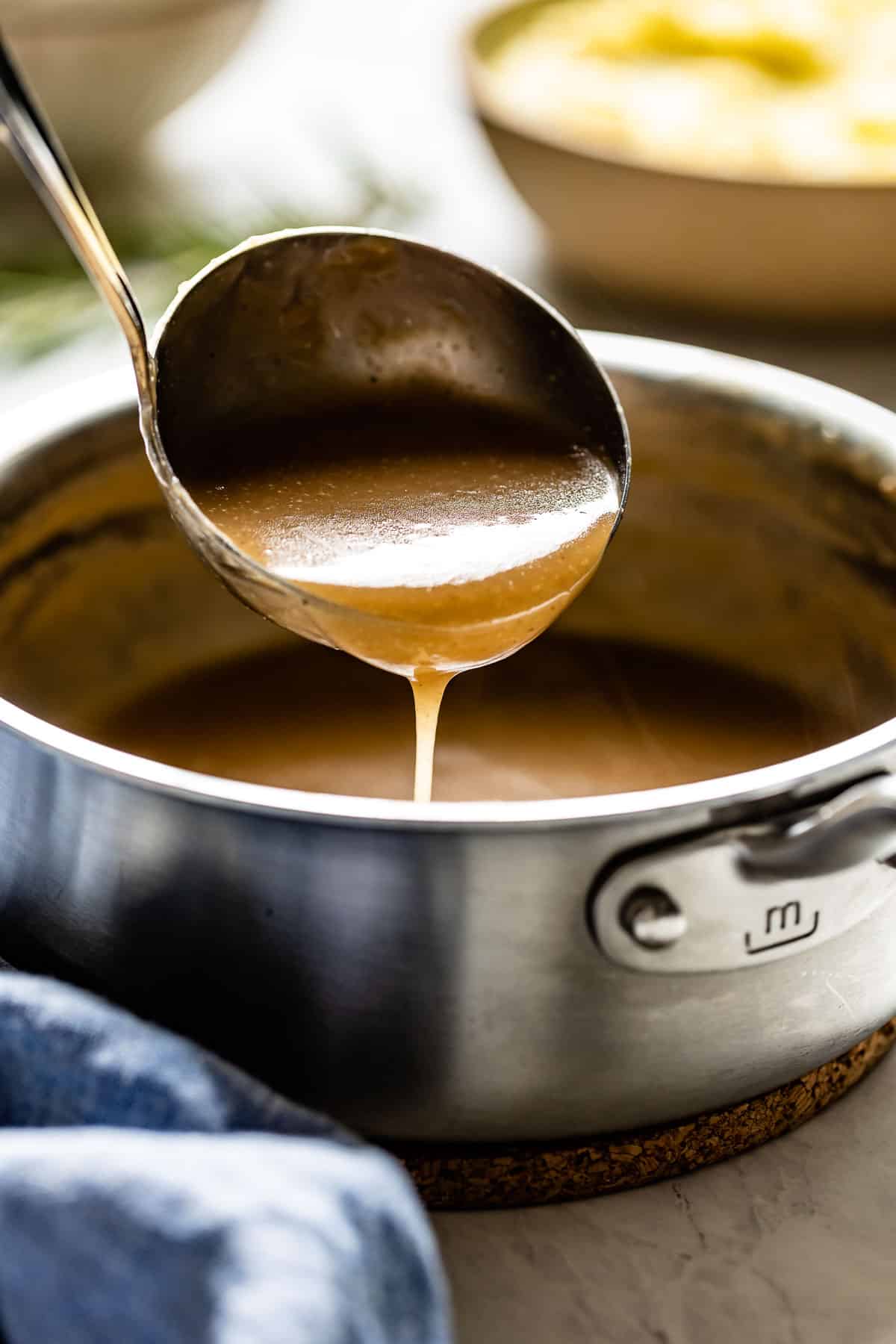
You use most of it as a sauce, but I usually use the leftovers to make a delicious gravy. Here is how I do it:
- Strain it: Pour the liquid through a fine mesh strainer to remove the bits of vegetables.
- Boil it: Pour the liquid into a small saucepan and bring it to a boil.
- Simmer: Turn the heat down to medium-low and cook for about 20-25 minutes or until it is reduced by half.
This gravy is truly wonderful when served over mashed potatoes, added to beef tacos, or even used as a rich pasta sauce.
I made a few changes to the original recipe: If you are following Ina Garten’s Company Pot Roast recipe from her book and comparing it to mine, you’ll see that I made a few minor adjustments to suit my taste.
I love her recipe, but after I made it so many times, I found a few ways to make it even better for my taste. Below is what I changed and why:
- The Salt: I skip the bouillon cube. I think the beef provides enough flavor, and the cube makes it a little too salty for me.
- The Sauce: I don’t use extra butter or flour to thicken it, as I think it’s already thick enough.
Ina Garten’s Pot Roast Recipe (Company Pot Roast)
Ingredients
For The Roast:
- 5 pounds boneless beef chuck roast, prime or choice (both works)
- 1 tablespoon kosher salt
- 1 ½ teaspoons black pepper
- 5 tablespoons all-purpose flour
- 2 tablespoons olive oil
For The Vegetables:
- 2 tablespoons olive oil
- 2 cups carrots, peeled and chopped
- 2 cups yellow onions, chopped
- 2 cups celery, chopped
- 2 cups chopped leeks, chopped (both white and light green parts) or use 1 small chopped onion
- 1 tablespoon kosher salt
- 1 teaspoon black pepper
- 5 garlic cloves, minced
- 2 cups red wine, Burgundy or Chianti
- 2 tablespoons Cognac or brandy, optional
- 1 large can diced tomatoes, (28-ounce)
- 1 cup chicken stock
- 3 branches fresh thyme
- 2 branches fresh rosemary
Instructions
- Preheat the oven to 325 degrees F. (163 degrees C.).
- Place the meat on a cutting board and pat dry with a sheet of paper towel on all sides. Tie meat using kitchen twine. Season it with salt and pepper. Dredge the whole meat in flour, ensuring that all parts are covered with flour. Shake the excess flour.
- Heat the oil over medium heat in a large Dutch oven. Cook the meat for 4-5 minutes on each side for about 20 minutes in total. Transfer it to a large plate, cover it with aluminum foil, and set it aside. Do not wash the Dutch oven.
- Heat oil in the now-empty Dutch oven. Place chopped carrots, onions, celery, leeks, garlic, 1 tablespoon salt, and 1 teaspoon black pepper in the Dutch oven. Cook until all vegetables soften, 12-15 minutes, stirring often. You do not want the vegetables to turn brown.
- Stir in the wine and cognac (if using), followed by tomatoes and chicken stock. Make an herb bouquet by tying thyme and rosemary. Place in the pan.
- Transfer the roast back to the Dutch oven, bring it to a boil, and let it come to a simmer for 12-15 minutes.
- Put the lid on and place it in the oven. Roast for 2 ½ hours, or the internal temperature registers 160 degrees F (72 degrees C.) when inserted with a digital thermometer. Next, turn the heat down to 250 F Degrees (or 122 degrees C) and let it simmer at that low temperature for an hour.
- Carefully remove the pot roast onto a cutting board and cover it loosely with aluminum foil. Discard the bundle of herbs. Using a large spoon, skim off the fat on top of the juices as much as possible.
- Transfer 3-4 cups of the sauce (about half of the sauce) and vegetables into a bowl and puree until smooth. I used an immersion blender but a food processor fitted with the steel blade or a standing blender would also work.
- Pour the pureed sauce back into the pot. Put the Dutch oven on the stovetop, turn the heat on to medium-low, and return to a simmer for about 15 minutes.
- Remove the strings from the roast and slice the meat.
- When ready to serve, place 2 (or more) slices of meat on a dinner plate and spoon the vegetable sauce over it.
Video
Notes
- A few changes I made to the original recipe: When I first made this Barefoot Contessa roast, I followed the original recipe to a T. After several times making the dish, I made a few changes to enhance its flavor and texture. For instance, I didn’t add a chicken bouillon cube, which made the sauce too salty for my taste. I also chose not to add flour and butter to thicken the pot roast sauce at the end. I thought that there was enough fat in the liquid even after skimming most of it.
- Store: To store the leftovers, first bring them to room temperature. Then, portion the roast into your desired number of airtight containers (perfect for meal prep!) and store them in the fridge for up to five days.
- Reheat: You can reheat the leftovers by placing them in an oven-proof casserole dish and baking them for 20-25 minutes at 350 degrees F. Or, you can reheat your leftovers on the stovetop if desired.
- Freeze: To freeze, place the meat with some juices in one airtight container and place the sauce in another. Separately freezing these components will ensure easy serving in the future. You can then store your two containers in the freezer for up to 2 months.
- Thaw: The easiest, safest way to thaw it is to place it in the fridge overnight and reheat it just before serving.
Nutrition
Nutrition information is automatically calculated, so should only be used as an approximation.
How to Store and Freeze?
Not only is this pot roast recipe delicious on the day you make it, but its leftovers are just as tasty, if not more. The tips below will help with storing, reheating, and freezing leftovers.
- Storing: To store the leftovers, first bring them to room temperature. Then transfer to an airtight container and store in the refrigerator for up to 5 days.
- Reheating: You can reheat the leftovers by placing them in an oven-proof casserole dish and baking them for 20-25 minutes at 350°F (177°C). You can also reheat smaller portions gently on the stovetop.
- Freezing: To freeze, place the meat with some of the cooking juices in one airtight container and the sauce in another. Freezing them separately makes reheating and serving easier. Store in the freezer for up to 2 months.
- Thawing: The easiest, safest way to thaw your company pot roast is to place it in the fridge overnight and reheat it just before serving.
What to Serve it With
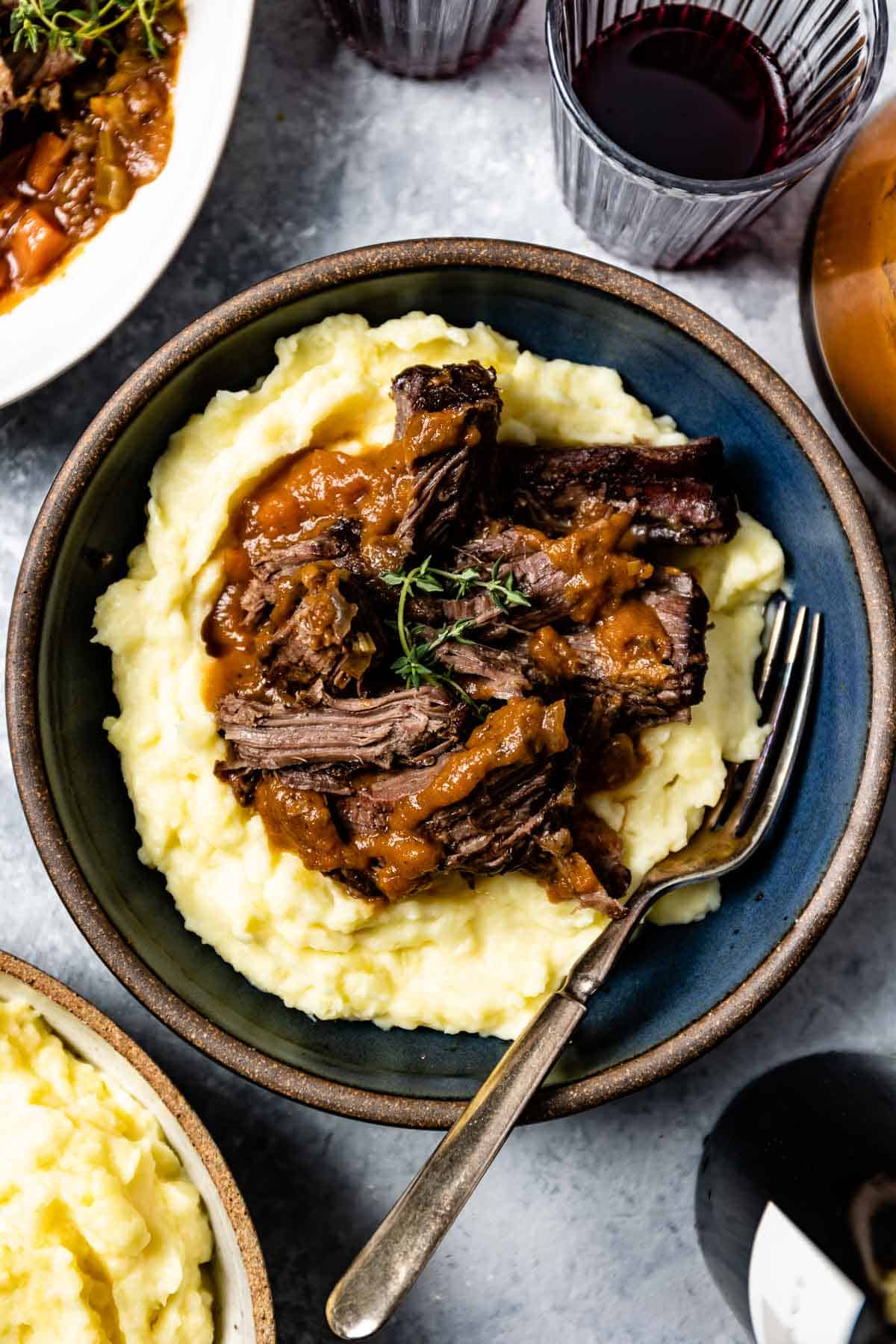
I’ve shared a full post on my favorite Pot Roast Sides, where you’ll find great side dish ideas to pair with your pot roast. Still, below are a few of my go-to pairings that work especially well with this recipe.
- Potatoes: Mashed potatoes are a natural pairing with pot roast. Rosemary Mashed Potatoes are a simple option that works well for both weeknights and special occasions, while Mashed Potato Casserole is a good choice if you’re cooking for a crowd. If you’re serving this pot roast for a holiday meal, you can also refer to my Holiday Potato Sides for more ideas.
- Grains: Egg noodles are a traditional option, but I also like serving this pot roast with Bulgur Pilaf or Wild Rice Pilaf. Both hold up well under the sauce and can be made ahead. Lemon Herb Quinoa is another good option if you prefer a gluten-free side dish.
- Vegetable sides: Simple vegetable sides balance the richness of the pot roast nicely. Green Beans in the Air Fryer and Pan-Sauteed Asparagus are both easy choices that come together quickly while the roast rests.
FAQs
Pot roast is best made with cuts of beef that benefit from long, slow cooking. Chuck roast is the most common choice, but London broil or brisket can also be used.
You can use an equal amount of chicken or beef stock in place of wine. I also recommend adding a splash of balsamic vinegar or red wine vinegar to mimic the depth and acidity that the wine provides.
Yes, you can overcook it. If the liquid in the pot runs out, the meat will become very dry and hard. Even if there is still liquid, cooking it for too long can make the meat turn to mush.
It depends on how hands-on you want the cooking process to be and how much time you have. I prefer making pot roast in the oven because you have more control, especially towards the end during the last hour of simmering. Cooking it in a slow cooker is a more hands-off option and keeps a steady temperature throughout, which works well if you don’t want to monitor the pot as closely.
Other Dinner Recipes To Serve A Crowd
If you enjoyed this Ina Garten pot roast, here are a few more dinner recipes that work well when you’re cooking for a crowd.
- If you want a quicker pot roast recipe, try my Pressure Cooker Pot Roast recipe. It is ready in under 2 hours and just as delicious.
- If you’re looking for a comforting pasta dish, my Baked Ziti with Meat is a great option for feeding a crowd and can be made ahead of time.
- And if you’re planning a more special occasion meal, my Reverse Sear Beef Tenderloin is a reliable choice that cooks evenly and makes a great centerpiece for holidays or dinner parties.
This post may contain affiliate links. If you purchase through these links, I may earn a small commission, at no additional cost to you.











This looks great and I am going to try it in my slow cooker which is only 6 qts- is that going to work?
And is the puree really worth doing ?
Thanks!
A 6-quart slow cooker should work but it will be tight, so if your roast is on the larger side you may want to go with a slightly smaller cut. As for the puree, I personally think it is worth it because it turns into the most delicious sauce. That said, plenty of readers have skipped it and just used the cooked veggies as is, and they loved it that way too. So honestly, either way you go, you will be happy! Let me know how it turns out.
I loved this roast. Im addicted to the flavor. Served over rice. Will look forward to making again . I used a boneless nil gai roast.
So happy you loved it! Served over rice sounds amazing. And how fun that you used nilgai! I love hearing when readers adapt the recipe with different cuts and meats. Looking forward to hearing how your next one turns out.
Hello! This recipe looks amazing and I’d like to try it for a dinner party I’m hosting. I would like to follow your idea of making the recipe the day ahead, then re-heating the day of. What would be your recommendations/ instructions for re-heating the day of?
Hi Laura,
I think that is a good idea. I would make the whole recipe, bring to room temp, and store it (in the Dutch oven with the lid on) in the fridge. On the day you are planning to serve it, take it out of the fridge a few hours before (to take the chill off) you are planning to warm it up (make sure that the lid is still on during that time). Then, 30-45 minutes before you are planning to serve it, you can gently reheat it on the stove. It is hard to give you an exact time as it really depends on the amount of liquid you have in the pot. I usually end up with a lot so I give myself a good hour to reheat. As it is heating, keep a close eye on it and stir it a few times to make sure it is warming nicely.
Alternatively, you can put the whole thing (without the lid) to a preheated 350 F oven and reheat it gently. Again, depending on the liquid you have in the pot I think it could take somewhere between 25-45 minutes.
I hope this answers your question.
Aysegul
Hi! This recipe sounds delicious. I’m wondering how to make this for only two people with leftovers. I have a 2.5 pound boneless chuck roast. Do I decrease all the liquid and the cooking time as well? I’m new to cooking for only 2-3 people. Thank you!
Hello Michele,
Since you literally have half the amount of beef, I would halve all the ingredients.
The timing on the other hand might be a bit tricker to advice on without actually testing it, but I would keep a close eye on the meat after the first 1 1/2-hour mark. Test it with two forks and see how it is doing. Though be careful opening the lid too early because remember, there is alcohol in there. I wouldn’t even touch it until 1 1/2 hours. Then very carefully open the lid and check. If it looks good, I would still let it simmer at 250 F but perhaps 30-45 minutes more so than an hour.
Hope this helps.
Hello!
I am looking for the slow cooker instructions for this recipe. Where can I find them? Can’t wait to try it!
Thank you!
Stephanie
Hello Stephanie,
The instructions for the slow cooker pot roast is right underneath the “how to make” section in the blog post above.
Hope this answers your question.
I took your advice and made it the day before. Since I was going to be out, I cooked it in the slow cooker. I had plenty of liquid, so I took out the 3 cups and puréed it, then kept it separate and used that as the gravy. Serving day, I popped everything in the oven at 325 for a little over an hour. Heated up the gravy, and had mashed potatoes and roasted carrots and onions It was delicious. Our guest raved about the taste and tenderness of the meat. This was a great recipe! Thanks for giving me a better idea for a pot roast!
Hello Sarah,
This is music to my ears. I am thrilled to hear that this pot roast recipe worked for you and that your guests raved about it.
Thank you so much for coming back and taking the time to leave a review.
Best,
Aysegul
Fantastic recipe!!! It was a hit at my dinner party.
YAY! It is a favorite in our house as well, Karen.
Thanks for coming back and taking the time to leave a review.
I made this today and it came out delicious! Everyone loved it. I didn’t puree at all and was perfectly fine with the vegetables and soupy sauce. I also used red cooking wine. I’m not well versed with wine. After googling Burgundy wine, I’m seeing that it’s a dry red wine. Is that what this recipe refers to and do you have any favorite brand of dry red wines to use this recipe?
I am happy to hear that you enjoyed this recipe, Desiree. To answer your question: I usually keep a few bottles of Decoy By Duckhorn Cabernet in my cabinet. It is a great full bodied wine that is not too expensive and tastes wonderful. Still, you can use any brand of Burgundy, Cabernet or even Pinot noir you like.
Hope this answers your question.