
If you have never cooked black rice before, you are in for a treat because in today’s post we are covering the basics of this whole grain in detail. And if you are someone who cooks it on the regular, I hope you will find some helpful tips from my extensive recipe testing for the pursuit of the best method of cooking forbidden rice.
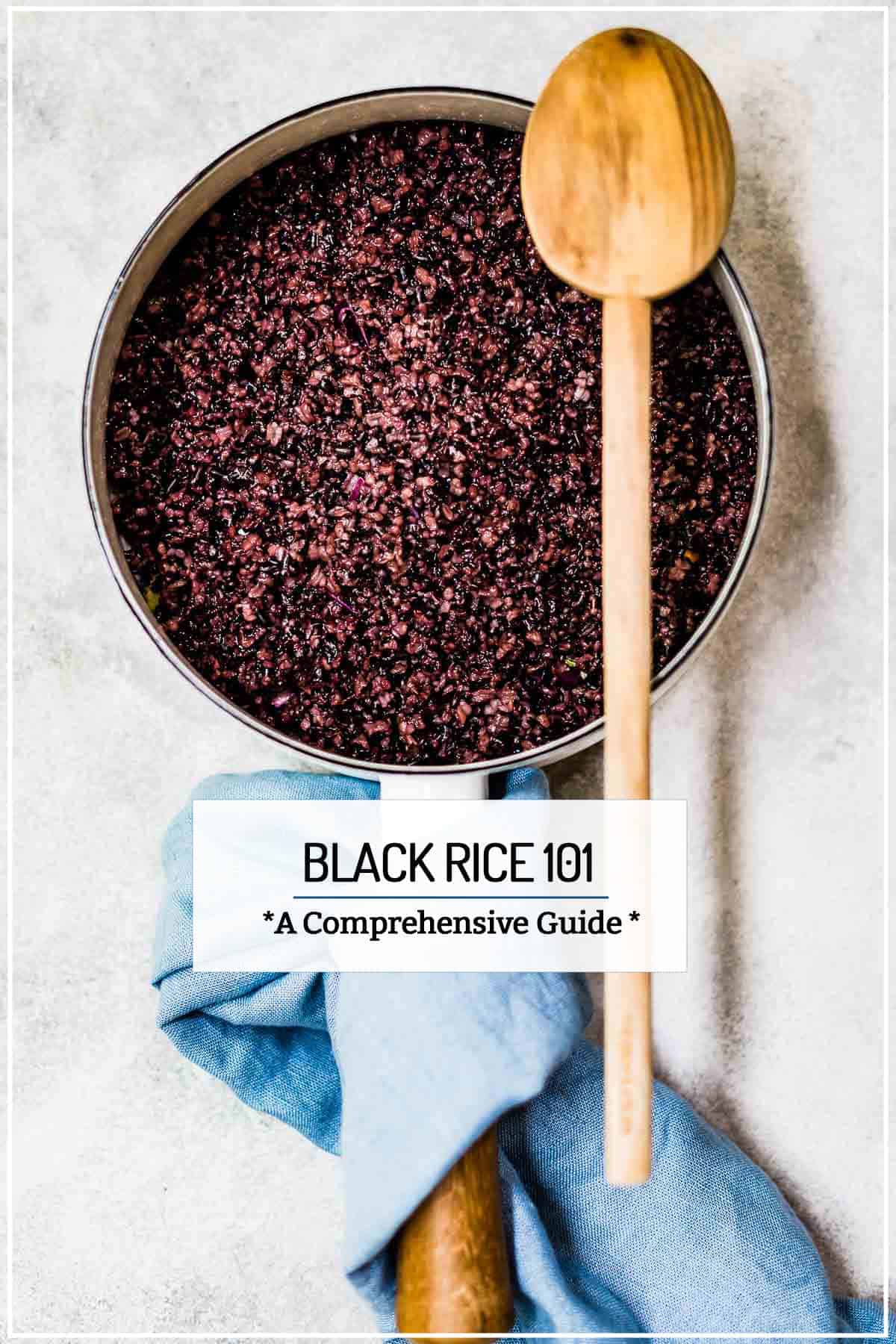
Table of Contents
- What is Forbidden Rice? Why is Black Rice called Forbidden Rice?
- Three Most Common Types of Forbidden Rice:
- Ingredients:
- How To Prepare Black Rice for cooking?
- How to Cook Black Rice On The Stove – Basic Cooking Instructions:
- Other Cooking Methods – In Instant Pot & In a Rice Cooker:
- How Long Does It Take to Cook black rice?
- How To Store, Freeze & Thaw?
- Forbidden Rice Recipe Ideas – What To Do With Black Rice?
- What to Eat With Black Rice?
- Expert Tips for Success:
- Forbidden Rice Recipe (Black Rice Recipe)
What is Forbidden Rice? Why is Black Rice called Forbidden Rice?
With its dark purple color, black rice is a cultivated form of wild rice and has been around for more than 9,000 years. It originated in China and spread to other parts of Asia and around the world.
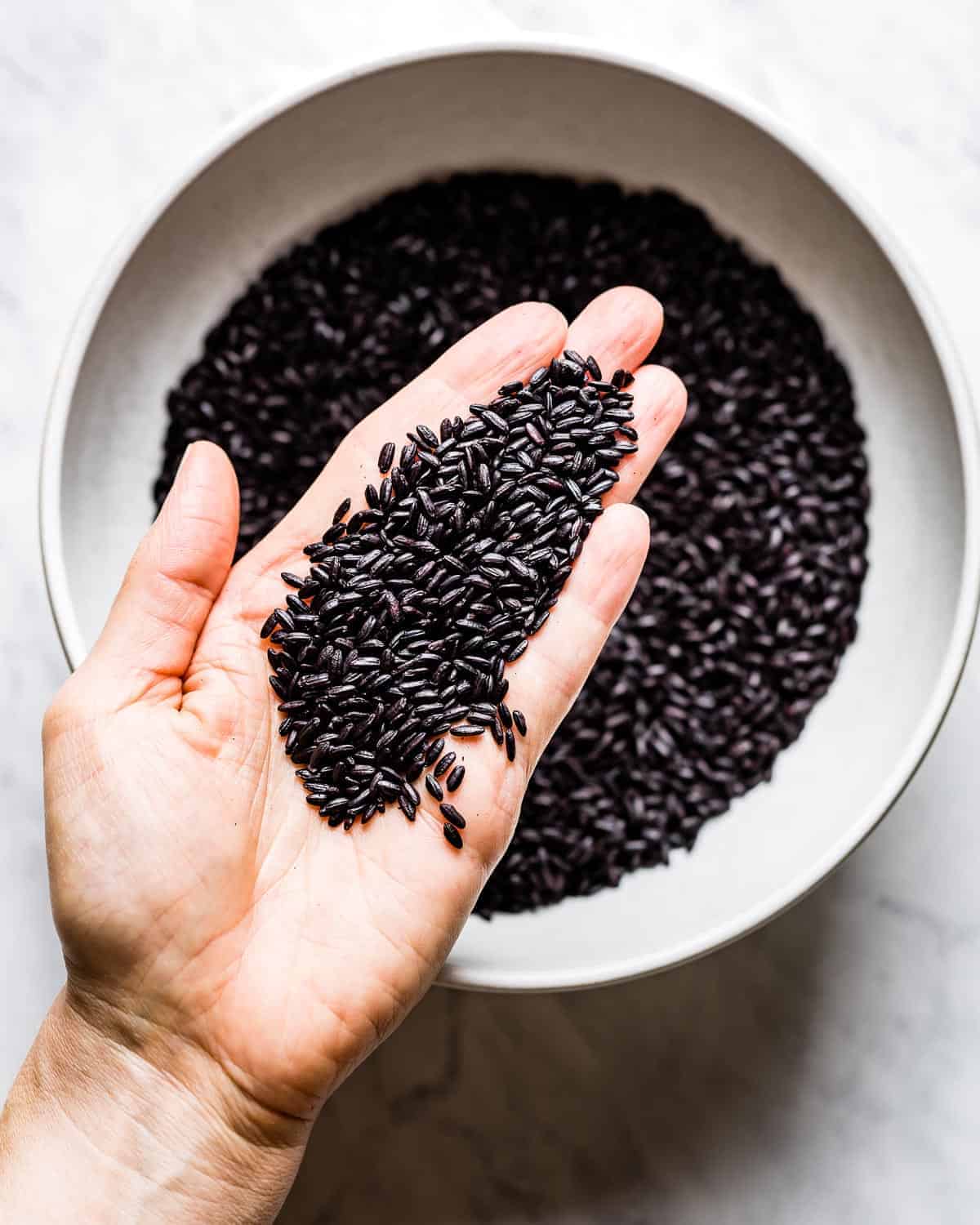
Black rice is also called Forbidden Rice and Emperor’s Rice because it was reserved exclusively for Chinese royalty and emperors, making it forbidden for anyone else.
Eventually, it became available for everyone and came to this day as a grain that is synonymous with good health and long life.
Three Most Common Types of Forbidden Rice:
Nowadays, it is easy to find black rice in supermarkets here in the US. However, the names and branding used by the manufacturers might be a bit confusing, especially if you are new to cooking black rice.

Below are the three most common types of forbidden black rice, along with the most popular brands you can find:
Black Rice (Purple Rice):
This is the most common type of black rice sold in the US markets. This unmilled, medium-grain rice is grown in Zhejiang province in China. However, nowadays, it is also grown in various parts of the world.
Some popular names for black rice are Forbidden rice, Heirloom Black Rice, Kavuni Rice, Purple Rice, Bolay Black Rice and Black Jasmine Rice.
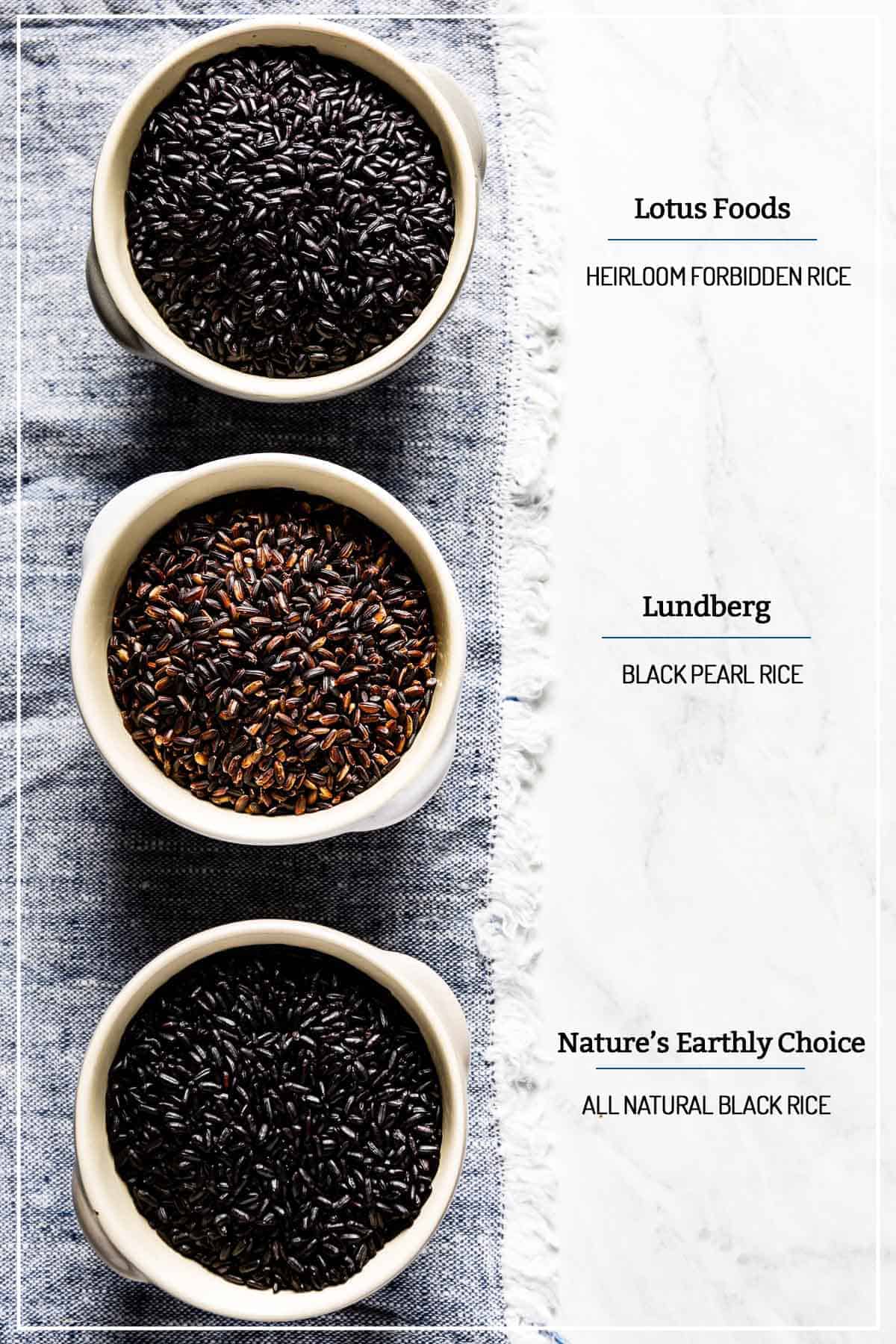
While there might be slight differences in production and/or brands, they are essentially the same thing.
Some popular brands that sell black rice in the US markets are (affiliate links):
- Lotus Foods – Heirloom Forbidden Rice (They offer an organic black rice as well)
- Nature’s Earthly Choice – All Natural Black Rice
Black Japonica Rice™ & Black Pearl Rice by Lundberg
Black Japonica Rice™ and Black Pearl Rice are not technically black rice. They are grown in California by Lundberg Family Farms.
However, because they are widely available in the US and offer a very similar taste and texture to black rice, I think it is appropriate to include them as a part of the family.
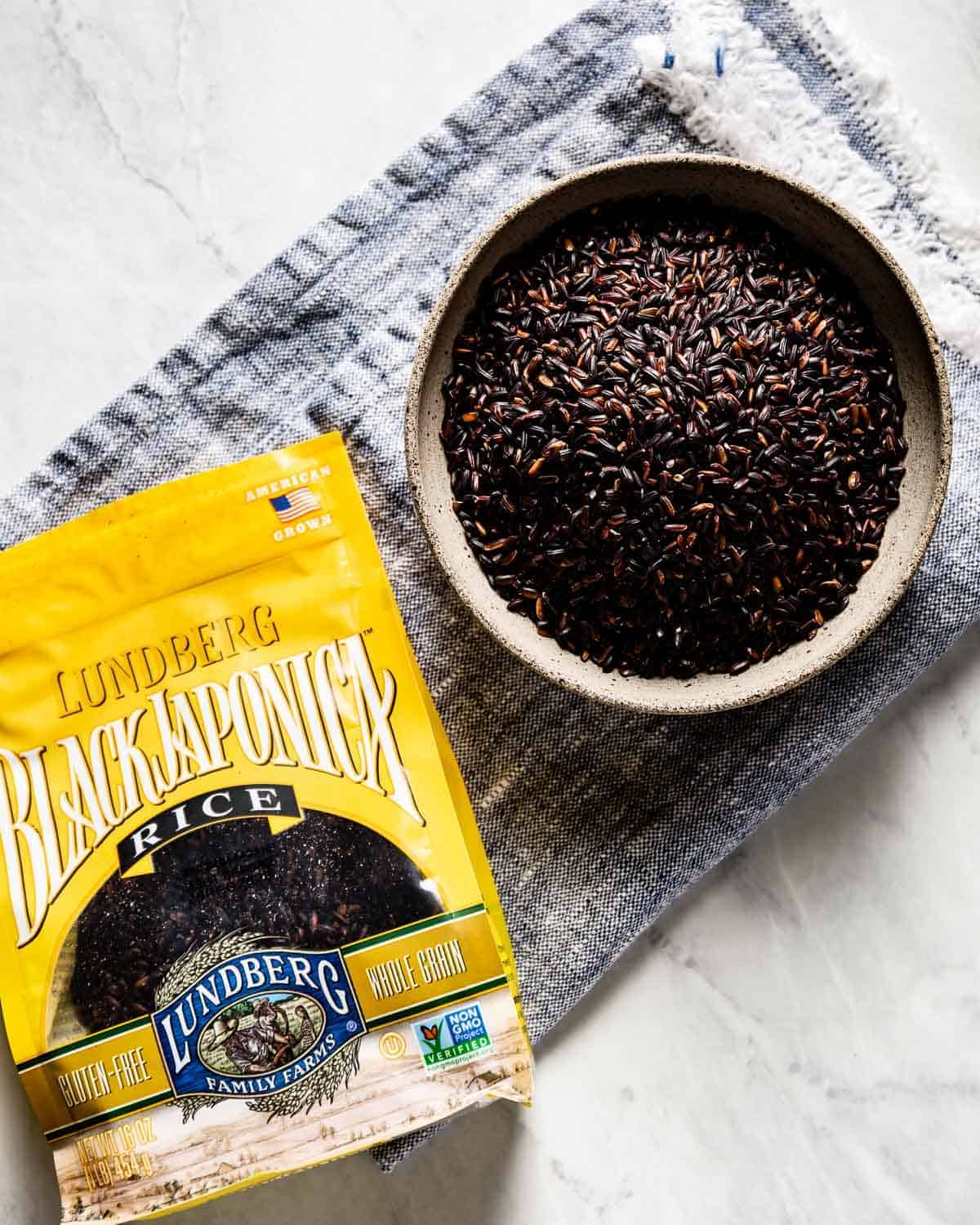
Black Japonica Rice is a mixture of short-grain black rice and medium-grain mahogany rice (a type of red rice.) The name is trademarked by Lundberg Family Farms. It is marketed as “A Gourmet Field Blend of Black & Mahogany Rice” and offers a very similar nutty flavor with subtle savory and sweet notes.
On the other hand, Black Pearl Rice is similar to black rice in that it is a whole grain rice with the bran intact and has a black pigment on the kernel.
Black Sticky Rice:
Also called Thai Black Rice, Thai Sweet Rice, Thai Black Glutinous Rice or Khao Niew Dam (in Thai), Black sticky rice is a medium to long grain glutinous rice from South East and East Asia.
It is often cooked by steaming (in a bamboo steamer) and compared to Chinese Black rice, it has a more sticky texture when cooked.
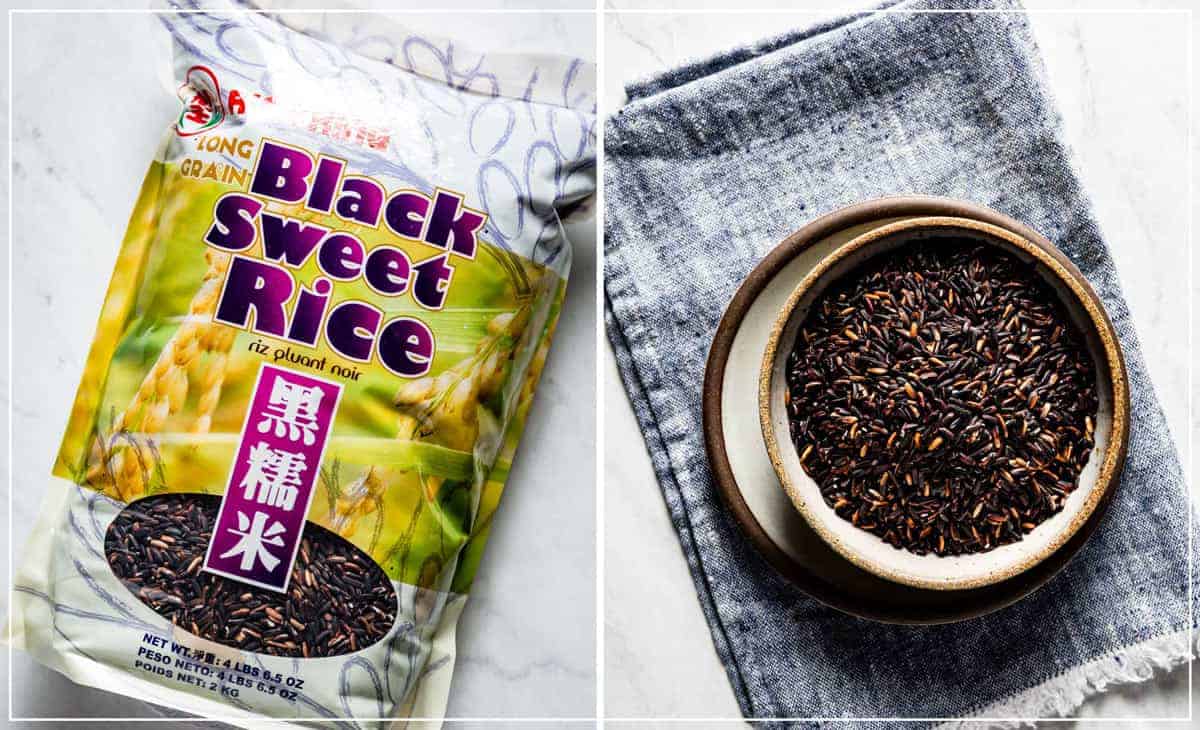
You can see this version also used in Korean cooking and they refer to it as Wild Sweet Rice or Black Sweet Rice.
It is often used in Thai cuisine in desserts, custards, pudding, and porridge recipes often topped off with fruit and coconut.
Black Thai Glutinous Rice is not as widely available in the US as the other two types of rice. However, you can find them in Asian supermarkets and specialty stores or purchase it online.
While Thai Black Rice is not the same thing as Chinese Black Rice, in most recipes, you can use Chinese Black rice instead of Thai sticky rice.
I am sure there are exceptions to this, especially if you are cooking authentic recipes, but I found that for basic recipes like Black Rice Salad or Black rice pudding, they can be used interchangeably.
Ingredients:
For each method of cooking below, you will need the same ingredients. They are black rice, water, and a pinch of salt.
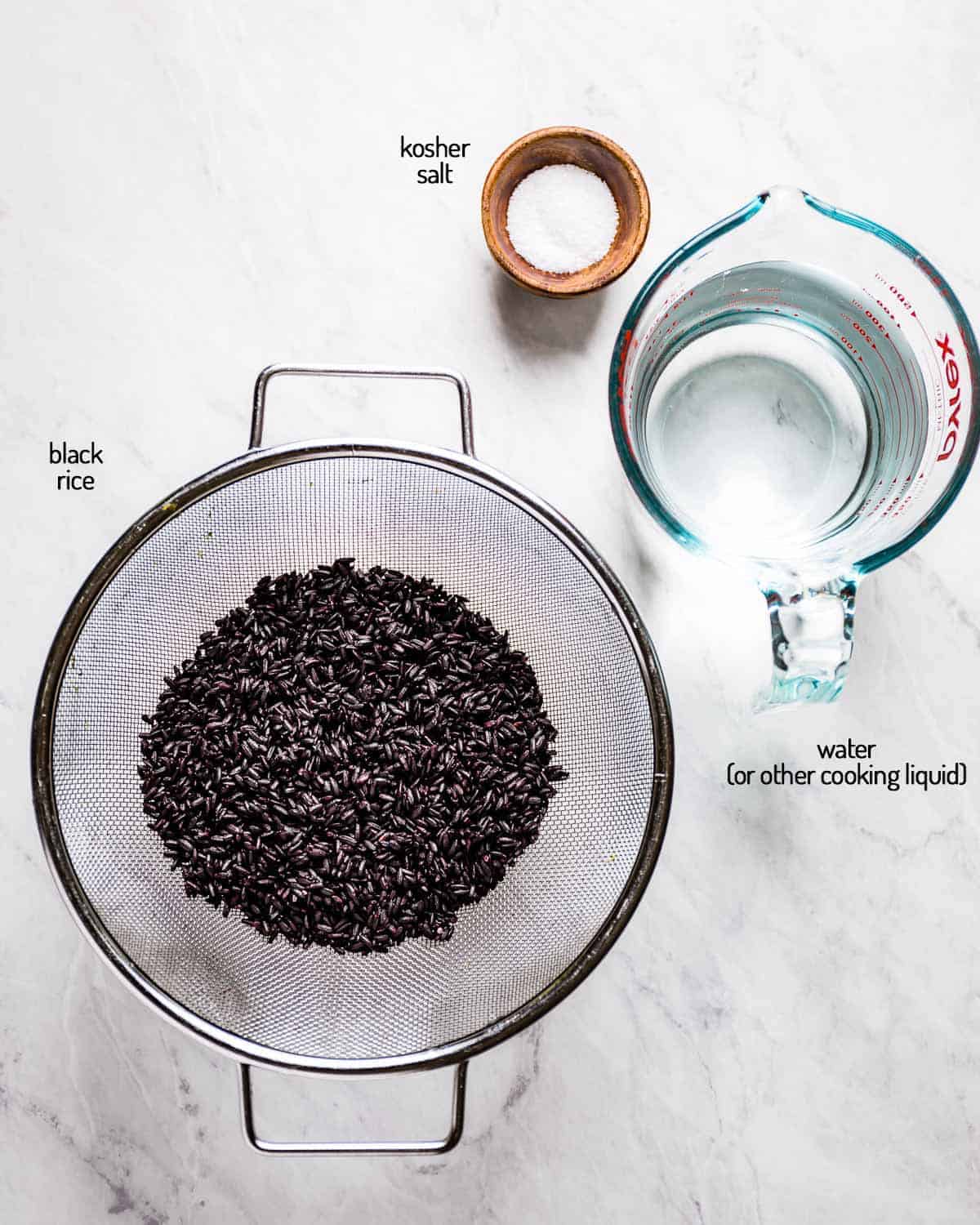
The only exception to this is when cooking it as pilaf, which we will cover in more detail below.
How To Prepare Black Rice for cooking?
Should I rinse before cooking?
The jury is out on this one. Popular websites like TheKitchn and Martha Stewart do not recommend rinsing black rice before cooking is not necessary.
However, some other websites suggest that rinsing is necessary to eliminate some of the excess starch that makes the rice gummy.
I personally wash my black rice only if I am getting it from the bulk bins. If I am buying packaged black rice, I do not rinse it. One exception to this is if I am cooking black rice in a rice cooker as most rice cooker brands suggest rinsing rice before cooking.
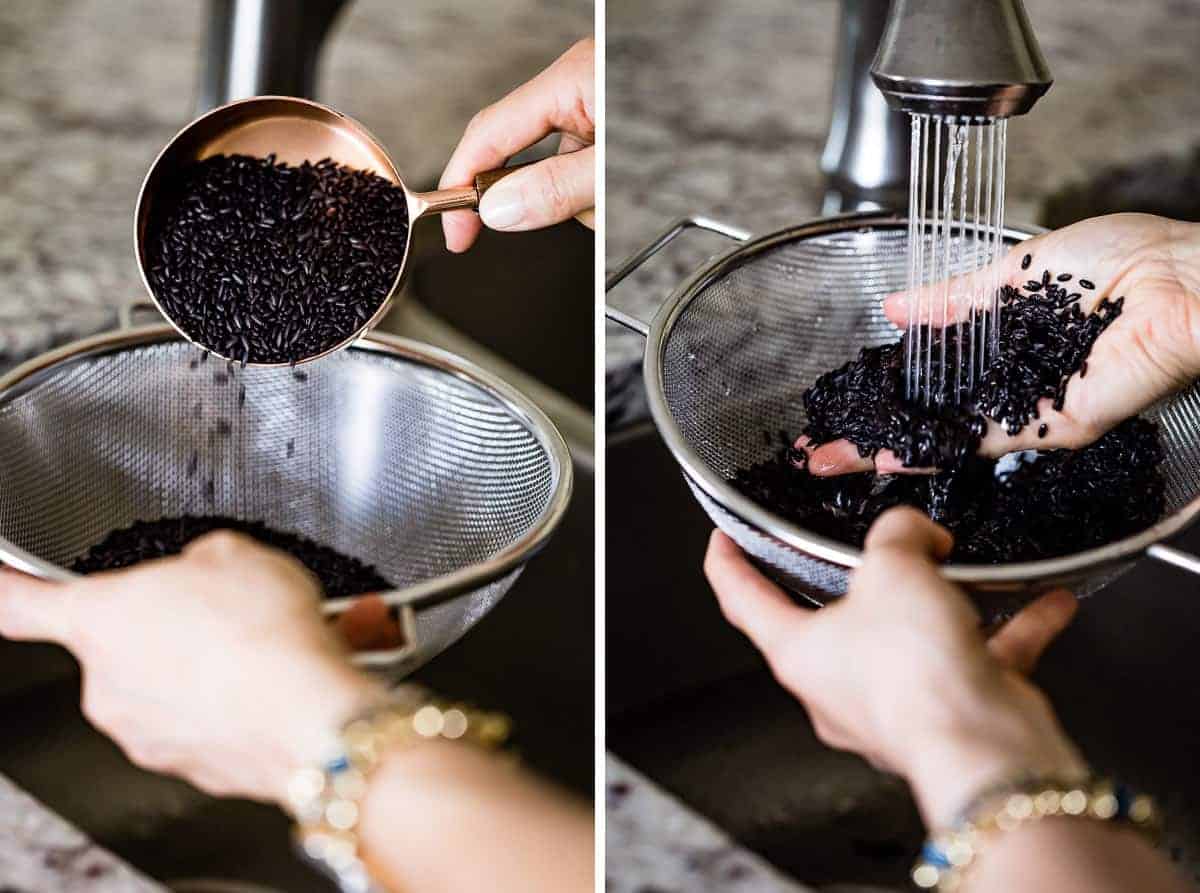
If you decide to wash it, measure and place it in a fine mesh strainer and rinse it under cold running water. As the water runs through the rice, you will see it turn dark purple. Be aware that this liquid will stain your clothes and your countertops so be careful not to splatter it all over the place.
Should I soak it before cooking? If so, how long?
The short answer to this question is no, as is the case with most whole grains; soaking it before cooking helps shorten the cooking time. Still, it is a personal preference.
If you decide to soak, mix 1 cup of black rice in three cups of water in a bowl and let it sit for an hour or overnight. Keep in mind that the cooking time will be shorter if you soak it. The amount of time will depend on how long you soak it. The longer it soaks the quicker it will cook.
I personally do not soak black rice before cooking (because I can never remember it), and the recipes I share below are made without soaking black rice prior to cooking.
How to Cook Black Rice On The Stove – Basic Cooking Instructions:
You can cook black rice on the stove using three different methods:
Cook it Like Rice:
This is the most popular method and the one that is recommended on the packaging of most black rice sold in the supermarket. It is also referred to as the absorption method.
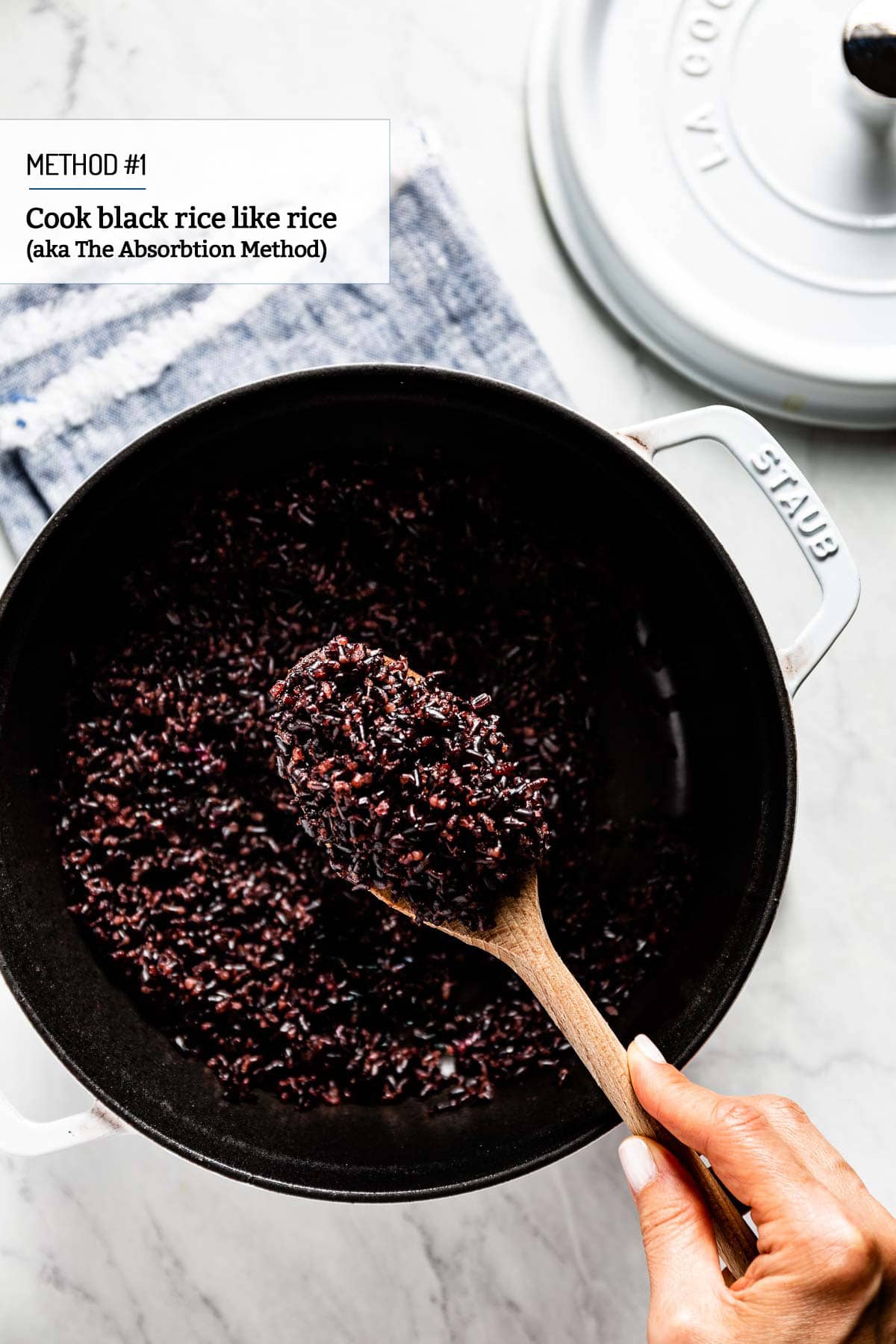
Water to black rice ratio for the absorption method is 2 to 1. In other words, you will need 2 cups of cooking liquid (like water, chicken stock or vegetable broth) for every cup of black rice you use.
To Cook Black Rice using the absorption method:
- Place 2 cups of cooking liquid of your choice, 1 cup of black rice, and an optional ½ teaspoon of kosher salt in a medium saucepan over medium-high heat.
- Bring to a boil, put the lid on, turn the heat down to low, and let it simmer for about 30-33 minutes or until all the liquid is absorbed.
- Remove it from heat (keep the lid on) and let it rest for 10 minutes. Fluff it with a fork.
Pros & Cons of Cooking It Like Rice:
- Pros: The advantage of this method is that you can change up your cooking liquid to make it more flavorful. I also like the fact that after all of the liquid is absorbed, the rice looks and tastes perfectly cooked.
- Cons: The disadvantage is that you have to keep a close eye on it to ensure that there is enough liquid in it and it is not sticking to the bottom of the pan. During all of my recipe testing, in every brand that I tried, my black rice was cooked between the 30-33 minute mark using this method.
Cook it Like Pasta:
To me, this is the easiest method. I love the fact that this method provides less sticky black rice in the end (compared to the absorption method).
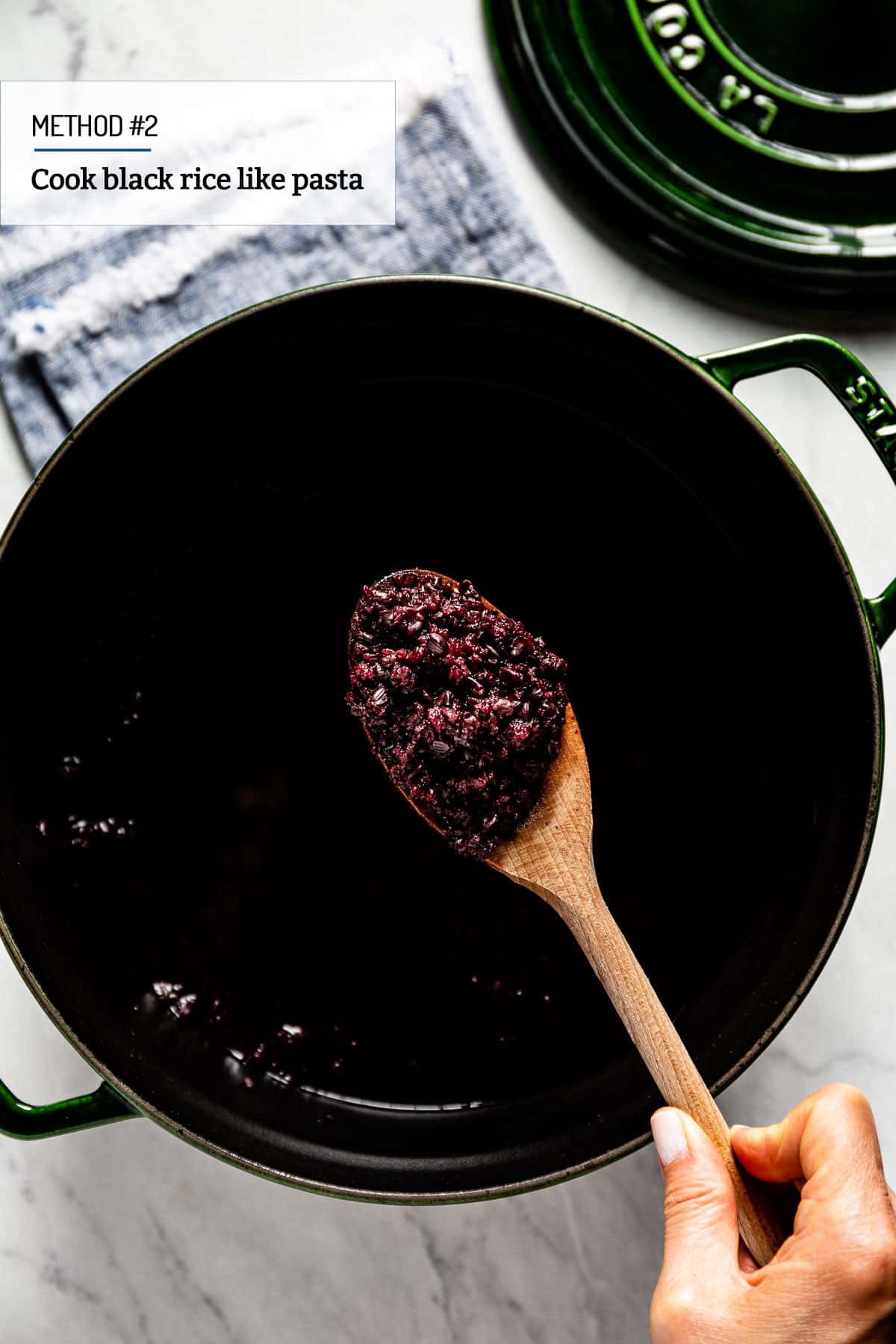
When you are cooking black rice like pasta, there is no need to be exact about the amount of water you use.
To cook black rice like pasta:
- Place 6 cups of water, 1 cup of black rice, and ½ teaspoon kosher salt in a medium saucepan.
- Bring it to a boil and let it simmer (stirring occasionally) for 20 minutes or until the rice is fully softened.
- Drain the liquid using a colander as soon as it cooks and serve.
Pros & Cons of Cooking it Like Pasta:
- Pros: This method of cooking is hands-off and quicker (ready after 20 minutes of simmering) than any other method.
- Cons: Similar to pasta, if you leave it in the liquid after it is cooked, it will get mushy.
Pilaf Method: Turn It into Forbidden Black Rice Pilaf & Cook it with Vegetables
You can use any vegetables you have on hand, including but not limited to onion, garlic, carrot, celery, peas, and mushrooms and flavor it with fresh herbs like thyme and parsley. You can also season black rice with fresh or dried thyme, chives and salt, and black pepper.
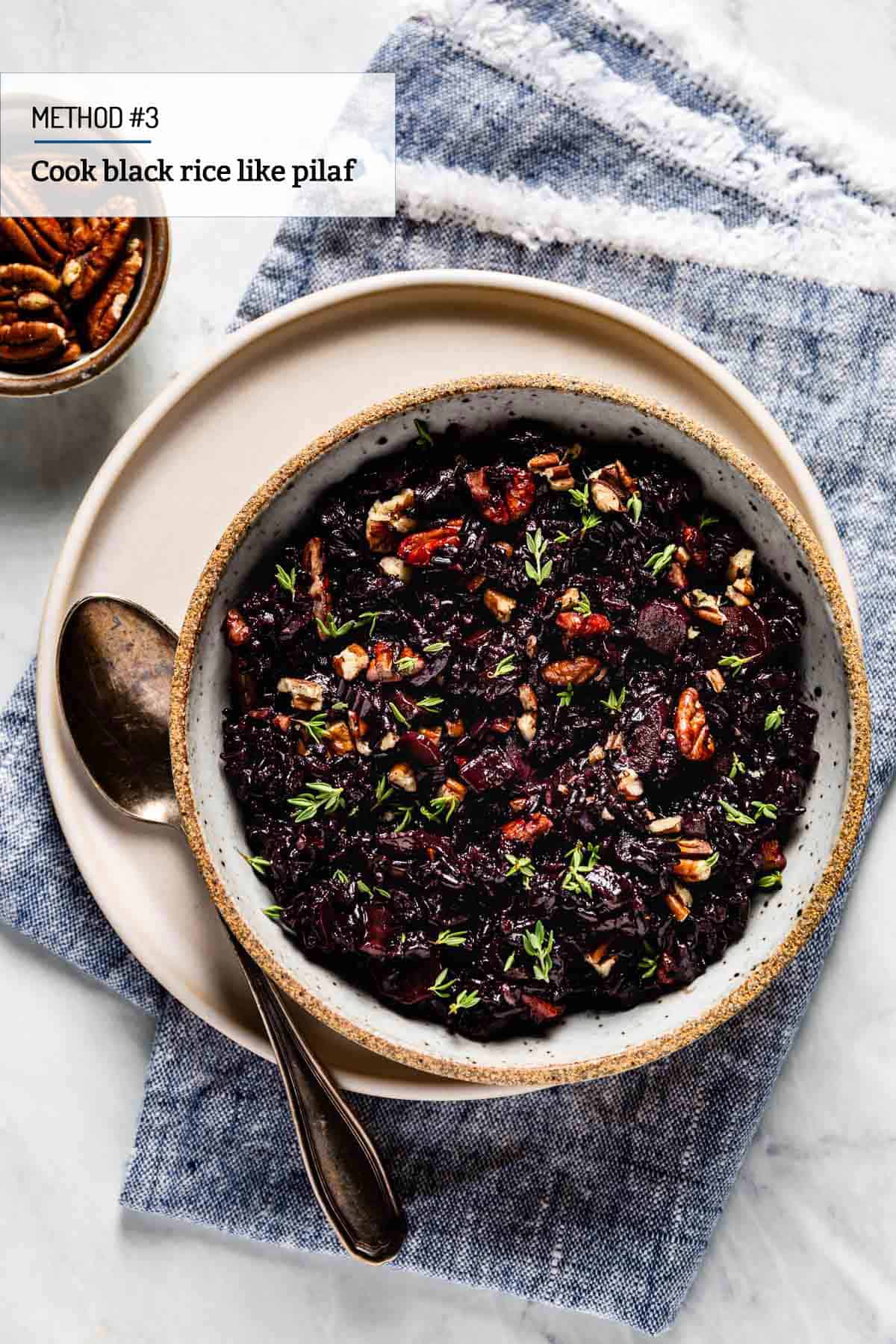
To make my basic Black Rice Pilaf recipe:
- Cook the vegetables: Heat vegetable oil in a medium saucepan with a lid over medium-high heat. Add in onion, carrots, celery and saute for 4-5 minutes or until softened. Add in garlic, fresh thyme leaves, a handful of dried cranberries and saute for 30 seconds.
- Add the black rice and cooking liquid: Add a cup of black rice and 1 ¾ cups of water, chicken stock or vegetable broth, salt and pepper. Bring to a boil, turn the heat down to medium-low and simmer for 30 minutes or until all the liquid is absorbed.
- Garnish & Serve: Optionally, top it off with chopped pecans/walnuts and garnish with fresh thyme leaves. Serve.
Pros and Cons of Cooking it Like Pilaf:
- Pros: Cooking forbidden rice with vegetables complements its nutty texture and makes it even more flavorful. You can literally serve this dish by itself as a vegan and gluten-free meal or as a side dish with any of your dinner recipes. Plus, you can switch up the vegetables using this basic black rice pilaf recipe as a place to start.
- Cons: This is not a very hands-off method. You would have to keep an eye on it to make sure that it has enough water and not sticking to the bottom of the pot.
Also, after it is fully cooked, all of the vegetables turn black, requiring a bit of food styling to make it look appealing to the eye. I top it off with a handful of chopped pecans (for color and crunch) and garnish it with fresh thyme (or any herbs you have on hand.)
Other Cooking Methods – In Instant Pot & In a Rice Cooker:
While cooking forbidden rice on the stove top is easy, if you would rather prefer a method that uses more hands off with foolproof, perfect-every time kind of results, then you can make it in an Instant Pot (or any electric pressure cooker) or in a rice cooker.
I covered each method with everything you need to know in their respective recipe posts, but below are a quick snapshot of how to make black rice in each device.
Pressure Cooker Method:
Cooking black rice in an Instant Pot is easy and hands off.
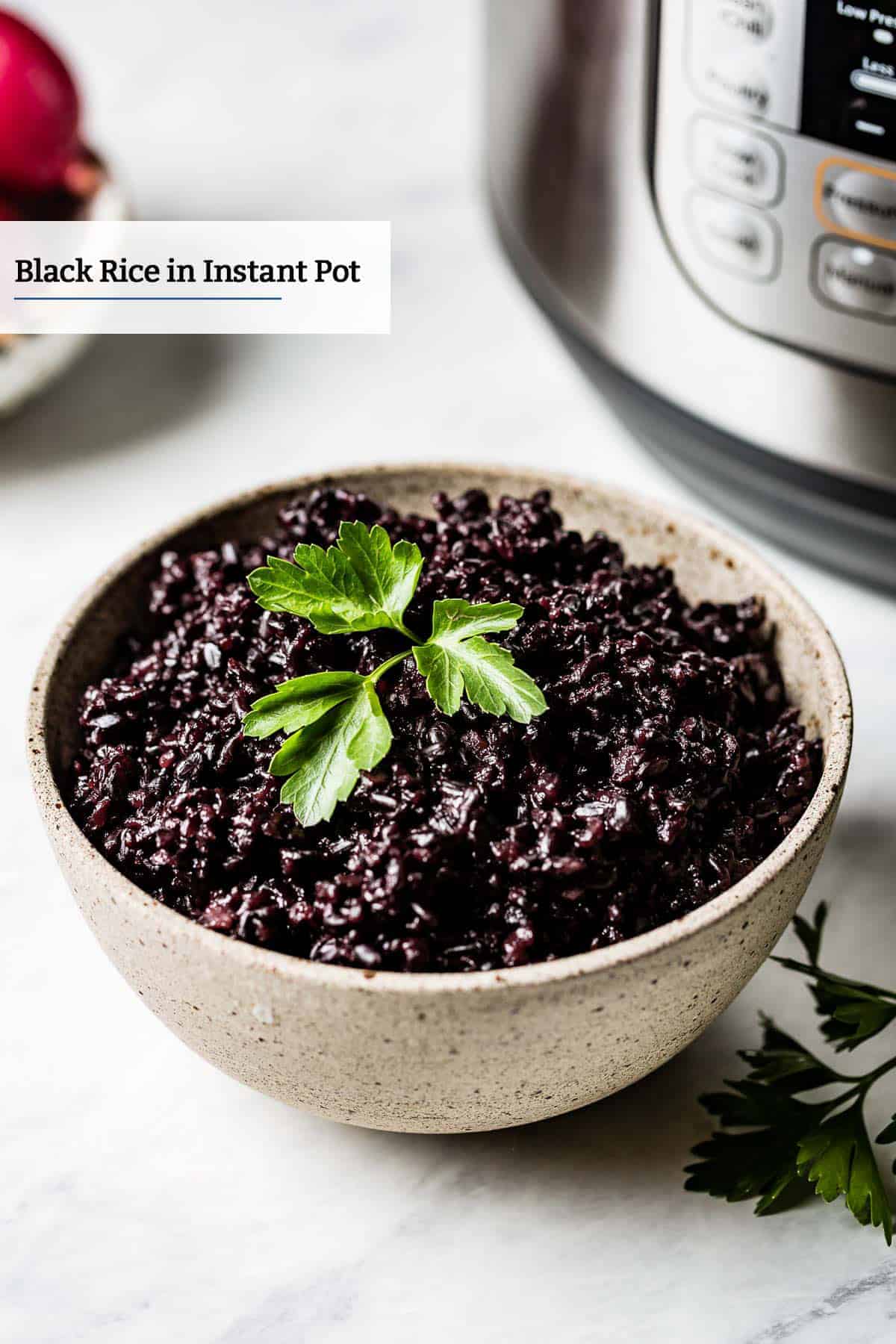
The water to rice ratio for cooking in a pressure cooker is 1 to 1. In other words, you will need 1 cup of cooking liquid (water, chicken stock or vegetable stock) for every cup of black rice.
For Chinese Forbidden rice, set your Instant Pot to 17 minutes on high and let it release the pressure naturally. If you are cooking Thai Black Sticky Rice, set it to 20 minutes on high and again, let it release the pressure naturally.
There is no need to grease the pressure cooker insert as it does not stick.
Rice Cooker Method:
Cooking Black Rice in Rice Cooker is also easy and perfect if you want a method where you can set-it-and-forget-it.
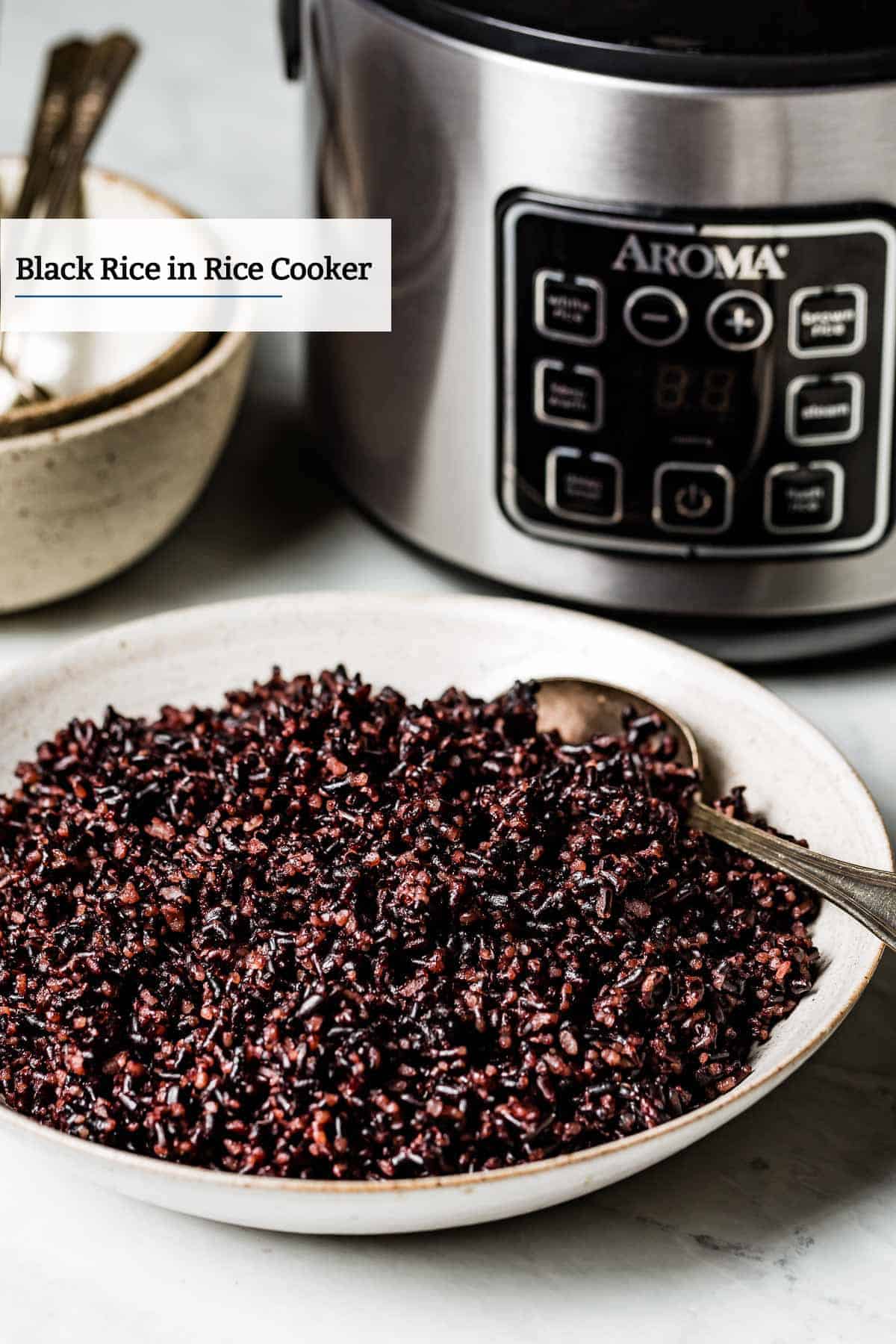
The ratio of water to rice for cooking black heirloom rice in a rice cooker is 1 ¾ cups of cooking liquid (water, chicken stock, or vegetable broth) to 1 cup of black rice.
When cooking it in a rice cooker, I recommend using a tablespoon of vegetable oil to grease the rice cooker insert because it does stick to the bottom and makes clean up difficult later on.
To cook it, I set my Aroma Rice Cooker to the brown rice setting and it took about 55-60 minutes to cook.
How Long Does It Take to Cook black rice?
Each method takes a different amount of time and might slightly differ based on the brand or the type of forbidden black rice and equipment you are using.
Below is a quick guide for cooking times for each method:
- The absorption method (aka cooking it like rice): 30-33 minutes of simmer time after the water comes to a boil
- Cooking it like pasta: 20 minutes of simmer time after the water comes to a boil
- Black Rice Pilaf (Cooking it with vegetables): 30 minutes of simmer time after it comes to a boil
- Instant Pot method: About 30-33 minutes (5 minutes for it to come to pressure, 17 minutes active cooking time and 10 minutes natural release)
- Rice Cooker method: About 55-60 minutes
How To Store, Freeze & Thaw?
- Storage: Bring leftover cooked black rice to room temperature, place it in an airtight container and store in the fridge upto 4 days.
- Freezing: Bring cooked black rice to room temperature, spread it onto a parchment-lined sheet pan, place in the freezer for upto 2 hours or until frozen, and then store it in a freezer friendly container.
- Thawing: Allow it to sit at room temperature for 1 hour. You can use it in cold dishes immediately or gently reheat to use in warm dishes.
Forbidden Rice Recipe Ideas – What To Do With Black Rice?
There are so many ways you can use cooked black rice. Since it stores well and can be used in many recipes, I cook a batch as a part of my weekly meal prep. You can pretty much adapt it to any recipe that uses quinoa, brown rice, and even wild rice. Here are a few suggestions:
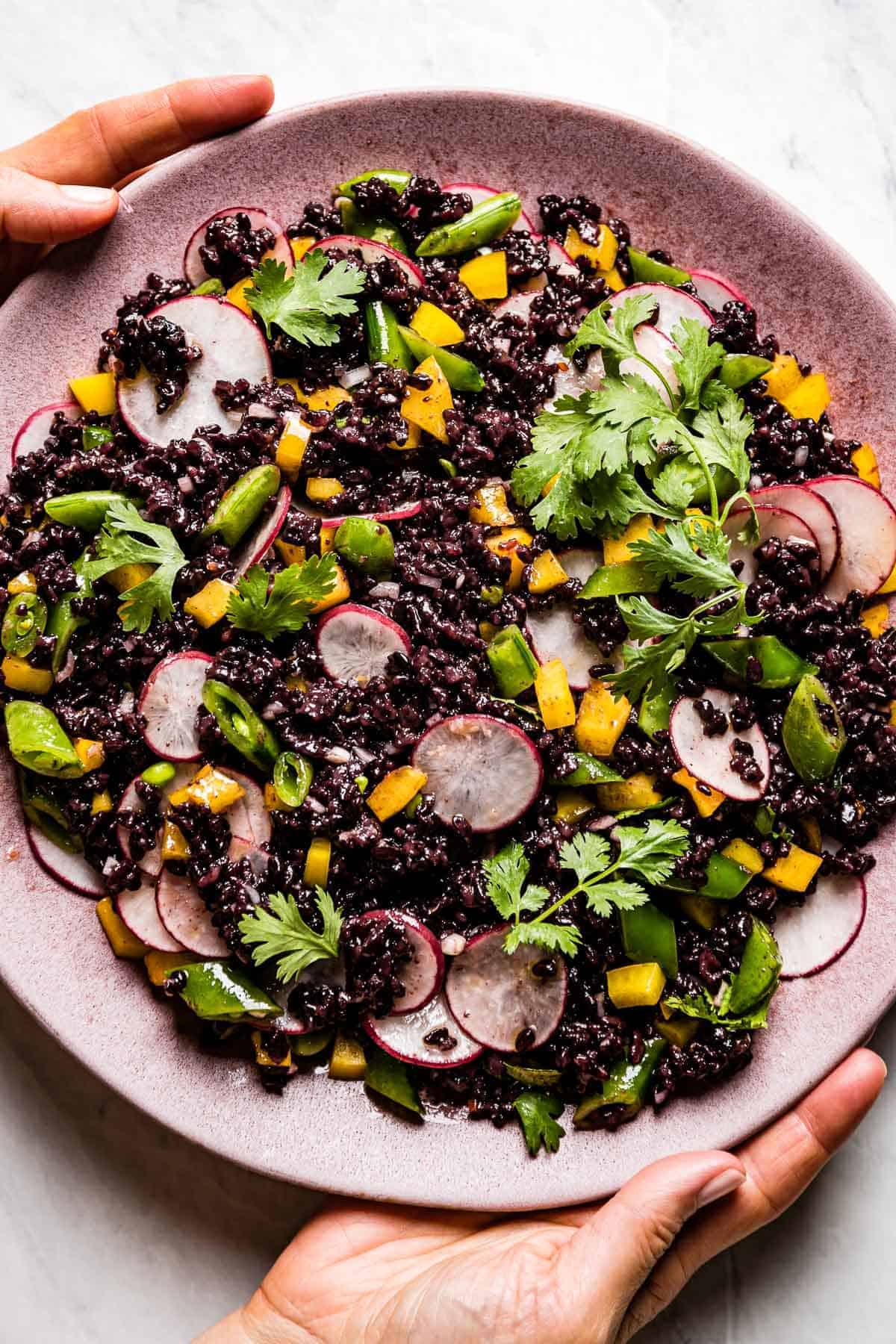
- Use it in salads as a grain: Adding a cup of cooked black rice in any salad recipe makes it super satisfying. A great example of it is my Black Rice Salad, where I use cooked rice as a base and flavor it with an Asian salad dressing. Or try this Forbidden Rice Salad with Curry Dressing.
- Black Rice Cereal/Porridge or Black Rice Pudding: Serve it for breakfast by simply pouring hot or cold almond milk (or coconut milk) over it and topping it off with nuts and fruit.
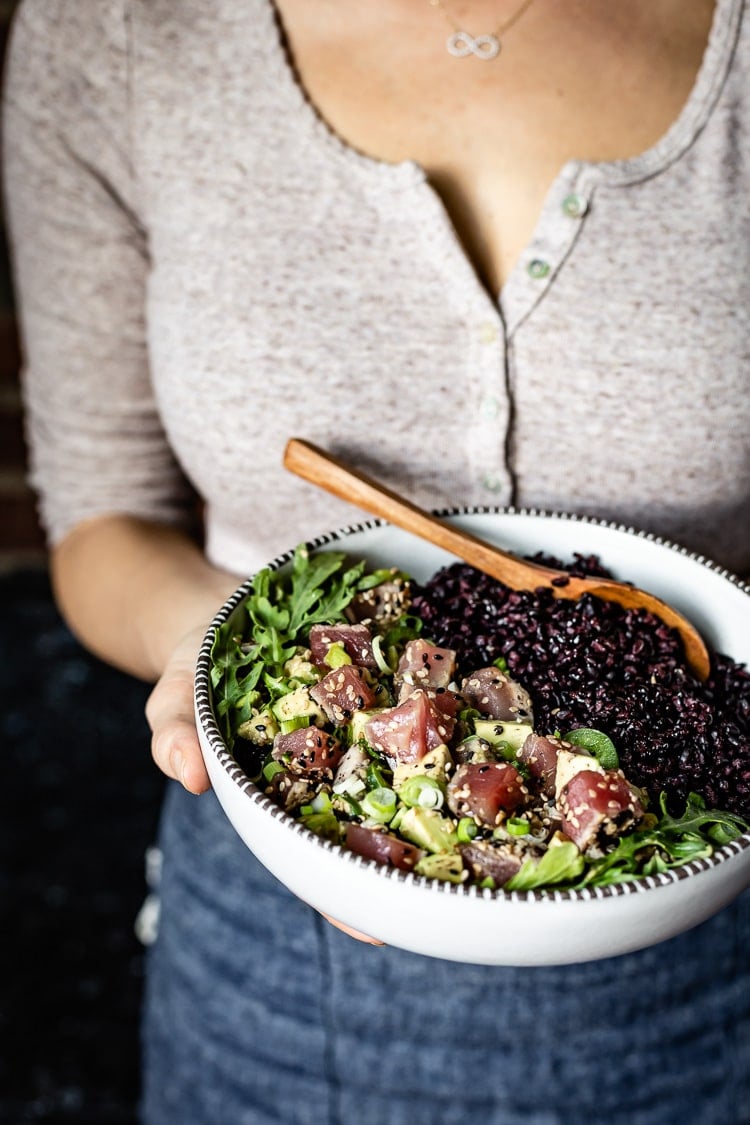
- Use it as a base for your grain bowls: I serve my Sesame Seared Tuna Salad over black rice, which turns it into a filling meal. You can also swap quinoa with black rice in my Sweet Potato Quinoa Bowl.
- Add a cup of black rice into soups and stews: You can add it to any soup or stew recipe that uses pasta/orzo, or quinoa as a filling.
What to Eat With Black Rice?
You can serve this black rice recipe with any of your meat, chicken and vegetarian meals as a whole grain side dish. A few of my favorites are:
- Ground Turkey Meatloaf
- Pot Roast
- Cornish Hen
- Whole Roasted Chicken
- With vegetable dishes like Baked Asparagus, Roasted Delicata Squash, and Whole Roasted Carrots
Expert Tips for Success:
- Black Rice Stains: When cooking black rice keep in mind that it stains clothes, cooking utensils, and even countertops. So, be careful when handling it.
- It is best to use a heavy bottom pot with a tight fitting lid: While you can use any pot to cook black rice, if you have it, I recommend using a Dutch oven with a tight lid and preferably with a dark interior when cooking black rice. Doing so will help cook it evenly and hide the black stains. I use my 4 quart round Staub Dutch Oven (affiliate link.)
- Every brand is different: I have tested these recipes several times using each method with all the brands I mentioned at the beginning of this post. Please keep in mind that the cook time might slightly vary depending on the brand and method of cooking you are using. Please use my recipes and recommendations as a place to start and adjust accordingly based on the brand and method you are using.
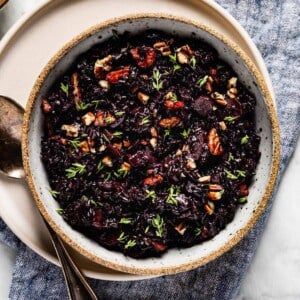
Forbidden Rice Recipe (Black Rice Recipe)
Ingredients
For Cooking It Like Rice (The Absorption Method):
- 1 cup black rice
- 2 cups water, chicken stock or vegetable broth would also work
- 1/2 teaspoon kosher salt
For Cooking it Like Pasta:
- 1 cup black rice
- 6 cups water
- 1/2 teaspoon kosher salt
For The Black Rice Pilaf
- 2 tablespoons of olive oil
- 1 small onion, chopped
- 2 small carrots, cut into small pieces approximately ½ cup
- 2 stalks of celery, cut into small pieces approximately ½ cup
- 1 clove of garlic
- ½ cup dried cranberries or raisins, roughly chopped
- 1 cup black rice
- 1 ¾ cups liquid, water or stock
- ½ cup pecans, chopped
Instructions
For cooking it like rice (aka the Absorption method)
- Place black rice, water, and kosher salt in a medium saucepan or Dutch oven with a tight fitting lid over medium-high heat.
- Bring to a boil, put the lid on, turn the heat down to low, and let it summer for about 30-33 minutes or until all the liquid is absorbed.
- Remove it from heat (keep the lid on) and let it rest for 10 minutes. Fluff it with a fork.
For The Pasta Method:
- Place water, black rice, and kosher salt in a medium saucepan or dutch oven.
- Bring it to a boil and let it simmer (stirring occasionally) for 20 minutes or until the rice is fully softened.
- Drain the liquid using a colander as soon as it cooks and serve.
For Black Rice Pilaf:
- Cook the vegetables: Heat vegetable oil in a medium saucepan with a lid over medium-high heat. Add in onion, carrots, celery and saute for 5 minutes or until softened. Add in garlic, fresh thyme leaves, a handful of dried cranberries and saute for 30 seconds.
- Add the black rice and cooking liquid: Add a cup of black rice and 1 ¾ cups of water (chicken stock or vegetable broth) salt and pepper. Bring to a boil, turn the heat down to medium-low, put the lid on, and simmer for 30 minutes or until all the liquid is absorbed.
- If you prefer, top it off with chopped pecans/walnuts and garnish with fresh thyme leaves. Serve.
Notes
- The nutrition information listed below is for 1 cup of cooked black rice.
- If you want to learn how to cook black rice in a pressure cooker or a rice cooker, check out my Instant Pot Black rice and Black Rice in rice cooker recipes for everything you need to know for each method.
- To Store: Bring leftover cooked black rice to room temperature, place it in an airtight container and store in the fridge upto 4 days.
- To Freeze: Bring cooked black rice to room temperature, spread it onto a parchment-lined sheet pan, place in the freezer for upto 2 hours or until frozen, and then store it in a freezer friendly container.
- To Thaw: Allow it to sit at room temperature for 1 hour. You can use it in cold dishes immediately or gently reheat to use in warm dishes.
Nutrition
Nutrition information is automatically calculated, so should only be used as an approximation.
The first time I published this Forbidden Rice Recipe was back in May of 2016. Since then it has been a favorite in our house. Today, Jan 2023, I am updating that old post with some new photos and additional helpful information.











Hi Aysegu ! And thank you for the history lesson about forbidden rice, it makes it even tastier 😉
I personally discovered this awesome rice in a Thaï restaurant in Paris, coming perfectly whit a fish green curry.
It was steamed over banana leaves ; unbelievable ! Thought I never dare this method, I may have a piece of advice for beginners : the proper rice/water ratio is, imho, 1 vol. rice for 1.7 vol. water. The slower cooking being the best. Forgive my english, I’m french…
Best regards.
Vadim
Hi Vadim,
I can totally understand your English 🙂
So glad to hear you enjoyed the short history of Forbidden rice. The way they served in that restaurant sounds amazing.
Thanks for your input.
Cheers!
I have made Forbidden Rice as a salad many, many times! I love it!
In the fall I make it with Fuyu Persimmons (cubed) and Pomegranate seeds & chopped kale. Talk about a powerhouse of nutrients!
The Fuyu Persimmons (the flat ones are the ones you can eat like an apple) are sweet and crunchy and the Pomegranate seeds pack a splash of juice with every bite. They are sweet, tart & also crunchy! This is an amazing combination & looks spectacular when plated. Give it a try, you will not be disappointed.
Enjoy!
Judy
Hi Judy,
I can only imagine. I would love to try your recipe.
Will you please share what kind of dressing do you use? I’d love to make it and share it in my social media 🙂
I soaked my Black Rice overnight and it expanded to double…. I tasted it and it seems to be almost soft enough as it is to eat without cooking…. Is that unusual ? I am making it tonight for guests so hope I don’t overcook and also have right ratio…. now we will have abundant Black Rice… any comments??
Hi Fern Merle-Jones,
It is normal for the rice to expand after soaking. I still recommend cooking it in 2 cups of liquid for 20 minutes or so. Though feel free to keep an eye on it after the 15-minute mark to prevent it from overcooking.
I hope this helps.
Excited to make this! I soaked it overnight and it expanded. Do I rinse post soak? I want to cook it with bone broth. Will this work? Same ratios? Since it expanded do I still add 2 cups of water to the 1 cup rice? Thanks!!!!
Hi Rebecca,
YAY! Glad to hear that you are trying it.
Here are the answers to your questions.
Do I rinse post soak? You can.
I want to cook it with bone broth. Will this work? I think it would, but I usually do 1 cup of broth and 1 cup of water. However, both would work.
Since it expanded do I still add 2 cups of water to the 1 cup rice? I think the liquid ratio should be fine. If anything you might end up with some liquid in the pan. I’d recommend keeping a close eye after the 15-18 minute mark.
I hope this helps.
Hi, thank you for your recipe! It’s informative and easy to follow. I have two questions:
I made forbidden rice for the first time last week. I cleaned the rice, let it soak, and cooked it following similar steps; however, my rice came out mushy. I’m trying to figure out why and what I can do next time to make sure that hasn’t happened. Any tips?
Also, on other pages I saw that people suggested letting the water boil before adding the rice. Is there a difference between doing that and adding the rice to the water from the beginning? Thank you and I look forward to your response!
Hi Elizabeth,
I answered your question on IG as well 🙂
I am not sure why it would be mushy as I am not sure how long you cooked it.
I never boiled the water before adding the rice before. I think what makes my recipe work very well is soaking overnight.
I hope this helps. Cheers!
If I decide to soak my black rice overnight, do I then cook it in the liquid, or do I drain the liquid and cook with fresh water?
Hi Mark,
I would drain it and cook it in fresh water. But please be aware that the cooking time would be less when you soak your rice. To gauge doneness, I would keep a close eye on it.
Hope this helps.
Ice
Thank you for this post! I just bought my first bag of black rice from the Korean Market. When you do soak the rice, do you drain and throw away the water you soaked it in?
I rinsed the rice and am now soaking it, thoughts on cooking it in the water it soaked in?
Thank you so much!
Hi Lina,
Yes, I do throw away the water and start with clean water.
I hope this helps.
I’ve probably read this post 4 times lol! I have black rice soaking at this very moment , and your girl is bursting with excitement to try this out! Thank you for the inspiration!
YAY! This is music to my ears. I hope you’ll like it as much as we do.
I am always here if I can answer any questions.
Cheers!
Soaking beans and grains also soaks out the water-soluble Vitamin Bs. Just do a quick wash and then drop the grains slowly into boiling water so that boil does not stop.
Good to know. Thanks for sharing your knowledge AA.
I am so intrigued- what an interesting rice!
This is such an amazing day starter!
This has everything I could’ve ever wanted to know about forbidden rice, thank you!
Fantastic
I never knew about forbidden rice before!
Super tutorial, thanks!
I’m having a party and I want to serve a forbidden black rice salad with seasoned dressing. I’d like to make it tonight to serve tomorrow
Thank you for sharing everything about forbidden rice. I always wanted to make it but was afraid to ruin it. Love your recipe too. Very creative. ??❤️
Hi Karibe,
I am so glad you liked it. I hope you will succeed following these directions.
All the best of luck.
This bowl looks absolutely amazing -so so colorful! Lovely!
how did i miss this post?! I love forbidden rice as well and agree that it makes such a nice morning bowl. Have you every tried with coconut milk and mango? So dreamy. I’ll have to try with almond milk + granola + berries like you too. 🙂
Oh I have to try that. As a matter of fact, we have coconut milk and mango in the fridge now. I think you just helped me with what I am making for breakfast this morning. 😉
Thanks my dear!
We have this rice in the north east states of India, Assam and Manipur. I like to make a kheer (Indian sweet pudding) with milk, and cardamom elaichi, sprinkle nuts and raisins on top and have it like a dessert!
Oh I have to try that Mou. It sounds so delicious.
Thanks for coming by.
I love forbidden rice. The good thing is that if you let it soak, it cooks much faster (20 min or so). I have been pairing it up with everything and it’s earthy and nutty tones compliment both savory and sweet dishes very well.
Thanks my friend. <3
Thank you for sharing your great information. I read your blog daily . It give me so much knowledge and ideas.