
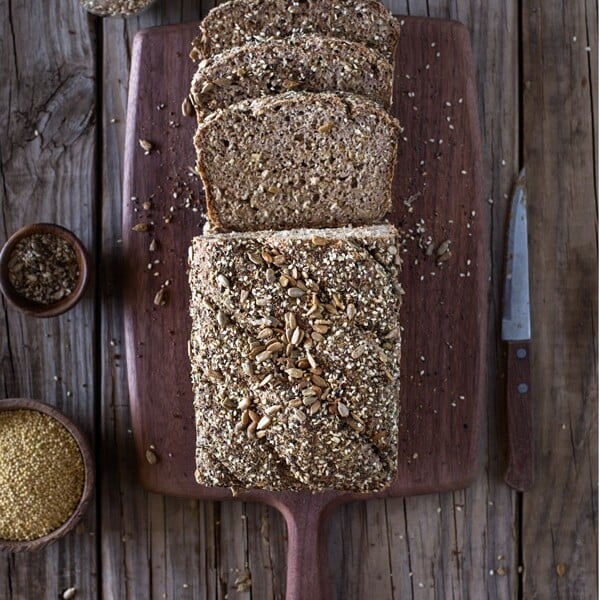
I have never baked a gluten-free bread before. Neither my husband nor I do have celiac disease. And truth be told, I don’t know much about baking gluten free. But when Amy Chaplin, who is one of my favorite vegan/vegetarian chefs, posted this recipe on her blog I was intrigued.
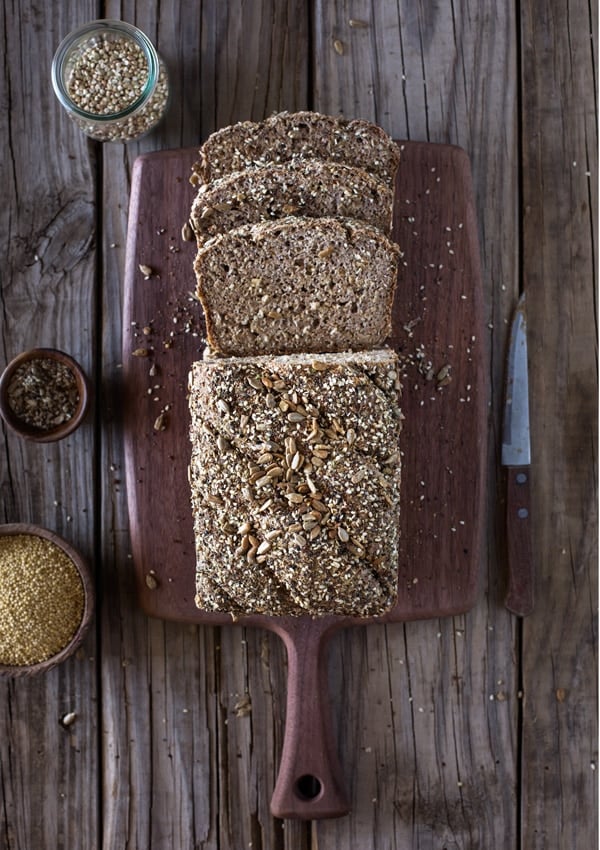
To be honest, I wanted to read more about it not because it was gluten-free, but because it was made with using millet and buckwheat (both of which are super healthy grains) instead of all-purpose flour. Even though there are many similar bread recipes out there on the Internet, I usually have a hard time figuring out where to start when it comes to baking bread using ancient grains.
But when she posted this recipe, I knew that it would be a good one to start with. Luckily as suspected, it didn’t disappoint. This bread is so easy to make, even for someone like me, who is learning her way around the world of vegan/gluten-free baking. It also is foolproof.
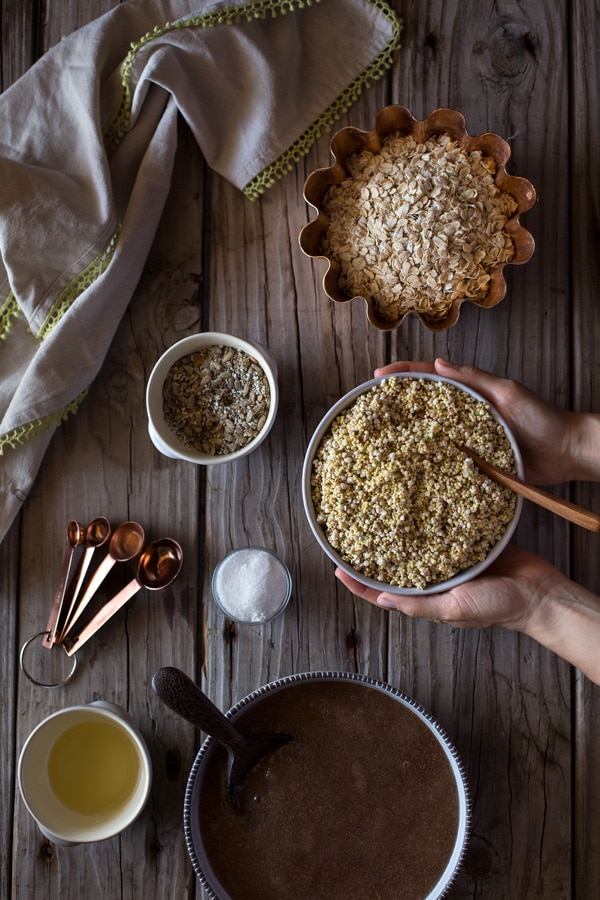
To make it, in addition to millet and buckwheat Amy uses an ingredient called psyllium seed husk (or also called psyllium husk). The first time I read about psyllium husk was a year ago, when David and Luise of Green Kitchen Stories posted a recipe called Cashew Rawgurt. It was basically yogurt made with cashews instead of milk.
They used psyllium husk to give it a creamy consistency that was similar to the consistency of yogurt. But then, more and more I read about gluten-free and healthy baking ingredients, I realized that it is a much more of a common ingredient than I thought.
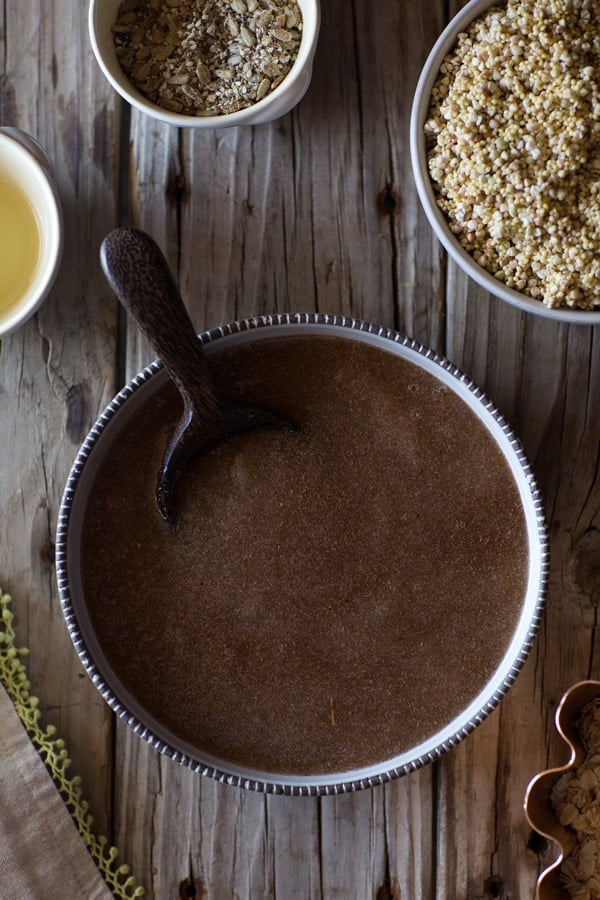
After some research and surfing through the Internet, I found out that psyllium husk (the photo above is what it looks like after it was mixed with water):
- Is a natural source of soluble fiber that doesn’t include wheat, and therefore it is gluten-free.
- Has multiple health benefits, because when mixed with liquids it turns into gel, which acts like a sponge and absorbs toxins in the digestive tract. Because of this reason, people with constipation and irregularity issues are advised to incorporate it into their diets.
- Is used in gluten-free baking, because due to its gel-like structure (when mixed with water/liquida), it acts like gluten giving body to baked goods. It is mostly used when baking gluten-free bread, pizza dough, rolls, pasta, etc.
- Is sold in the gluten-free baking section of the supermarkets as either in capsules or in powder form. (This recipe uses the powder form. In particularly, this brand.)
With all that being said, there are many resources on the Internet cautioning people as some allergic reactions to pysllium husk have been recorded. Therefore, if this is your first time consuming it, I recommend trying in a small dose before using it to bake bread.
You could also do what I did; simply add a tablespoon of it in a smoothie (another popular way of incorporating it into your diet) to see if you react to it in a negative way. Luckily, both my husband and I were totally fine after we drank our smoothies.
About This Millet Buckwheat Recipe
In her blog post, Amy posted a halved version of this recipe. However, she suggested that it would be fine to double it, which is what I did. To make the dough, you use a food processor. If you have a regular 9-cup food processor like mine, you may find that when all the ingredients are placed in it, it may look like it is too much. For this reason, on my first try I made two separate batches, mixed them in a bowl, and then baked them together.
But on my second try (which is the bread in the photos), I placed everything in the food processor at the same time. It was quite full, but I stopped every 8-10 seconds to scrape the bowl during the process to make sure that everything is mixing evenly. Either way, they both turned out nicely. So it is totally up to you and your preference. Also if you want, you can half the recipe for a smaller loaf.
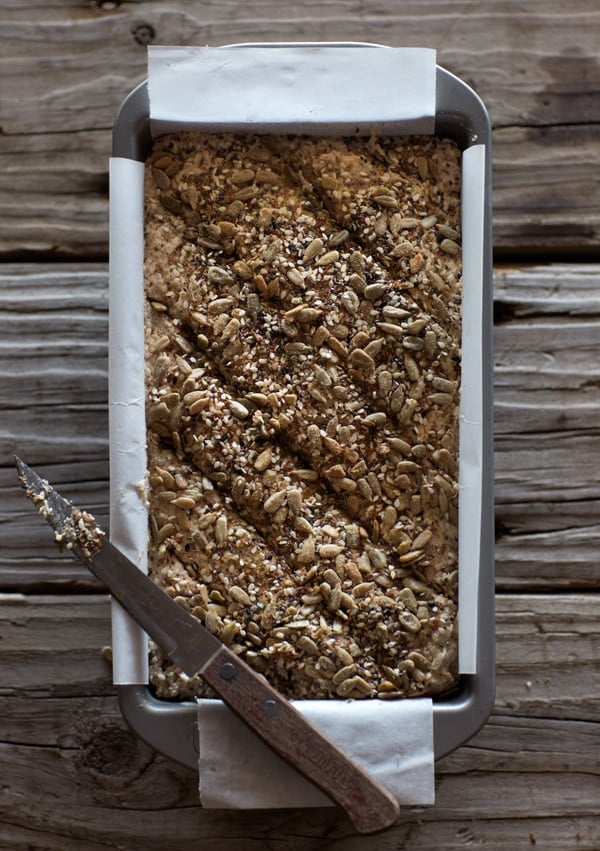
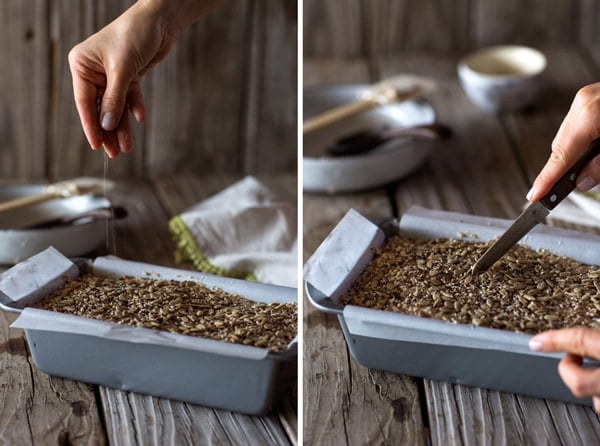
On a final note, it is imperative to score the bread twice- once before it goes into the oven and an additional time after it has been baking for 40 minutes. Doing so lets some air into the dough for it to cook properly. Since it is better to score it in the same place, I suggest sprinkling it with the seeds prior to scoring it for the first time. That way when it is time for you to score it again you can easily see the marks.
Other Gluten-Free Recipes You Might Be Interested In
- Almond-Kasha Porridge with Ginger and Pineapple
- Overnight Coconut Buckwheat Porridge
- Sorghum Pilaf with Lentils, Feta, and Grapes
- Creamy Mushroom Pasta with Fresh Peas and Ricotta
- Gluten-Free Almond Flour Bread
- Need more inspiration? Check out all our bread recipes

Millet and Buckwheat Bread
Ingredients
- 1 cup buckwheat groats
- 1 cup millet
- 3 cups filtered water
- 1/2 cup psyllium whole husks (I used Yerba Prima brand), 1.5 oz.
- 1 1/2 + 1 cups, (9 oz.) rolled oats, divided (Gluten-free type)
- 2 tablespoons baking powder
- 2 teaspoons sea salt
- 4 tablespoons walnut, coconut or olive oil would work too oil
- 2 teaspoons ground flax seeds
- 2 teaspoons chia seeds
- 2 teaspoons toasted sesame seeds
- 2 teaspoons sunflower seeds
Instructions
- Place buckwheat groats and millet in a large bowl. Pour enough water to cover at least 2 inches from the top. Allow it to soak for 10 hours or overnight.
- Pre-heat the oven to 350 degrees. Line a 9X5 loaf pan with parchment paper. Set aside.
- Drain the buckwheat and millet combination in a strainer. Rinse well and set aside. (Buckwheat will be slimy so it is important to wash it well.)
- Place psyllium whole husks in a bowl and add the 3 cups of water. Mix and set aside. 5-10 minutes should be enough.
- Place rinsed buckwheat groats, millet, and 1 1/2 cups oats in the bowl of a food processor. Process until completely combined and grains are almost completely broken down, 45-50 seconds. You may have to scrape the bowl 1 or 2 times.
- Add in the soaked pysllium husks, rest of the oats, baking powder, sea salt, and oil in the bowl of a food processor. Process until everything is combined, 30-45 seconds. Make sure to stop and scrape the bowl a couple of times.
- Transfer the dough into the prepared loaf pan. Spread it out using the back of a spatula.
- Combine flax, chia, sesame, and sunflower seeds in a bowl.
- Sprinkle half of the seeds on top of the bread. Using a sharp knife, score the top of the loaf in several places. (For a visual, see the photo above)
- Sprinkle the rest of the seeds and place it in the pre-heated oven.
- Bake for 40 minutes. Remove and re-cut the places you scored earlier to let some of the air in for the inside of the bread to fully bake. Return it to the oven and bake for 55-60 minutes or until a knife inserted in the middle comes out slightly sticky.
- Let it cool for 15 minutes on the kitchen counter and remove it from the pan.
- Before slicing it, allow it to come to the room temperature.
- You can store it in an airtight container for up to 4 days at room temperature or up to a week in the fridge.
Nutrition
Nutrition information is automatically calculated, so should only be used as an approximation.
This recipe is adapted from Amy Chaplin’s Gluten-Free Millet and Buckwheat recipe.










Hi, I love this bread.. I’ve made it 3/4 times.. This last time, I used 2/3 cup each buckwheat, millet, and quinoa. I added 3 tsp. garlic powder and it came out great.. Thanks for the great recipe.
Linda
Hello Linda,
I love the idea of adding quinoa into the mix. Thanks for sharing your experience and taking the time to leave a review.
Aysegul
You have just given me more ideas. I tend to make fermented buckwheat bread with lots of spices and seeds. After the seeds soak overnight, I don’t rinse it with water as those microbes are superb for the fermentation after. I only let the water drip off, so its quite gooey almost and then add it to the blender with water and salt. I let this sit for another 12-24 hours depending whether its winter or summer temperatures. Now I will add millet to the process….. thank you for this amazing recipe!
I am happy to hear you felt inspired Madeleine. Thanks for coming by.
I love this bread so much! I’ve made it dozens of times. I use yogurt in place of oil, which feels healthier (and adds a bit of tang). I also pour some whey in the soaking water with buckwheat and millet to help break down the grains. I’m going to try making this a “sweet” bread – substituting the oil with applesauce, and adding some cinnamon and raisins!
I am happy to hear that you like this recipe Allie. Thanks for coming by and taking the time to share your experience.
I didn’t read the entire post before making the recipe , I used my high speed blender after blending the buckwheat and the millet which was perfect I added the psyllium and all the rest of the ingredients except the nuts , I had no clue my high speed blender wouldn’t be able to mixe this . I transfer the entire mixe in a food processor it was a mess , it struggled to blend it , I added probably 1/4 more water it finally worked , I think it should have been blended better but it was difficult , I dumped it in a bread pan and baked it for the entire time plus another 12 minutes to the baking , I checked frequently to see if it was baked . I reduced the salt to 1 tsp next time 1 1/2 tsp will be perfect for my taste . The texture is very nice kind of chewy my next loaf should be better , I know now how to make it , I didn’t toast any seeds it get toasted enough in the oven I will add a few more different seeds like pumpkin seeds I didn’t use the flax , I also use sunflower oil . Seriously a very healthy bread it’s hard to stop eating it yum yum yum !
One question do you think I can reduce some oats like 1/4 less for easier mixing ? I thought it was very very thick almost impossible to mixe . I wish I could post a picture it’s 5 1/2” high beautiful !
WOW! Brigitte – Thanks for sharing your experience. Just out of curiosity, did you bake two loaves or one?
Hi! This is some of the best bread I’ve ever made! I have an allergy to yeast and insensitivity to gluten, so yaaay thanks for this, you’ve made it possible for me to have bread!!!
This is music to my ears Jan. I am thrilled to hear that you liked it.
Thanks for coming by and leaving a review.
Hi I made this recipe for the first time today. Tastes delicious, but after I took it out of the oven, the middle dropped, can you suggest how to stop this happening because I don’t know what I’m doing wrong.
Thanks heaps
Claire
I am sorry to hear that happened. That usually happens when you have too much liquid in the batter or if the temperature of your oven is lower than it should be. I know this batter is quite dense so that is the only thing I can think of.
Hope this helps.
Hi
Hope you’re doing good. I tried this recipe n it turned out really good.This was my first attempt at a a gluten-free bread and I was extremely happy with the result My only concern is that the top portion becomes too crispy, so is there any other way that I can make it a bit softer. Has anyone tried covering n then baking
I’ve made this before a couple of times. Such a good bread! Is it better to use avocado oil or extra virgin olive oil?
Hi Nadine,
I am happy to hear that you like this buckwheat bread recipe. I use them both but perhaps I like avocado oil more because it has a very mild taste. Still, EVOO would also work. I think it is a personal preference.
Thanks for coming by and taking the time to leave a review.
Cheers!
i’ve made this recipe 10 times and i’m eating a slice now. it is so wholesome and good, makes me happy like bread should, but doesn’t upset my system like gluten bread unfortunately does. i usually eat with a lil butter but nut butters, jam, and avocado are good too 🙂 it makes me happy to wake up in the morning and go toast a slice. i have made it with sprouted grains and that worked great as well. i always add about 2 T of water to the grains when i’m processing to make it easier to blend together. i also add a T of maple syrup to balance the flavor and i use olive oil cuz i always have that on hand. after i slice it i freeze it all so it stays fresh longer and take out a slice or 2 at a time to toast and eat. of all the times i made it, it turned out perfect every time. it really is fool proof. i know i’ll be making this for the rest of my life. i love it <3 thank you!!!!
Rosie,
Your kind words make me so happy. I appreciate you sharing your experience.
It has been a while since I made a batch. Reading through your words I found myself craving for it. This weekend I will make it again but this time following your tips as well.
Thanks for taking the time to share your experience and leaving a review.
Cheers!
Thanks for sharing this. I make this bread often and it’s amazing!!
My question to you is would these work as rolls? No big deal if they don’t as I’m happy to have a wholesome and delicious bread!
Thanks again 🙂
Hi there,
I am glad to hear that you like it. Sadly, I have never tried making rolls. Definitely worth a try though.
Also, the oats quantity in the recipe appears to have an error. What is the correct 2nd amount?
Hi PJ,
Glad to hear that you liked this bread.
Not sure what you mean though when you say “error”
The first amount is 1 1/2 cups and it goes into the food processor with buckwheat and millet.
And the rest goes in to the processor with the psyllium husk, baking powder, oil and salt.
Does this make sense?
Hmmm… for me, it reads “1 1/2 + 1 cup 9 oz rolled oats”. But I suspect the first amount is 1 1/2 cup, and the second amount is 1 cup, not 1 cup 9oz.
Yes, you read it right. I am sorry that it was confusing. I made a few adjustments to the recipe to make it easier.
Thanks for letting me know. Cheers,
Aysegul
I am on my third loaf! First time, followed the recipe as written – fantastic. Second time, used almond flour in place of (all the) oats, and added walnuts to the dough – delicious! But I did taste some of the baking powder. Third time used only 1 T baking powder, combo of almond flour, brown rice flour and oats, added sunflower seeds and walnuts to the dough, topped with sesame and poppy seeds – delicious! Third time didn’t rise quite as much, so denser loaf, but still tender and terrific. This recipe is so flexible! Love it!
This is music to my ears PJ. Thanks for sharing your experiments. I am going to try it with almond flour next time.
Cheers!
My buckwheat and millet is soaking as I type. After reading all the comments, I cannot wait! Question for all: has anyone tried adding nuts, and/or seeds to the dough before cooking?
Hello PJ,
This is a really fun to make and delicious bread. Hope you like it as much as we do.
I have not added nuts into the recipe but it has a very nutty texture to it. I would recommend trying the recipe as written first and then adding in other things.
Hope this helps.
I baked this today and it’s the most incredible bread! I couldn’t believe the height of the bread seeing there is no yeast in the recipe and the flavour was amazing.
I’m blown away and will bake this from now on. Thank you so much!!
This makes me so happy Vyk. So happy to hear that you liked it. I am a fan of it as well.
Cheers,
Aysegul
Beautiful even with a few adjustments, I used the 16 teaspoons of psyllium powder instead of husks, perfect, I did have to add a wee bit of extra water, maybe 1/4. I do not have a food processor so I used my blender and did made the buckwheat, millet and oats in batches and mixed it all together in a big bowl. Wet hands worked best????. So yummy, I haven’t been able to eat wheat for awhile and this is so good. Not too heavy but it is substantial like I like it.
Lisa,
This makes me so happy. I am thrilled to hear that you liked it.
Thank you so much for sharing your experience in such detail.
I have never tried making it in a blender but will be sure to give it a go next time I make it.
Cheers,
Aysegul
I’m so so excited to make this! Thank you for sharing.
I have my buckwheat and millet soaking and will bake it tomorrow.
Could I replace the oats with something else do you think? I would love to share this with a friend but I don’t have gf oats. If there isn’t a sub I couldn’t possibly go and buy some gf oats.
Thanks so much ????
Hello Vyk,
I am happy to hear that you are excited about this recipe. It is a great gluten-free bread that I make often myself.
I would not recommend substituting oats with anything else. I just don’t know if it would work with anything else without actually trying it. However, psyllium husk powder should work.
I hope this helps.
Amazzzing recipe after trying so many gf df that I can’t even count! My kids enjoy it…what a keeper!
Only issue is the flour sometimes clumps in the food processor. Would love any tips for that if possible….
Hi Vicky,
I am thrilled to hear that you liked this recipe.
Have you tried stopping the food processor and scraping down the sides a few times as you process the ingredients?
I usually do this 6-7 times. As you know, since the food processor is quite full it helps to move things around manually a few times.
I hope this helps.
Cheers!
Yes I do scrape but need to more often I guess. Love love this bread and have told a few friends about it too!
I plan on making a batch over the weekend and will see if I can find an easier way to do this. I will update you if I find a better way.
Thanks Vicky. I am thrilled to hear that you liked it.
I’m wondering if any non-vegans have tried adding eggs to this bread recipe (which I make often, by the way…) so that it’s a bit fluffier and more moist.
Hi Lori,
This is a good question. I have never tried adding eggs to this recipe.
I will your comment here and hopefully, someone will chime in.
It looks delicious! What could I substitute the psyllium husks with?
Hi Anna,
Glad to hear that you liked it.
Sadly, what makes this recipe work is the psyllium husks. It is a key ingredient for it to work. Therefore, I won’t be able to offer you a substitute for it.
I am not sure where you live, but nowadays most larger supermarkets sell it in their healthy food section.
I am sorry I couldn’t give you a helpful answer, but I would hate to offer something and you end up with a recipe that doesn’t work.
Please let me know if I can help in any other way.
Finally a delicious GF bread. Thank you Aysegul for such a good recipe (and easy to prepare). Looking forward to my breakfast tomorrow morning to try it with avocado and my cashew herbed cheese. Cheers from Europe. Isabelle
This is music to my ears. Thanks for letting me know Isabelle.
I made this bread with steel cut oats and a blend of millet and quinoa and it turned out absolutely wonderful.
Oh SO good to know. I will try it using steel cut oats next time. Thanks for letting me know April. Cheers!