
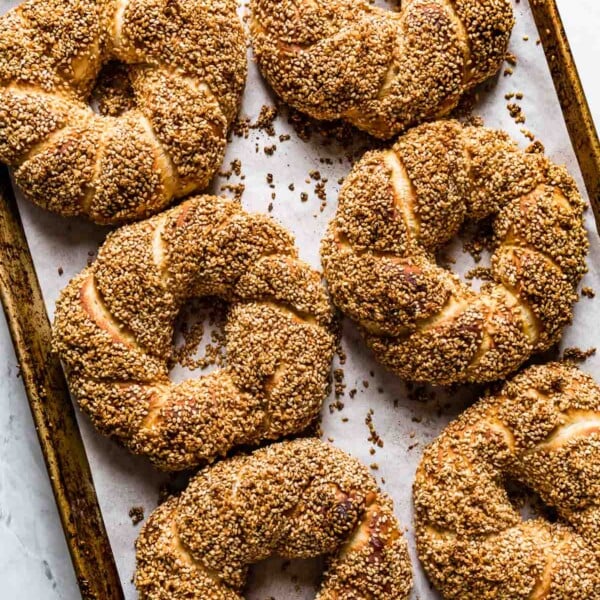
If you have ever visited Turkey or are a fan of Turkish food, you know our version of a bagel, Turkish Simit bread. It is one of those iconic Turkish recipes, right up there with Turkish Coffee, Borek, and Turkish Bulgur Pilaf.
Usually served with feta cheese, olives, and Turkish tea or ayran (aka Turkish Yogurt Drink), simit has been a breakfast staple in every Turkish household for centuries. Sadly, for those of us living outside of Turkey, it is not easy to find (unless you are living in a town with a great Turkish restaurant.) The good news is that making simit at home is easy with my foolproof method.
What Is Simit?
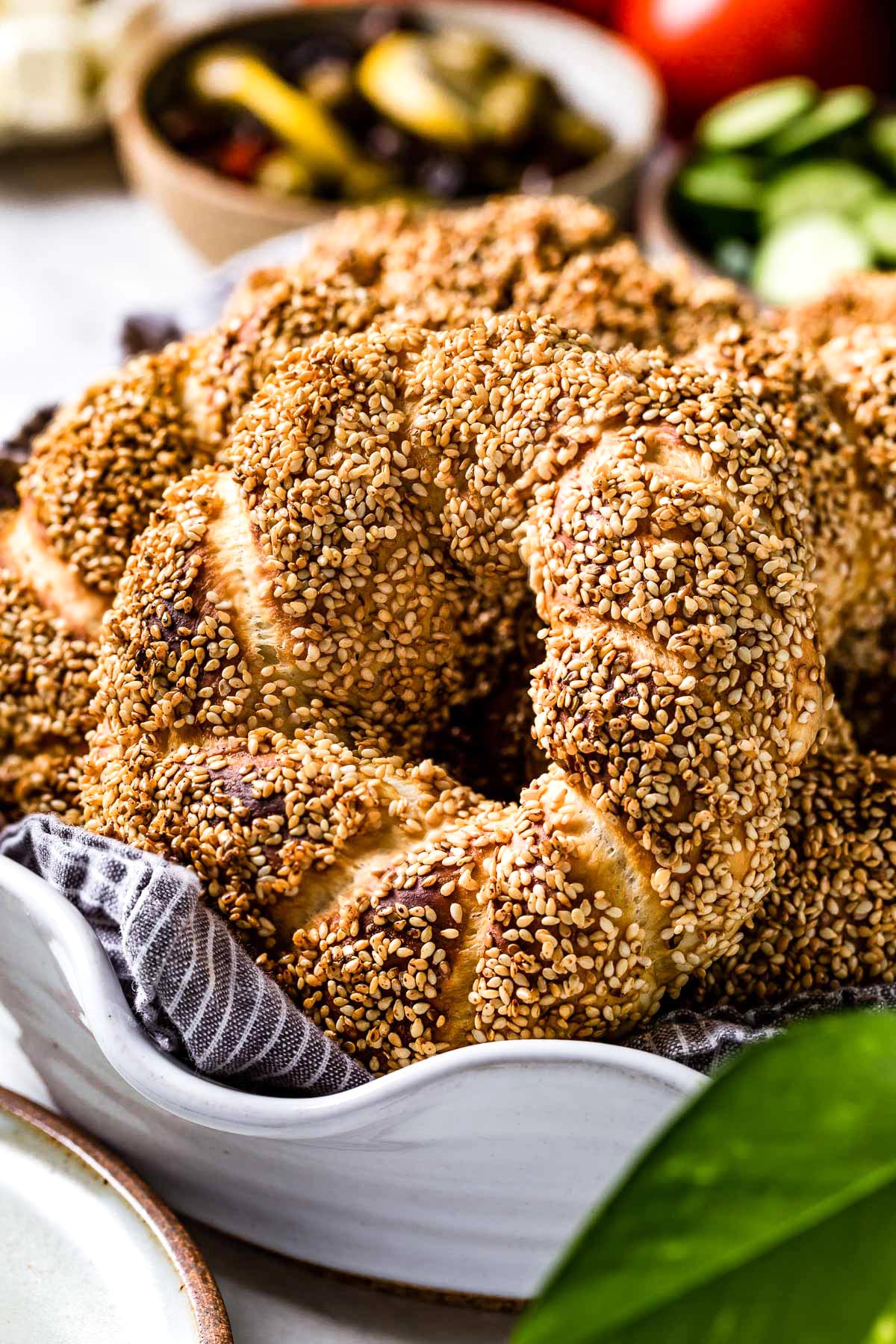
Simit also referred to as gevrek or gjevrek, is a sesame-bathed, circular Turkish bread. It is similar to an American bagel in how it looks but crustier on the outside and softer on the inside.
Because it is mainly served for breakfast, I’ve heard some people in the US refer to it as “Turkish Bagel” or “Turkish Pretzel.”
Traditionally sold by street vendors on the streets of Turkey for no more than $0.50, it is usually made by twisting simit dough and dipping it in molasses and toasted sesame seeds before baking it in the oven.
Simit Ingredients:
To make it easier, I will divide the Turkish Sesame Bread ingredients into three parts.
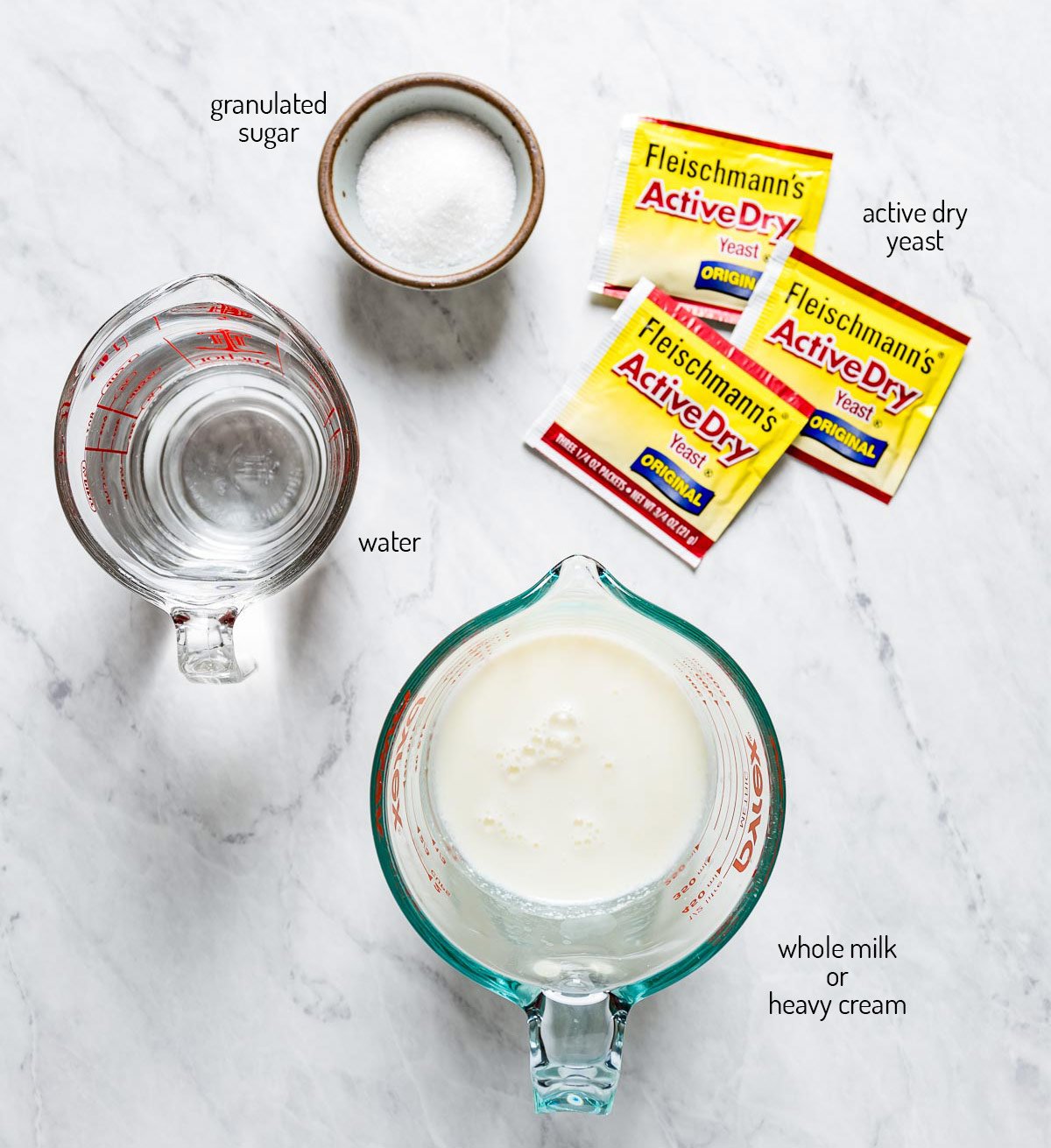
The Yeast & Milk Mixture:
- Water at 110 Fahrenheit degrees (43 Celsius degrees)
- 1 cup whole milk (or heavy cream) at room temperature: You can use milk and heavy cream interchangeably in this recipe. The version of Simit bagel made with heavy cream is richer due to the higher fat content of heavy cream. Still, if you can’t find it, you can substitute it with whole milk. I would not recommend substituting plant-based milk in this recipe.
- 2 tablespoons or 3 (1/4 oz.) packets of active dry yeast (I used Fleischmann’s)
- Granulated sugar
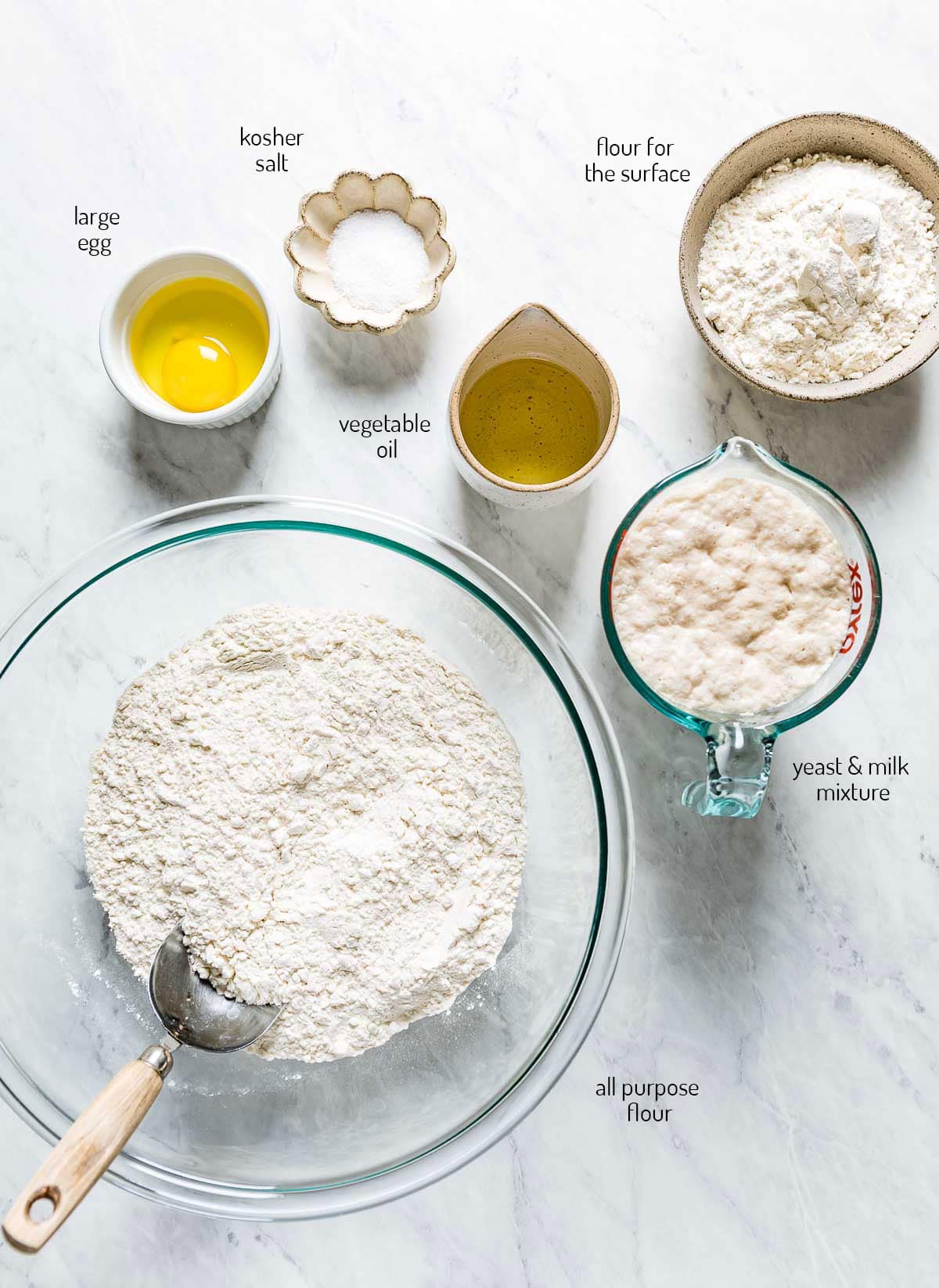
The dough of the ingredients:
- All-purpose flour: I tested this recipe with several all-purpose flour brands, and the results were similar. I personally like King Arthur Flour as it has a higher amount of protein which is ideal for making bread. The recipe below starts with 5 cups, but you will need at least 1 to 1 ½ cups or more flour to use on the surface as you are kneading the simit dough.
- Large egg
- Kosher salt
- Vegetable oil (avocado oil, canola oil, or grapeseed oil would all work.)
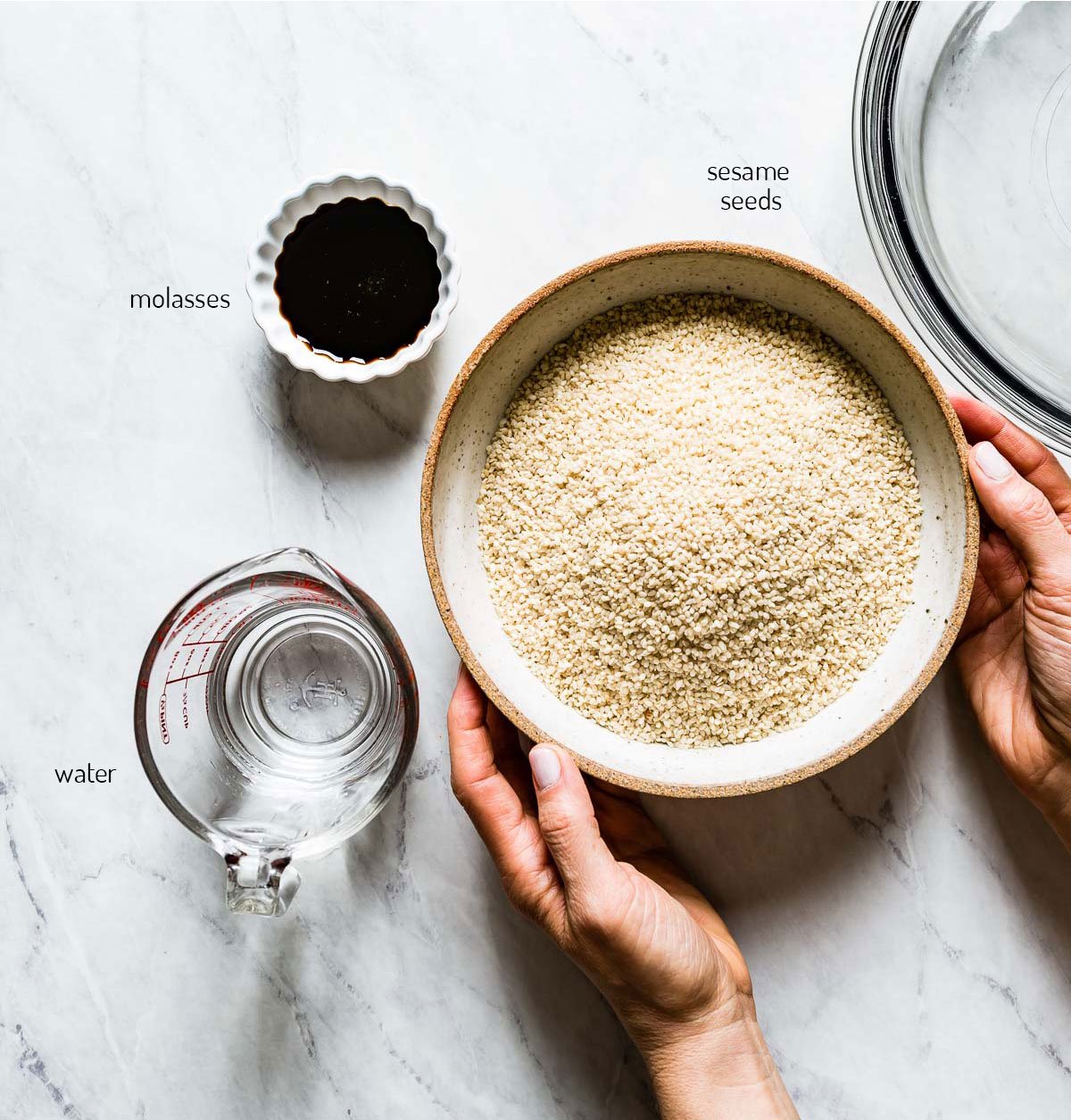
The Sesame Coating
- Molasses (I used Grandma’s Molasses – affiliate link): Alternatively, you can also use pomegranate or grape molasses (this Turkish Molasses is my favorite) if you can get your hands on them, which is traditionally used in Turkey. Molasses coating helps sesame seeds stick to the dough and give the overall bread slight sweetness that its known for.
- White sesame seeds
How To Make Simit?
This Simit bread recipe below makes ten sesame breads. Even though the steps look like a lot, the process of making simit is quite simple.
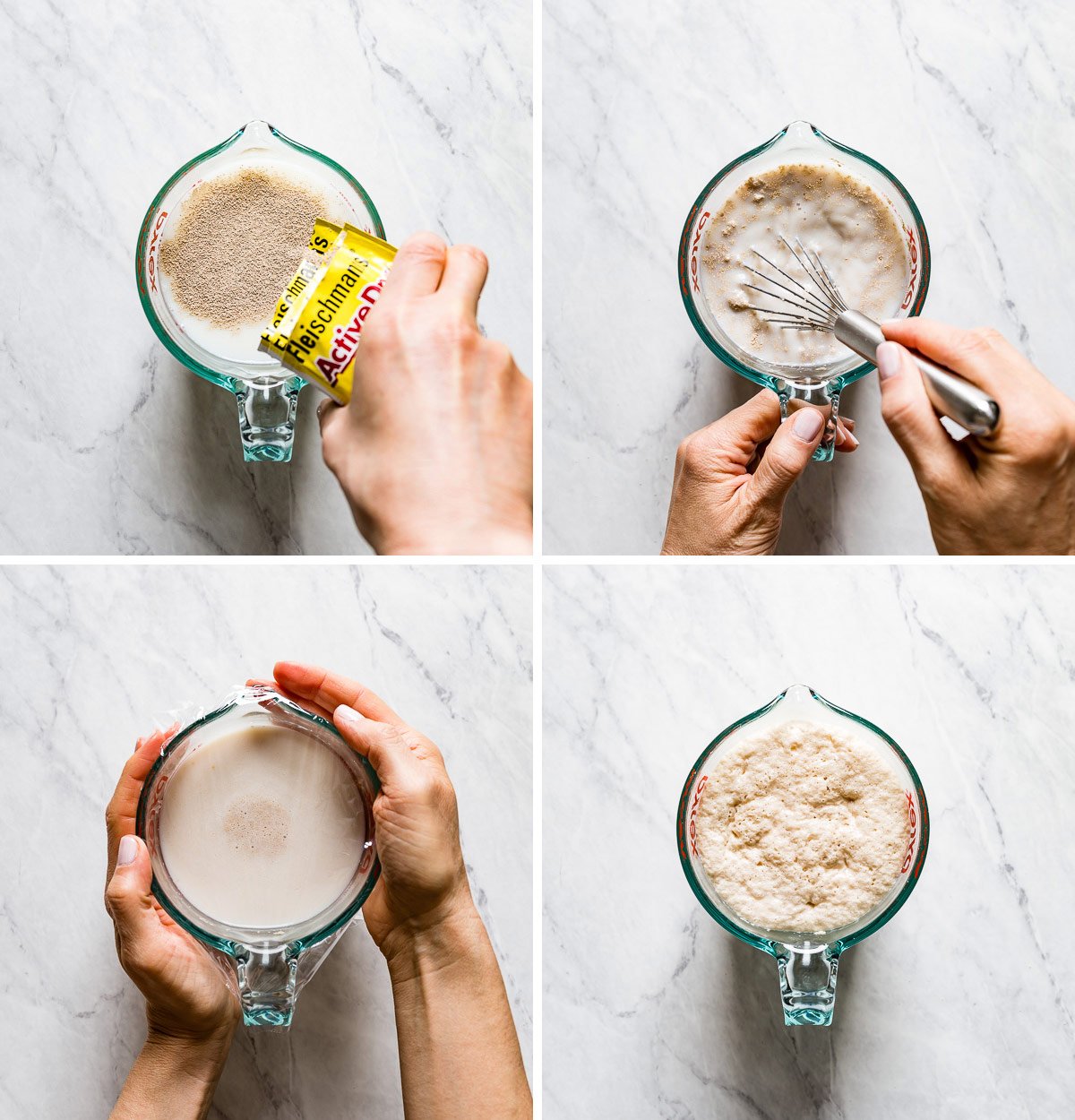
- Activate the yeast: Place water, milk, sugar, and active dry yeast into a measuring cup. Give it a quick whisk, cover it with stretch film, and let it sit on the counter for 10 to 15 minutes or until bubbles form on top.
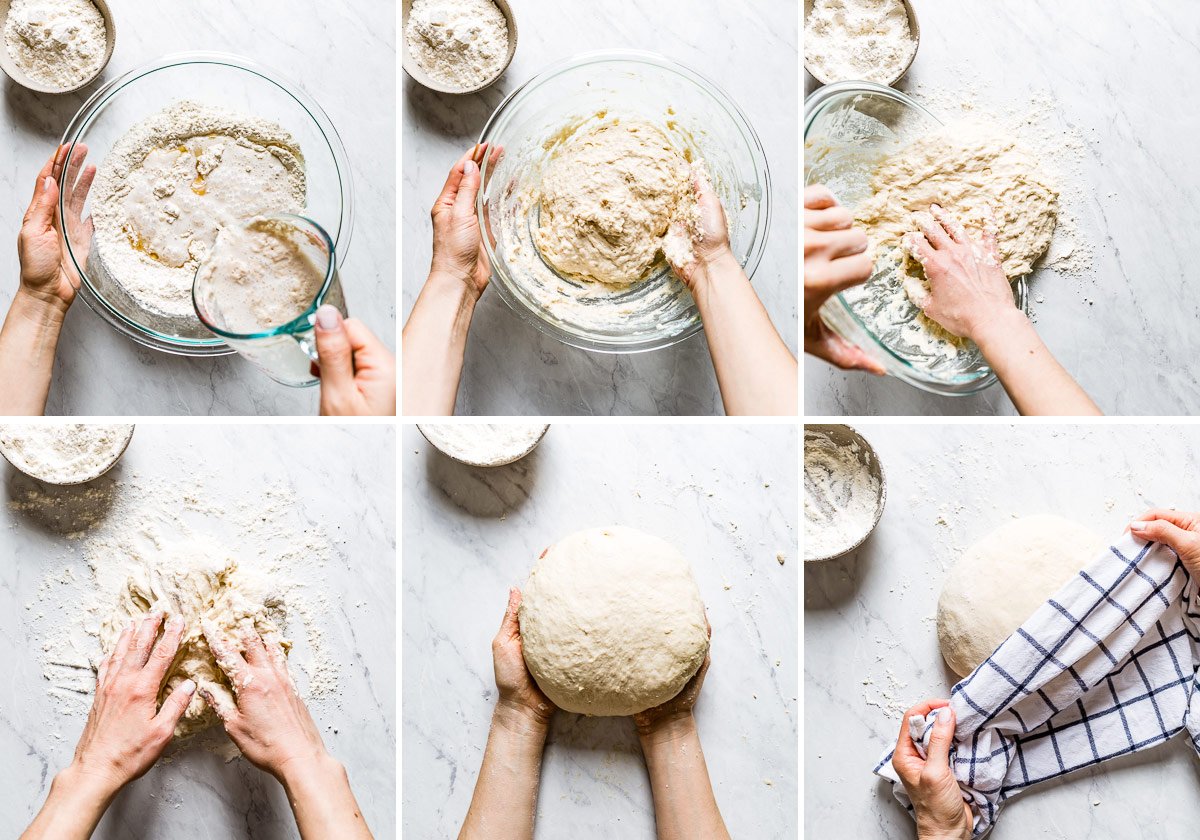
- Make the simit dough: Place 5 cups (700 grams) of all-purpose flour, kosher salt, oil, egg, and now-risen yeast-milk mixture in a large mixing bowl. Start mixing the sesame Turkish bread dough by hand until it comes together. Lightly dust the counter with flour and dump the dough onto the surface. Knead by hand to form a smooth and elastic dough until the dough is not sticking to your fingers. This may take around 15 to 17 minutes. Alternatively, you can do this in a stand mixer. I included the instructions for that in the recipe card below.
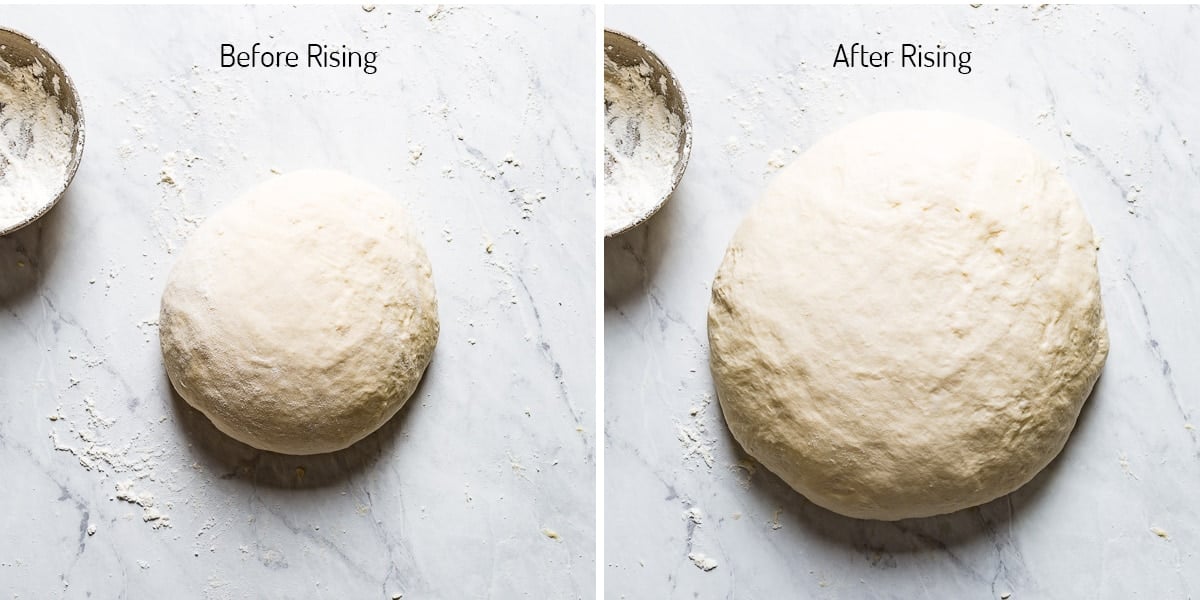
- Let the simit dough rise: Lightly wet a kitchen towel with hot tap water and place it over the dough. Let it sit on the kitchen counter until it doubles in size, 30-45 minutes.
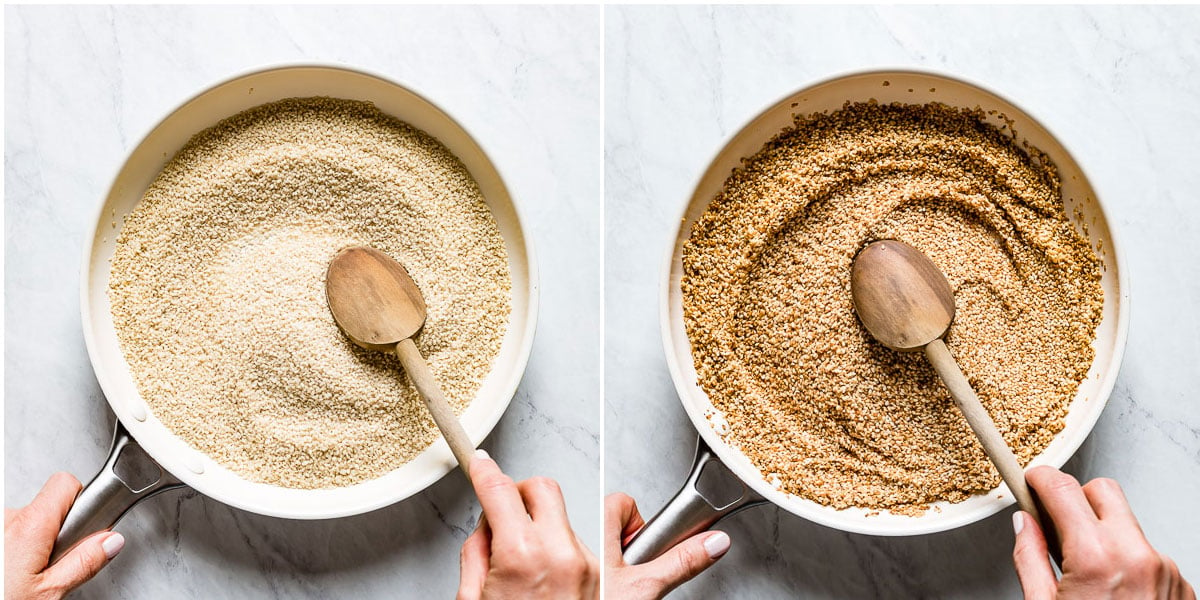
- Toast sesame seeds: While the dough is rising, place sesame seeds in a large non-stick skillet over medium heat, stirring constantly, and toast until they turn golden brown, 20-25 minutes. Transfer to a large shallow plate to cool.
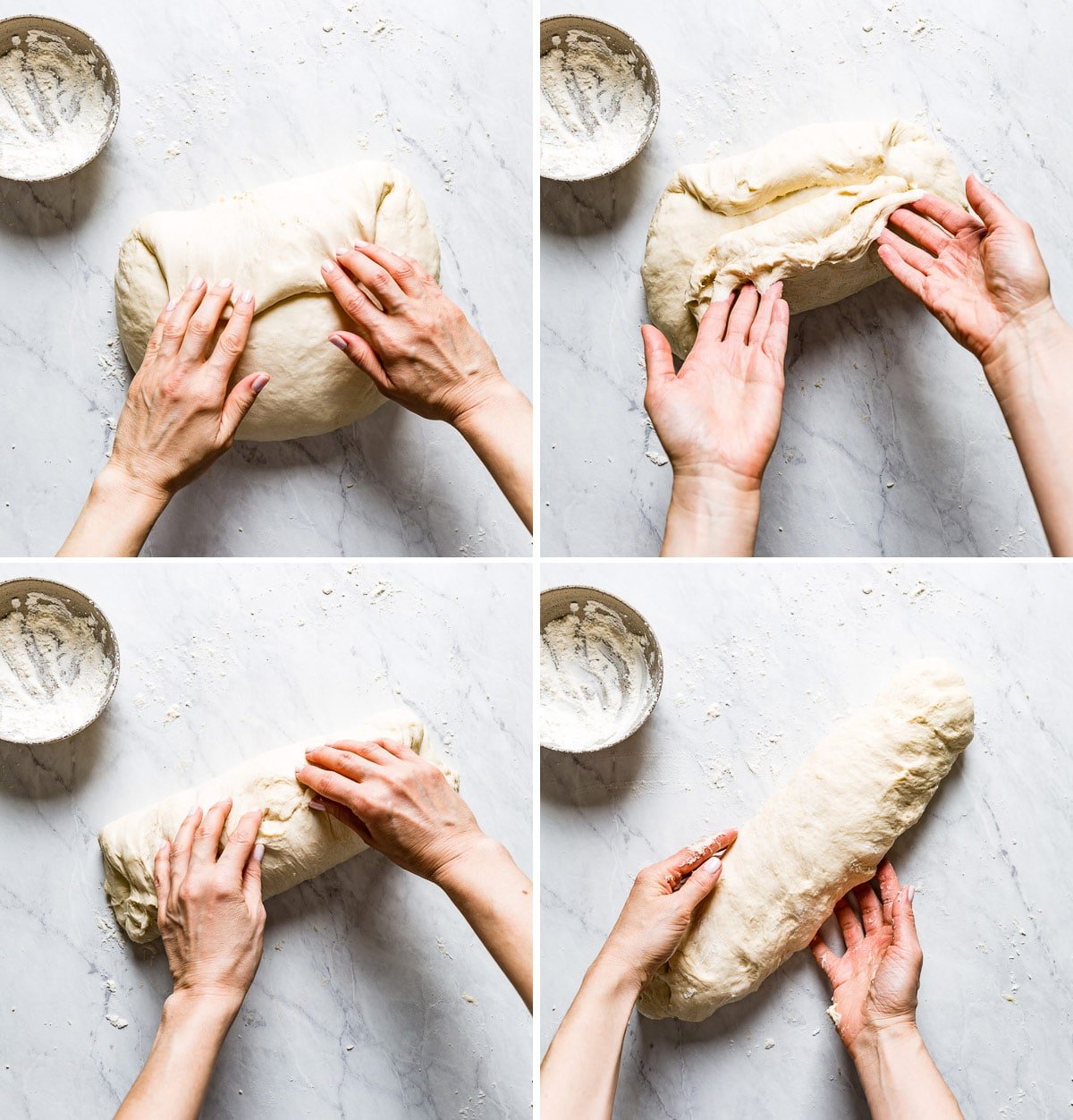
- Turn the dough into a cylinder: Fold the dough from each end onto itself towards the middle, gently pinch, and roll into a cylinder of roughly 20-inches (51 cm.)
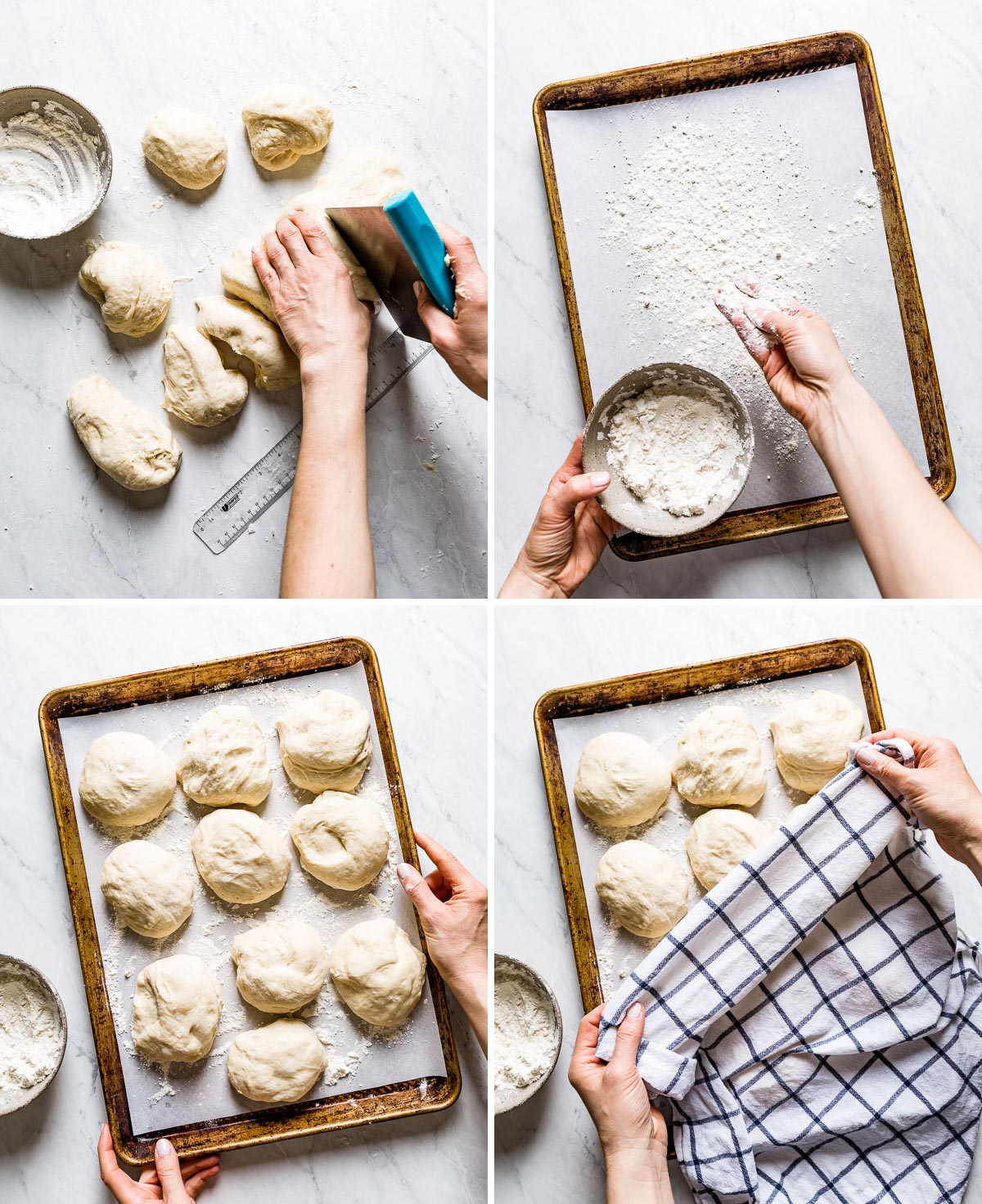
- Divide the now-risen dough: Using a sharp knife or a pastry scraper, divide the dough into 10 equal pieces and transfer onto a sheet pan (lined with parchment paper and sprinkled with flour.) Cover it with a clean kitchen towel (to prevent them from drying as you work on each piece.)
- Preheat the oven to 400 F degrees. Line two baking sheets with parchment paper.
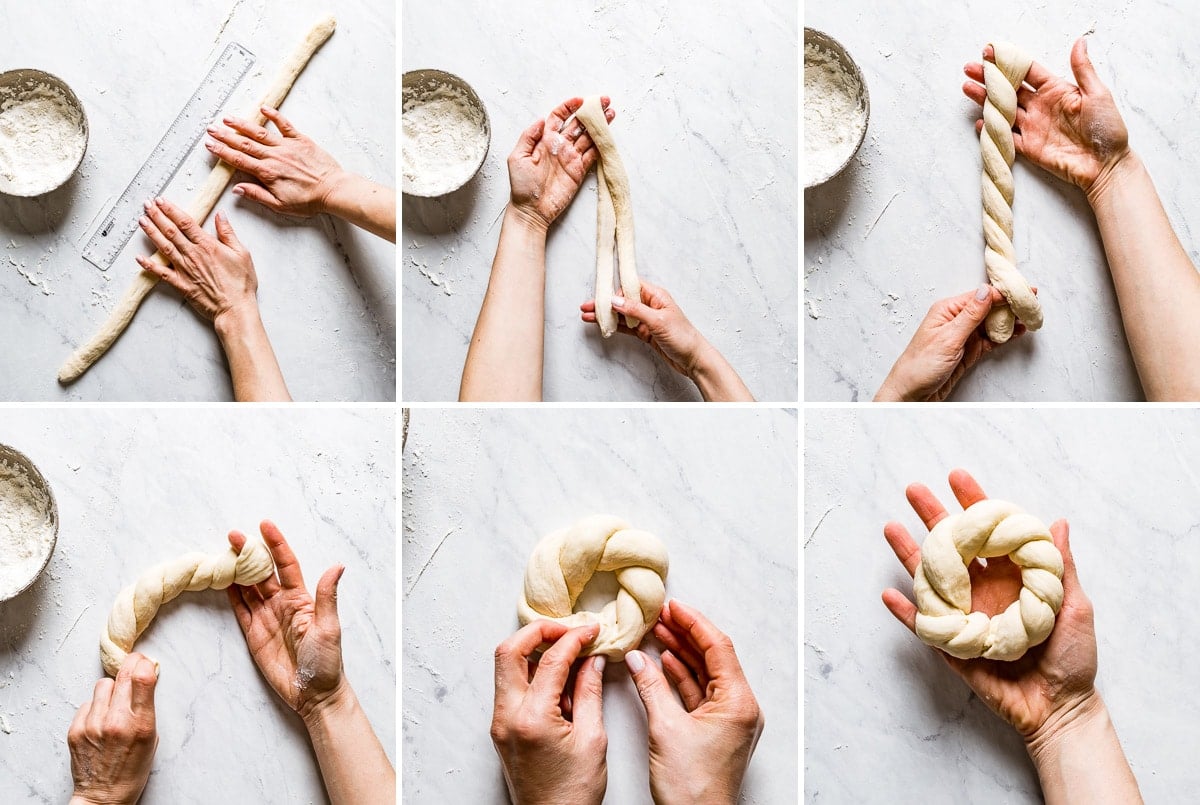
- Shape each simit dough: Roll each dough ball into a roughly 40-inch (102 cm) long strand. Fold the string onto itself using your finger to hold it in the middle. Twist the dough in the opposite direction to form a spiral rope. Roll it into a 5-inch diameter ring and gently pinch the end to seal.
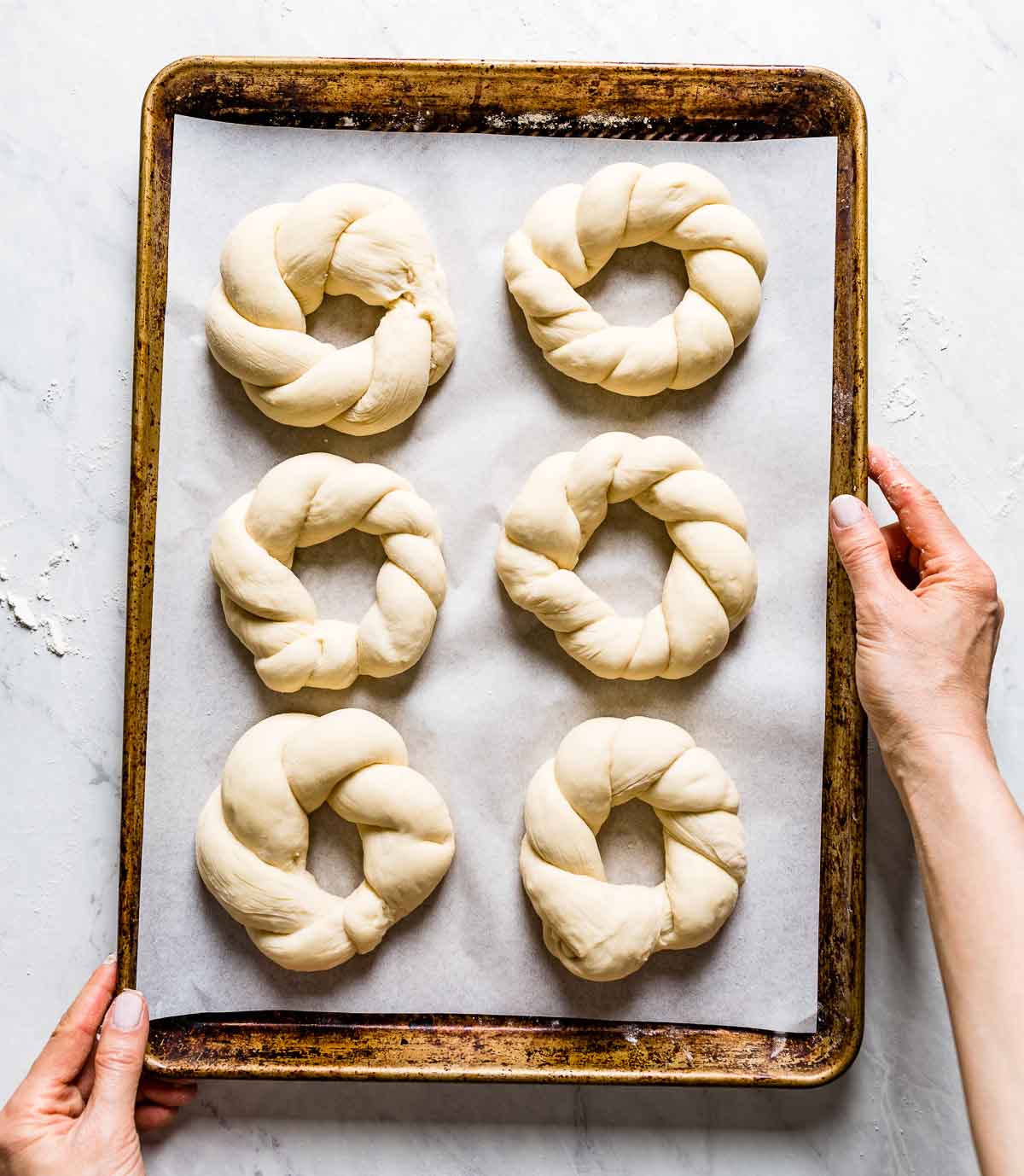
- Let them rest: Transfer the now-shaped dough onto the parchment-lined baking sheet. Repeat the same process for the rest of the dough balls. Let them rest until they rise for 30 minutes. How much they rise depends on the temperature of your kitchen. (You can learn more about this in the tips section below)
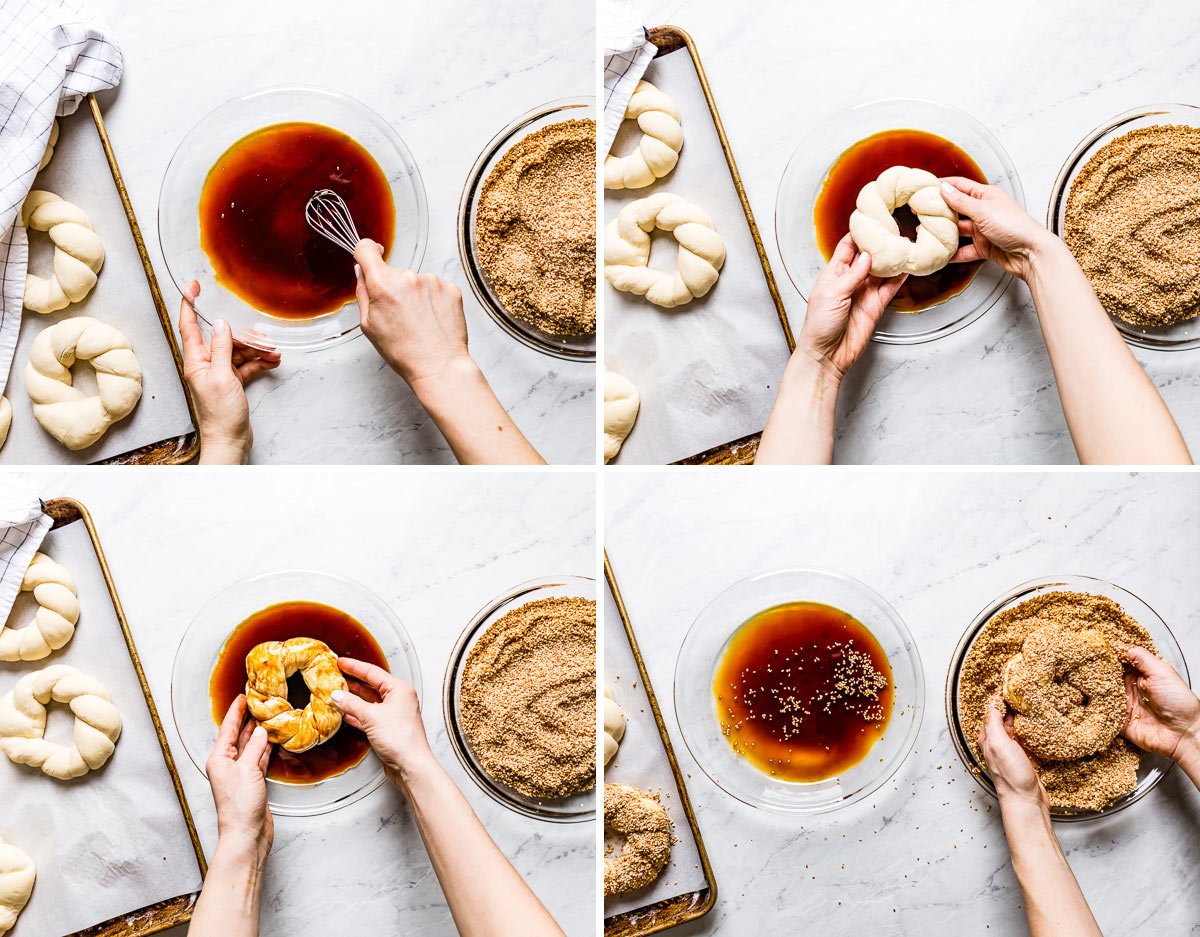
- Dip simit into molasses and sesame seeds: Mix together molasses with water in a large shallow plate. Bring in the sesame seeds. First, dip simit into the molasses mixture (on both sides) and then into the sesame seeds making sure that all sides are fully covered with sesame seeds. Transfer the sesame-seeded bread onto a baking sheet and repeat the same process for the rest of the limit. Do not skip this part as sesame seeds add a nutty flavor and crunch texture to simit, which makes this bread so special.
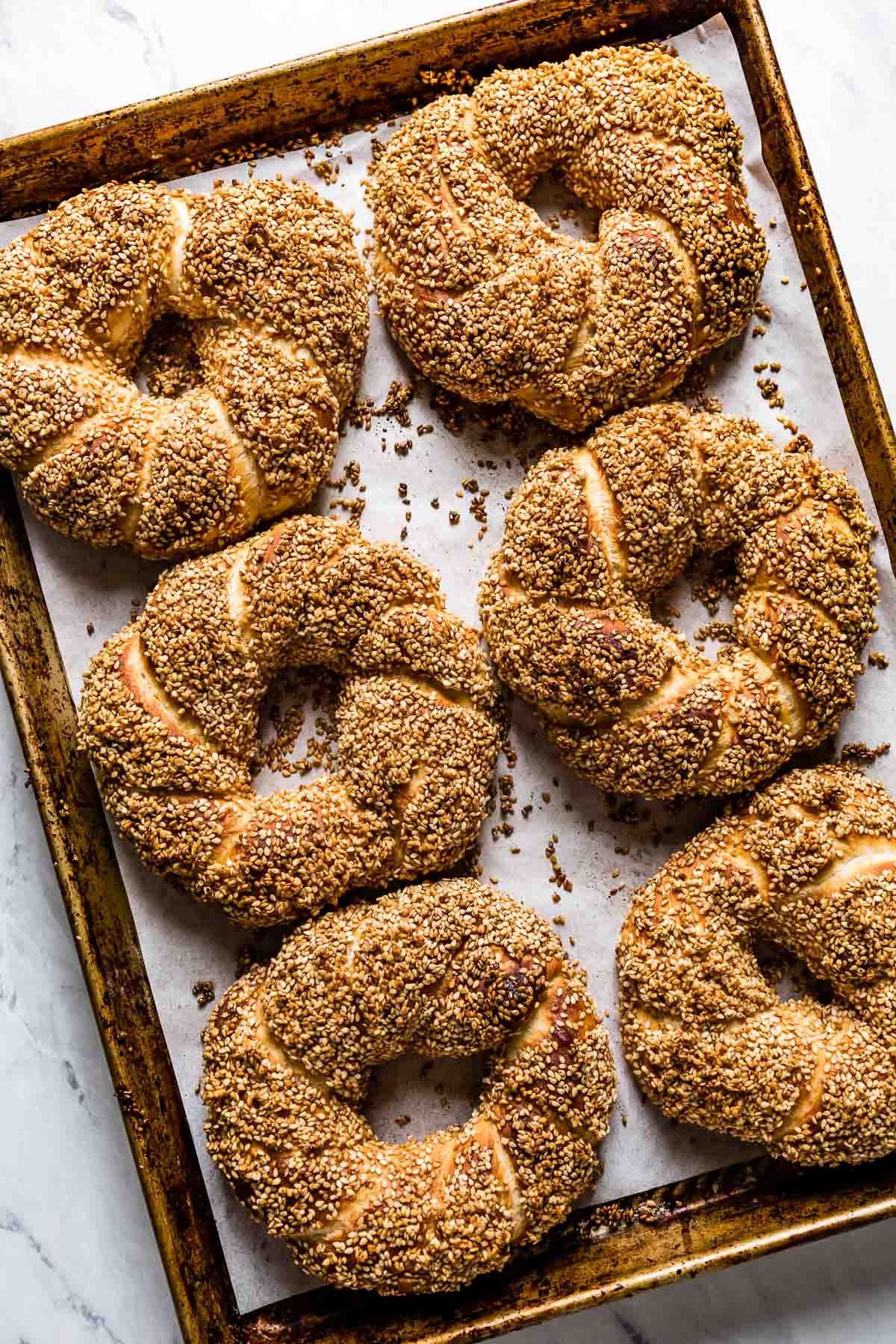
- Bake: Bake both sheets in the oven for 18-20 minutes or until golden brown, making sure to rotate them from top to bottom halfway through the baking process. Let them cool for 5 minutes and serve while still warm.
What To Serve with Turkish Simit Bread?
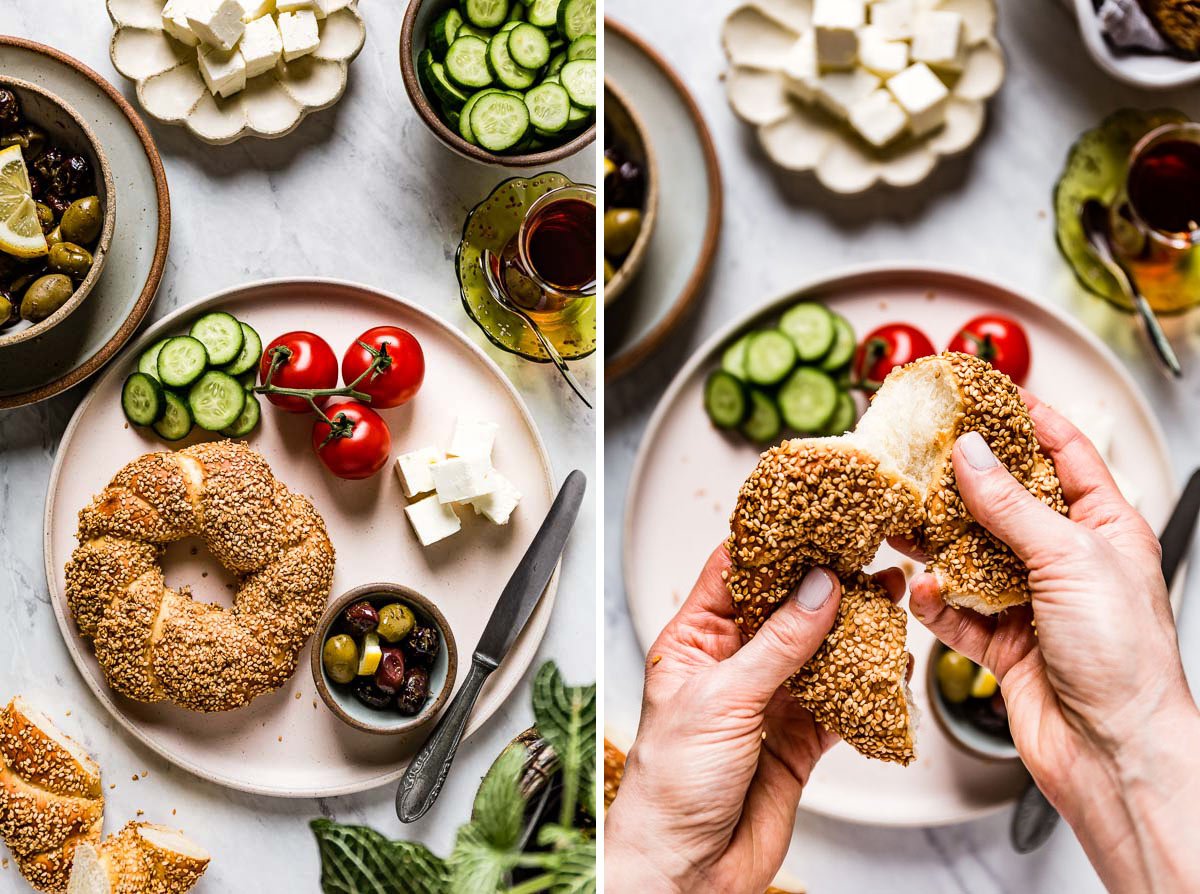
Traditionally, we serve simit bread for breakfast with feta cheese, olives, sliced tomatoes, cucumbers, Turkish eggs and Turkish tea or Ayran. With that being said, you can serve it with any cheese and even with your favorite jams or preserves.
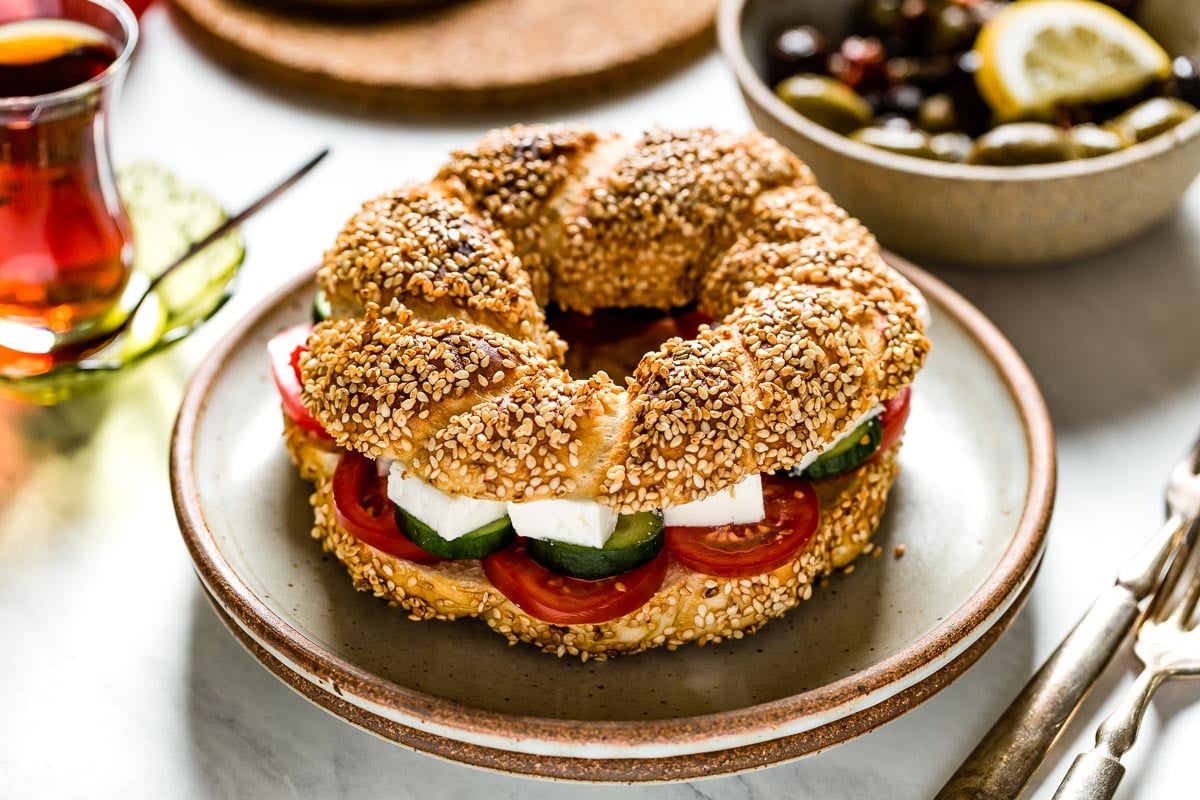
Alternatively, you can make a simit sandwich by slicing it horizontally in half and place cheese, sliced tomatoes, and cucumbers in the middle. You can also do a simit toast by toasting each slice in a toaster.
How To Make Ahead, Store, and Freeze?
The best part of this Turkish bread recipe is that it can be made ahead. So, you can easily make a batch, eat some right away, and freeze the rest for later.
- Make Ahead: Whenever I am serving simit for breakfast, I make the dough a day before (up to 12 hours before), store it in the fridge, and bake it fresh in the morning. To do so, make the recipe until the step right before dipping the braided dough into sesame seeds. Place them on a parchment-lined baking sheet and store them in the fridge. In the morning, remove them from the fridge, let them come to room temperature for about 15-20 minutes, and follow the recipe as written.
- To store leftovers: Bring simit to room temperature, place in a plastic bag, remove the air out as much as you can, and store at room temperature. It should be fresh for up to 2 days. You can toast it for a few minutes before serving.
- To freeze: Repeat the same process but place in the freezer instead. When ready to serve, let it thaw for 10 minutes on the counter, and then heat it in a preheated 300 F degree oven for 10-12 minutes.
Expert Tips:
- The shape doesn’t matter: If this is your first time trying your hand in making this Turkish simit recipe and if your simit strands don’t look like the ones in the pictures, do not worry. I promise that they will look better as they rise, and regardless of their appearance, they will taste great after they are baked. You will get the hang of it after you make it a few times.
- The temperature of the water & milk: For the active dry yeast to get activated, your water must be around 110 F degrees (43 Celsius), and your milk (or heavy cream) is at room temperature. If they are colder or warmer, the yeast might not get activated, and as a result, your simit Turkish bread might fall flat.
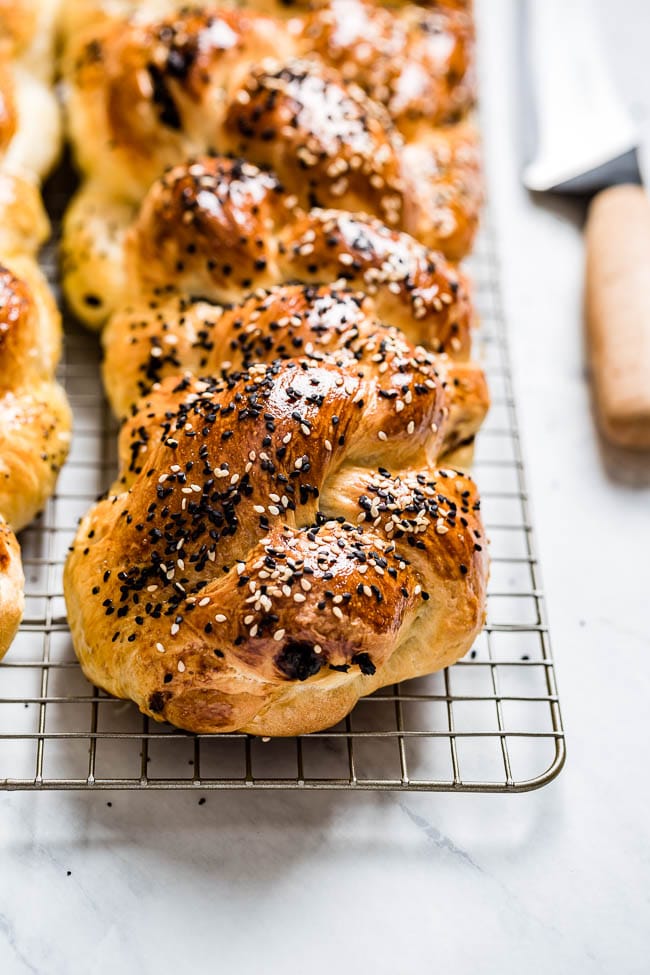
- The temperature of your kitchen: As it is with any bread recipe (like I explained in my Challah bread recipe), the temperature of your kitchen (or the time of the year) will affect how much your dough rises. If you are making simit on a hot summer day, it will likely double in size. However, I have made this recipe several times all throughout the year, and it consistently delivered great results.
- The temperature of your oven: Most Turkish simit recipes start with a 400 F degree oven, bake for 20-25 minutes, raise the temperature to 425 to 450 F degrees and then bake a little longer (usually 5-7 minutes). I tested this recipe several times and did not think it was necessary to bake it in two stages. However, I recommend keeping an eye on it after the 18th-minute mark.
- Sesame seeds cook faster than the simit dough: Be careful when you open the oven door at the end of the baking process as some smoke might come out due to sesame seeds cooking faster than the limit.
- Istanbul Simit vs. Street Simit: If you ever visit Turkey, you will see that the simit sold on the street does not have this many sesame seeds because sesame seeds are costly. My mom, who grew up in Istanbul, always made simit with a lot of sesame seeds, similar to how I did here. If you are not a fan, you can adjust the amount and use less.
FAQs:
This Turkish sesame bread is made by mixing flour, yeast, milk (or heavy cream), sesame seeds and molasses.
Compared to American bagels, the Turkish simit is lighter and crustier. Also, there is no boiling done during the process of making simit. Instead, we dip simit dough in a water-molasses mixture and coat it in sesame seeds before baking.
It tastes like a lightly sweetened, savory crusty bread with a very pronounced sesame flavor.
While it is not traditional, you can use honey instead of molasses. However, please be aware that the taste might be slightly different. To do so, use a mixture of 5-6 tablespoons of honey and 4 tablespoons of water instead.
Yes, you can, and I recommend using the dough hook to knead. Also, you might have to adjust the amount of flour by adding more until the dough no longer sticks to the bowl.
Each serving of this recipe is 370 calories.
Other bread recipes you might also like
Other Turkish recipes you might like
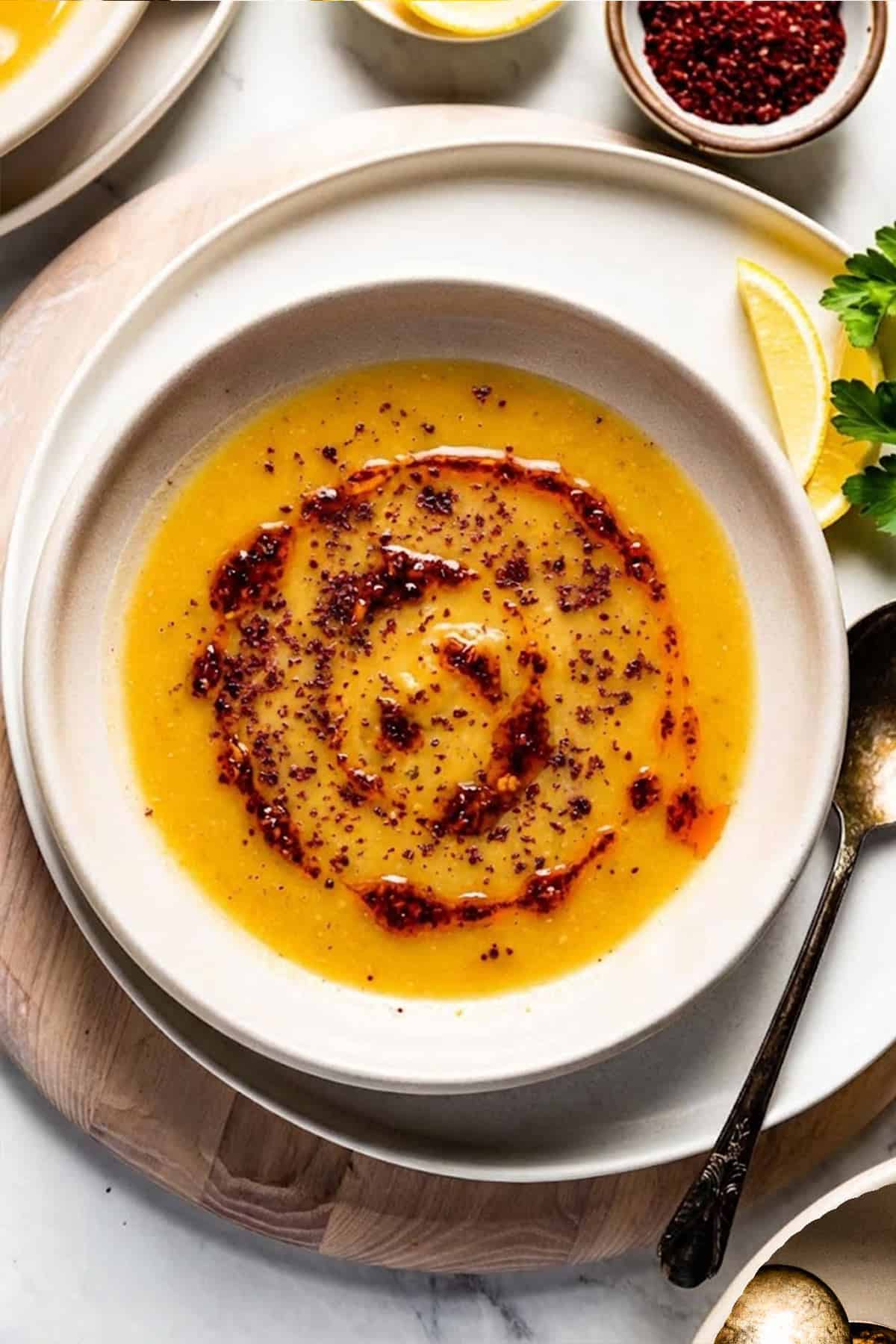
- Turkish Lentil Soup
- Yogurt Salad Dressing
- Tabbouleh
- Quinoa Tabbouleh
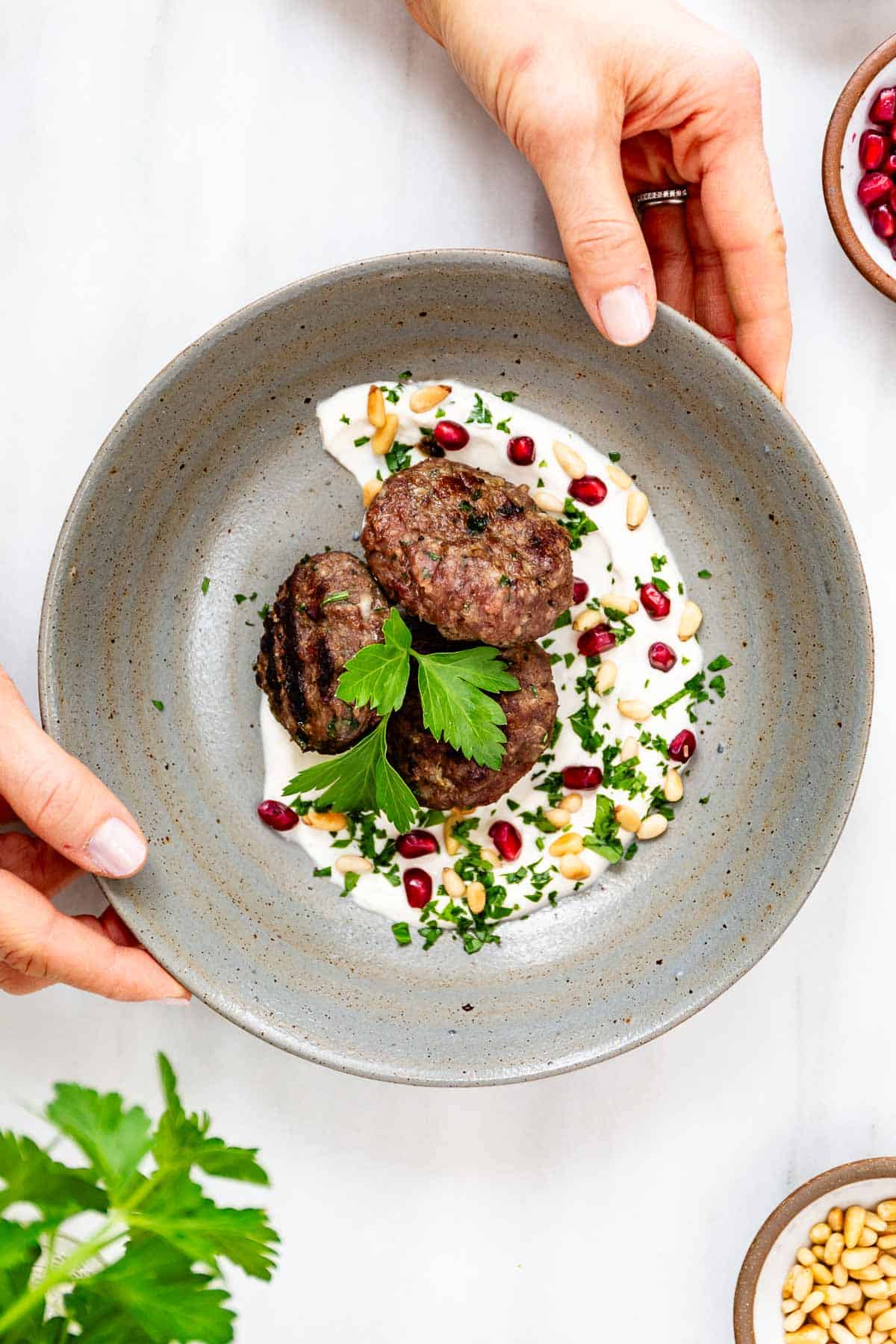
- Turkish Meatballs Recipe
- Tahini Yogurt Sauce
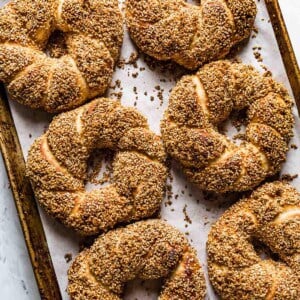
Turkish Simit Recipe (Turkish Bagel)
Ingredients
- 1 cup water, at 110 F degrees (43 Celsius)
- 1 cup whole milk, at room temperature (or heavy cream)
- 2 tablespoons active dry yeast, Or 3 (1/4 oz.) packets
- 2 tablespoons granulated sugar
- 1 large egg, at room temperature
- 2 teaspoons kosher salt
- 3 tablespoons vegetable oil, (Canola, avocado, and grapeseed oil would all work)
- 5 cups all purpose flour, (25 oz.) plus more for when kneading the dough and for the surface
- 3 cups sesame seeds, (12 oz.)
- 7 tablespoons molasses, diluted with 5 tablespoons of water
Instructions
- Activate the yeast: Place water, milk, sugar, and active dry yeast into a measuring cup. Give it a quick whisk, cover it with stretch film, and let it sit on the counter for 10 to 15 minutes or until bubbles form on top.
- Make the dough: Place 5 cups (700 grams) of all-purpose flour, kosher salt, oil, egg, and now-risen yeast-milk mixture in a large mixing bowl. Start mixing by hand until it comes together. Lightly dust the counter with flour and transfer the dough onto the surface. Knead by hand to form a smooth and elastic dough until the dough is not sticking to your fingers. This may take around 15 -17 minutes.
- Let the simit dough rise: Lightly wet a kitchen towel with hot tap water and place it over the dough. Let it sit on the kitchen counter until it doubles in size, 30-45 minutes.
- Toast the sesame seeds: While the dough is rising, place sesame seeds in a large non-stick skillet over medium heat, stirring constantly, and toast until they turn golden brown, 20-25 minutes. Transfer into a large shallow plate to cool.
- Roll The Dough into a Cylinder: Fold the dough from each end onto itself towards the middle, gently pinch, and roll into a cylinder of roughly 20-inches (51 cm.)
- Divide: Using a sharp knife or a pastry scraper, divide the dough into 10 equal pieces, transfer onto a sheet pan (lined with parchment paper), and cover it with a clean kitchen towel (to prevent them from drying as you work on each piece)
- Preheat the oven to 400 F degrees. Line two baking sheets with parchment paper.
- Shape the dough and let it rest: Roll each dough ball into a roughly 40-inch (102 cm) long strand. Fold the string onto itself using your finger to hold it in the middle. Twist the dough in the opposite direction to form a spiral rope. Roll it into a 5-inch diameter ring and gently pinch the end to seal.
- Let it rise: Transfer the now-shaped simits onto the parchment-lined baking sheet. Repeat the same process for the rest of the dough balls. Let them rest until they rise for 30 minutes. How much they rise depends on the temperature of your kitchen.
- Dip: Mix together molasses with water in a large shallow plate. Bring in the sesame seeds. First, dip simit into the molasses mixture (on both sides) and then into the sesame seeds making sure that all sides are fully covered with sesame seeds. Transfer onto a baking sheet and repeat the same process for the rest of the limit.
- Bake in the oven: Bake both sheets in the oven for 18-20 minutes or until golden brown making sure to rotate them from top to bottom halfway through the baking process. Let them cool for 5 minutes and serve while still warm.
Notes
- Yields: This recipe makes 10 of these sesame breads. The nutritional information below is per simit.
- Make Ahead Instructions: Whenever I am serving simit for breakfast, I make the dough a day before (up to 12 hours before), store it in the fridge, and bake it fresh in the morning. To do so, make the recipe until the step right before dipping the braided dough into sesame seeds (until step 10.) Place them on a parchment-lined baking sheet and store them in the fridge. In the morning, remove them from the fridge, let them rest on the counter, and come to room temperature for about 30 minutes, and follow the recipe as written.
- To store leftovers: Bring simit to room temperature, place in a plastic bag, remove the air out as much as you can, and store at room temperature. It should be fresh for up to 2 days. You can toast it for a few minutes before serving.
- To freeze: Repeat the same process but place in the freezer instead. When ready to serve, let it thaw for 10 minutes on the counter, and then heat it in a preheated 300 F degree oven for 10-12 minutes.
- The shape doesn’t matter: If this is your first time trying your hand at making this Turkish simit recipe, and if your simit strands don’t look like the ones in the pictures, do not worry. I promise that they will look better as they rise, and regardless of their appearance, they will taste great after they are baked. You will get the hang of it after you make it a few times.
- The temperature of the water & milk: For the active dry yeast to get activated, your water must be around 110 F degrees (43 Celsius), and your milk (or heavy cream) is at room temperature. If they are colder or warmer, the yeast might not get activated, and as a result, your simit Turkish bread might fall flat.
- Using a standing mixer: The most time-consuming part of this recipe is kneading the dough by hand. If you have a standing mixer, you can knead the dough using the dough hook. To do so, in step 2, instead of mixing everything in a bowl, mix them in the bowl of your mixer. Mix until everything comes together (no more than 7-8 minutes), and it turns into a soft bowl, stopping and scraping the bottom of the bowl a few times. Towards the end, if it is too sticky, you can add a small amount of flour to help it come together.
Nutrition
Nutrition information is automatically calculated, so should only be used as an approximation.
This Turkish Simit recipe post was originally published in April 2014. It has been updated with new photos and minor changes to the originally published recipe in January 2024.










After pinning some photos on Turkish Breakfast, I found your recipe for Simit. I read the instructions and watched the video. I thought, “I can do this.”
So, I made the dough last night and left it in the oven to rise. Not knowing how it would be in the morning. It was “fantastic.”
My first ever Simit has been made and it tastes marvelous.
The mix of molasses and water gives it just a little sweetness without being over the top. I posted some photos on facebook and my Turkish friends gave me the thumbs up. I’m hooked.
Hi Carmelleta,
Ohhh I love this. I am so glad to hear that you liked it. YAY!
It makes me so happy when people make my recipes and they like it as much as we do.
Thank you so much for letting me know.<3
Cheers!
Hello, Ice! I went to Istanbul last month to spend my year-end holiday there and have missed the city every day since I returned 🙁 So I thought I’d try making some simits to cheer myself up and came across your recipe. My first attempt came out better than expected but the first batch was slightly burnt. Living in Singapore, I thought the hot & humid temperature here was probably the reason why. So I lowered the oven temperature to 190°C when baking the second batch and they came out perfect! I ended up with 11 big simits (the first 5 being slightly burnt but tasted fine), posted the picture on Instagram and am now getting requests from my family in Jakarta to bring them some when I fly home tomorrow! So I’ve just finished making the dough and am now waiting for it to rise. I’ll probably make them smaller this time around (perhaps make 14-16 simits) and will freeze these babies before hand carrying them to Jakarta tomorrow afternoon and give them to my family! Sorry for the long post but I wanted to let you know your recipe is really amazing so thank you for sharing it with us!!! ?
So nice to hear from you Yosi. This is music to my ears.
It took some experimenting from my side as well, and sometimes I, too, make little changes to the recipe depending on the time of the year mainly because of the temperature outside.
I am heading to Instagram to see your photos.:)
Thank you so much for letting me know. Cheers!
Hello again, my dear! How are you? Just a quick note to ask that if I want to make half the recipe, what would the ingredients ratio be? The egg bit threw me off so thought I’d come by and ask the expert instead 🙂
Hi Yosi,
I am good. Thank you!
Honestly, I would not halve this recipe. I just don’t know how it would work if you do so. Instead, I highly recommend making a batch and freezing the leftovers. They freeze well and make the best breakfast bread.
I am sorry I was no help but I truly don’t think that halving it would deliver great results.
I hope this helps. I am here if I can answer any other questions.
Best,
Aysegul
Hi, Thanks for the recipe and the video. I followed your recipe in the same exact fashion . My limits are decent but I believe they could be better by just a bit of changes in the recipe. for the last 4 I lowered the temperature to 440 and baked them for about 20 min. They came out much much better than the first six. I also think that baking them on baking sheets or stone would be a better option. I think, it would be better if we just roast the sesame seeds for a bit till they turn to light golden or not at all. The first six ones are bitter due to the burnt seeds at the bottom and in general I think it would be better to not roast them for 20 min. Thank you so much for your wonderful video and recipe .
Hi Nasrin.. Thank you so much for your note. I am glad you mentioned about baking them on a baking sheet. I always wanted to try it. Now that I know that it works, next time I bake simit I’ll do it on a baking sheet.
All the other tips are great too.
Thanks for sharing it.
Great recipe! Thank you so much for sharing!
I had my first simit about 20 years ago when I first came to US (I was born in Ukraine). I never been to Turkey, but it’s my most favorite bread in the world and until recently I didn’t even know what it was called 🙂
It’s pretty difficult to find it in the stores in New York, even ones that have them usually sell out almost immediately. When I stumble on it, I buy as many as I can 🙂
Now I’m ready to try making one by myself, thanks to this site!
Hi Len!
I was in the same boat with you, missing simit more than anything else.. Until I found this recipe made with US supermarket ingredients.
Since then, I made it many many times and always had really good results. I hope you will get a chance to make it soon.
If you have ant questions, please feel free to reach out. I’ll be more than happy to help in any way I possibly can.
All the best,
Aysegul
Looks delicious. Elinize sağlık !!!
Tesekkur ederim. Sevgiler.
Thank you for the detailed recipe and the very helpful demonstration video. My 15-year old’s son has been taking Turkish classes at his school since 4th grade, and as part of their “final” tomorrow, they are having a Turkish feast. He volunteered us to bring simit, and I panicked – until I found your site. Your recipe is the most complete – both with ingredients and with instructions – that I’ve found in all my week-long searching. The dough is rising as we speak! Thank you again.
Lisa… I am so glad to hear that you found the Simit recipe you needed.
I make it in my Caribbean kitchen all the time and my friends and family love it.
I hope it turned out well.
Best wishes and THANK YOU for letting me know.
Cheers!
Merhaba Ayşegül,
I’m so happy I stumbled upon your blog! I lived in Turkey for a few months during my gap year and absolutely fell in love with the Turkish people and the Turkish food. I have been using a lot of nar ekşisi, pul biber and bulgur ever since I returned to the Netherlands, but never attempted to make simit. Will do so very soon though 🙂
Thank you for this recipe – ellerine sağlık!
/Silke
Merhaba Silke,
I am so glad you found my blog too. Simit is one of those things that I missed the most through the years I lived in the U.S. Luckily, now that I have this recipe I can make it anytime.
I hope you’ll give it a try as well. Let me know if I may help you with anything.
Best,
Aysegul
Hello,
Thank you for the recipe, I am so anxious to try it. I tried another recipe once and it turned out hard as a brick. I lived in Adana for three years in the 60s and the simit was something I’ll never forget. I also loved the fresh-roasted pistachios. Thanks again.
Hi David,
I am glad I found this recipe too. Living so far away from home, I crave simit all the time. I love this recipe because it works with the American supermarket ingredients. If you decide to give it a try and have any questions, please don’t hesitate to ask.
One of my very best friends is from Adana and I have been there once. I can never forget the taste of the Adana kebap that I had there. So so delicious.
Sending Caribbean Sunshine to your way!
Best,
Aysegul
hi there. looks nice. what kind of molasses did you use? is it grape molasses or just regular molasses sold at stores in the u,s ? thanks a lot in advance.
Hi there S.M.
It is the regular molasses. I think it is called Grandma’s unsulphured molasses. Like you said, one that you can easily find in the U.S. supermarkets.
Hope this helps. If you need any help or have any other questions. I am always here to guide/help/answer.
Cheers from the sunny Caribbean!
Aysegul
hi Aysegul and thanks a lot for your kind reply to my previous comment 🙂 i made this a couple of days ago and the result was a lot better than when i used the recipe that i kept trying for a few months. the only thing that i didn’t like was that the bottoms of the simits were kind of burned and sort of stuck to the aluminum foil. they were not burned to the point were it affected the taste or anything, but i still think that the bottoms of the simits shouldn’t be as dark and shouldn’t be as sticky ( i did sprinkle some flour under each simit to prevent ’em from sticking)
not sure what to do improve my result next time 🙂 should i use parchment paper on top of the aluminum foil? or was my oven too hot it burned the bottoms and caused stickiness? not sure there.
by the way, how long should i heat the oven before actually placing the simits in it?
oh yeah.. i almost forgot to say that even though the color of my simits was a lot better than when i used the other recipe, it just was NOT as perfect as the color of the simits in your photos 🙂
again, thanks a lot for your help (thank you, gracias , shukran ) that’s thank you in three languages 🙂 i really appreciate it.
Sure s.m
I am glad you liked it. One thing I suggest with the burning is to generously spray the aluminum folio with vegetable spray before putting the simits on it. It really helps. I have never used parchment paper, but it may work as well.
In terms of the oven temperature, I just warm it up until it reaches the desired temperature.
You are so sweet with all the thank you notes.
Thank you so much for letting me know. I am so so glad to hear that you liked it.
All the best,
Aysegul
why use heavy cream? i’m sure it makes simit dough taste delicious but i am pretty sure no one uses cream in turkish baking..
Hi Seyhan,
I know.. You are right. People back home almost never uses heavy cream in their baking.
However, as I mentioned in the blog post, I ended up loving this recipe, because it is made with ingredients that can be found in the U.S. After trying several others this one was the best one that gave me the taste that was the closest to what we had back home.
The creator of the recipe also suggests that you can use milk. I did try that too, but I personally liked the version with the heavy cream. That is why I chose to use it.
Please let me know if I can answer any other questions.
Best,
Aysegul
Oh thank you for this! I was looking for an almond milk oatmeal recipe and found yours online -then I saw the photo of the simit next to it and I just *had* to click on it. I’m originally from Greece but been living in Australia for the last 3 years and I’ve really missed simits (which back home are extremely cheap and you can find them either in bakeries or street vendors).
Can you take the molasses out of the recipe and put some honey in instead, by any chance? Or will it not turn out the same?
Thanks for sharing!
Hey Sofia,
I am so happy that you found me. 🙂
I miss simit so much that I had to find a recipe for it. So I know how you feel.
I have never tried it with honey but I doubt that it would make a big difference in the taste. If anything, I think it would be better.
Let me know how it works out.
Thanks for stopping by.
Cheers!!
Ice
Harika bir video!
Turkce ararken istedigimi bulamayip, ismini Turkce kullanmaniz sayesinde sizin sayfaniza kadar geldim,cok da guzel oldu. Hos bir muzikle,basit,yalin ve pratik bir sekilde cekmis oldugunuz bu video’dan dolayi cok tesekkurler. Simidi cok seven ve ozlemini ceken biri olarak yarin deneyecegim! Elinize saglik!
Sevgiler,
Ayse Hanim Merhaba,
Beni buldugunuza ve videomu begendiginize cok sevindim.
Cabuk ve ogretici birsey yapmaya calistim ve sizden anladigim kadariylada basarili olmusum.
Umarim yaptiginizda sizde tanidi bizim kadar begenirsiniz.
Nazik sozleriniz icin cok cok tesekkur ederim.
Sevgiler, selamlar
Aysegul
Living more than 30 yrs outside my “home”, as you very rightfully called, simit is on top of my list with “can erik”. Thanks for sharing this.
Ahhh how much I love “erik”…
Glad to hear that you liked it. I hope you’ll get a chance to try making it.
Best,
Aysegul
Looks perfect both simits and the video, absolutely loved it :))) You have very talented hands.
Binnur,
Thank you for your lovely comments.
You know, I haven’t realized that you have a blog up until you left this comment.
I love love love your recipes. I may steal the “yufka kasesinde patetes sufle” idea from you.. :)))
Thanks again.
Sevgiler…
Aysegul
Thank you Ayşegül :)))) which ever you want you can use it, I’ll be very hapy :)))
Loved the video.. And the bread… I can tell for a fact… Was delicious!!!
Thank you Berenice. You know when I was talking about “my neighboors” I was talking about you guys!! :))
Beautiful post and photography, Ice. I can practically taste the simit just from your description of it. What a beautiful way to bring a little of your “real” home to your newer home. I’m sure your neighbors love you when you share 🙂
Hi Lori,
I know, they love me. Especially when I make things that they have never had before.
Thank you so much for your kind words about my photography and writing.
Cheers!
Ever since I visited Turkey a few years ago I’ve been meaning to try making my own simit. I loved picking one up from a street vendor each morning to fill my stomach! I’m so glad I came across your recipe (and beautiful blog). The video is so helpful and well-made. I can’t wait to try this out!
Hi Janessa,
Thank you for your kind words about my video and blog.
I hope you’ll get a chance to try it in your own kitchen soon.
Let me know how it works out..
Thanks again.
Cheers!
Ice
I have tried simit and it’s delicious. Now I know how to make it. Love your photos!!
Thank you Azu. I really appreciate your kind words.
It’s nice to make up a bit of longing through a recipe 😉 It moves you closer to your home, don’t you think?
This bread looks great, I’ll make it .Perhaps less quantity, but I’ll tell you when I try it.
In my case, as I never (yet!) have traveled to Turkey, it will approach me to a pending destination 😉 I love discovering new Turkish dishes beyond the kebab, and I making a little collection at home as my boyf loves real turkish food. Or so he says 😛
Hi Paula,
Exactly.. The smells and tastes take us back to our memories. These simits just do exactly that for me.
Yes please let me know how it turns out. I hope your boyfriend likes it too.
You know, you can never go wrong with a “classic”..
Cheers!
Ice
Looks wonderful!
Thank you Sherri.. 🙂